
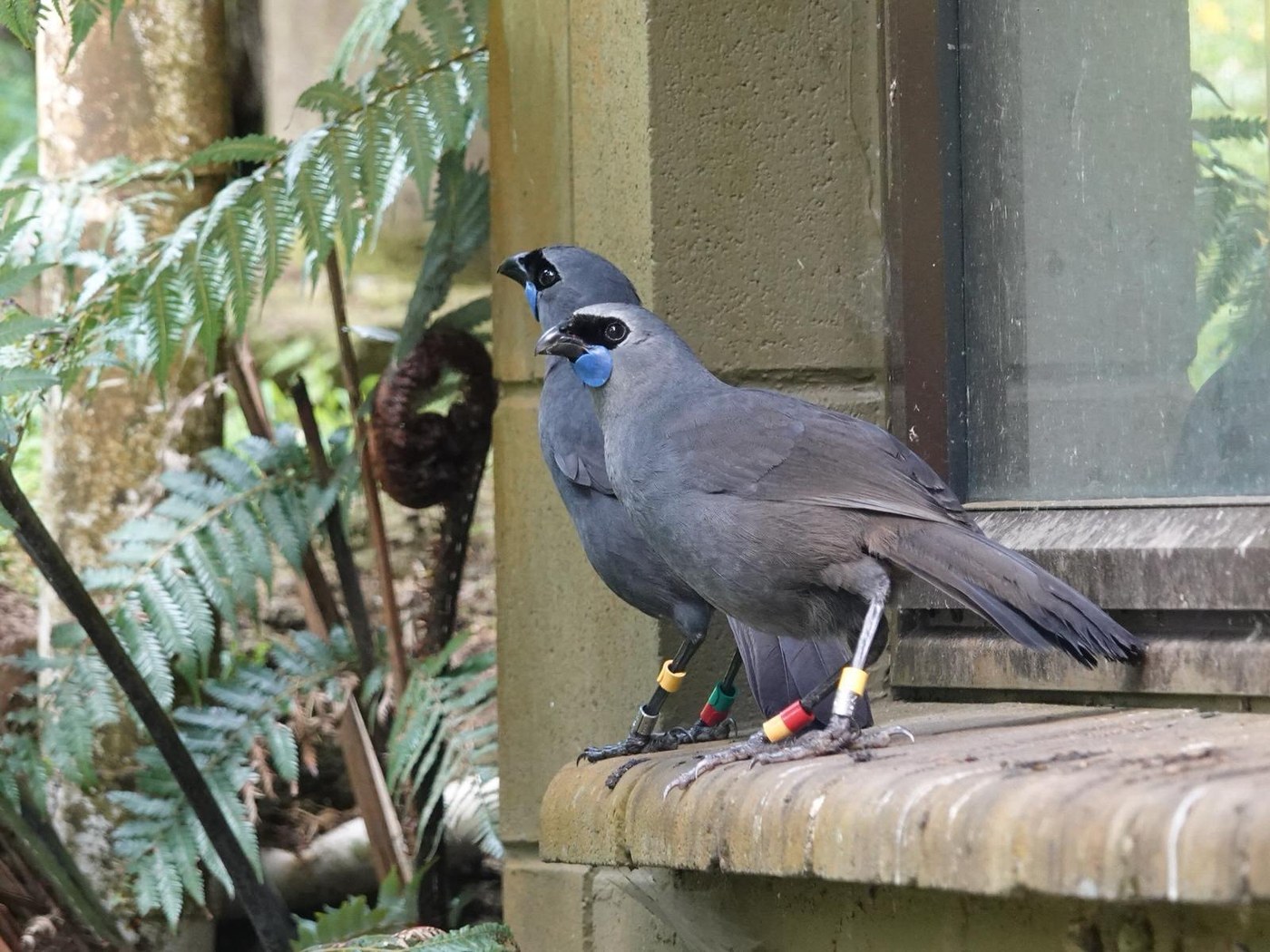
North Island Kokako
Callaeas wilsoni
A slate-blue-grey New Zealand forest bird with striking blue wattles, a weak flier that instead leaps and glides gracefully through the canopy, once nearly lost but now recovering thanks to intensive conservation.
- Size
- 38 cm (15 in) long
- Habitat
- mature native forest of the North Island, New Zealand
- Type
- songbird
Spotted a bird like this?
Identify any bird from a photo, free.
Overview
The North Island Kokako is a soft blue-grey bird with a black facial mask and a pair of vivid blue, fleshy wattles hanging beneath the bill, features that immediately catch the eye against the muted plumage. It belongs to the ancient New Zealand wattlebird family, Callaeidae, which also includes the Saddleback and the now-extinct Huia.
Rather than relying on strong flight, the Kokako has short rounded wings and typically moves through the forest by a distinctive sequence of bounding leaps and long, gliding swoops between trees, rarely flying far or high. Once widespread across the North Island, it declined severely due to predation and habitat loss, but intensive pest control and translocations have allowed numbers to recover in many managed sites.
How to identify it
Key field marks
- Soft blue-grey body plumage
- Black facial mask around the eye and bill
- Bright blue, fleshy wattles beneath the bill (orange to yellow at the very base in some individuals)
- Short, rounded black wings; long tail
- Strong legs adapted for hopping and leaping through the canopy
Similar species
- Tui is glossy black-green rather than blue-grey and has a white throat tuft, not blue wattles.
- Saddleback is smaller, mostly black with a chestnut "saddle" on the back and red (not blue) wattles.
- No other New Zealand bird combines blue-grey plumage with prominent blue wattles.
Habitat & range
Range
Endemic to the North Island of New Zealand, now found mainly in protected mainland forest reserves with intensive predator control and on several offshore islands where it has been translocated.
Habitat
Requires large tracts of mature, structurally complex native forest with a closed canopy that allows its characteristic leaping-and-gliding style of movement.
Migration
Sedentary and strongly territorial, pairs holding the same forest territory for many years.
Behavior & voice
Behavior
Moves through the forest mainly by hopping and leaping along branches and gliding between trees rather than sustained flight, foraging deliberately through the mid and upper canopy.
Voice
Gives slow, deep, organ-like song phrases that carry remarkably far through the forest, often performed as duets between mated pairs at dawn, along with a range of softer conversational and mewing calls.
Feeding
Browses on leaves, fruit, flowers, and buds of native trees and shrubs, occasionally taking invertebrates, and can go for extended periods on leaves alone when fruit is scarce.
Nesting
Builds a large, well-hidden cup nest high in the forest canopy; the female incubates two to three eggs while the male brings her food, and both parents feed the chicks.
Frequently asked questions
Why does the Kokako rarely fly far?
Its short, rounded wings are not well suited to sustained flight, so it typically moves through the forest by leaping along branches and gliding between trees instead.
What is the Kokako's song like?
A slow, deep, organ-like series of haunting notes, often sung as a duet between paired birds, considered one of the most distinctive sounds of New Zealand forest.
Is the North Island Kokako the same as the South Island Kokako?
No, they are now generally treated as separate species; the South Island Kokako (with orange wattles) is critically rare and possibly extinct, while this blue-wattled North Island species survives in managed populations.
Why did Kokako numbers decline?
Predation of eggs, chicks, and incubating females by introduced possums, rats, and stoats, combined with historic forest clearance, caused steep declines, though pest control has enabled recovery at many sites.
North Island Kokako guides
In-depth guides for identifying, finding, and understanding North Island Kokako.
Other birds you may enjoy

Black Redstart
13-14.5 cm (5.1-5.7 in) long, 23-26 cm wingspan

Black-throated Sparrow
12-14 cm (4.7-5.5 in) long, about 19-20 cm (7.5-8 in) wingspan

Greater Bird-of-paradise
Body about 43 cm; males with additional flank plumes up to 50 cm and long tail wires

Blue Tit
11-12 cm (4.3-4.7 in) long, 17-20 cm wingspan

Red-billed Quelea
11.5–13 cm long, wingspan about 20–22 cm
White-plumed Antbird
13-14 cm (5-5.5 in) long

Pyrrhuloxia
19-22 cm (7.5-8.7 in) long, 30 cm wingspan

Blue-gray Tanager
16-18 cm (6-7 in) long

Blackburnian Warbler
11-13 cm (4.3-5.1 in) long, 20-22 cm wingspan

Bluethroat
13-14 cm (5.1-5.5 in) long, 20-22 cm wingspan

Eurasian Nuthatch
12-14.5 cm (4.7-5.7 in) long, 22.5-27 cm wingspan

Wood Thrush
19-21 cm (7.5-8.3 in) long, about 33 cm (13 in) wingspan