
North Island Kokako Identification Guide
A striking slate-grey forest bird of the North Island with a short black mask and vivid blue wattles, better known for its haunting organ-like song than for being easy to spot in the high canopy.
Read the full North Island Kokako encyclopedia entry →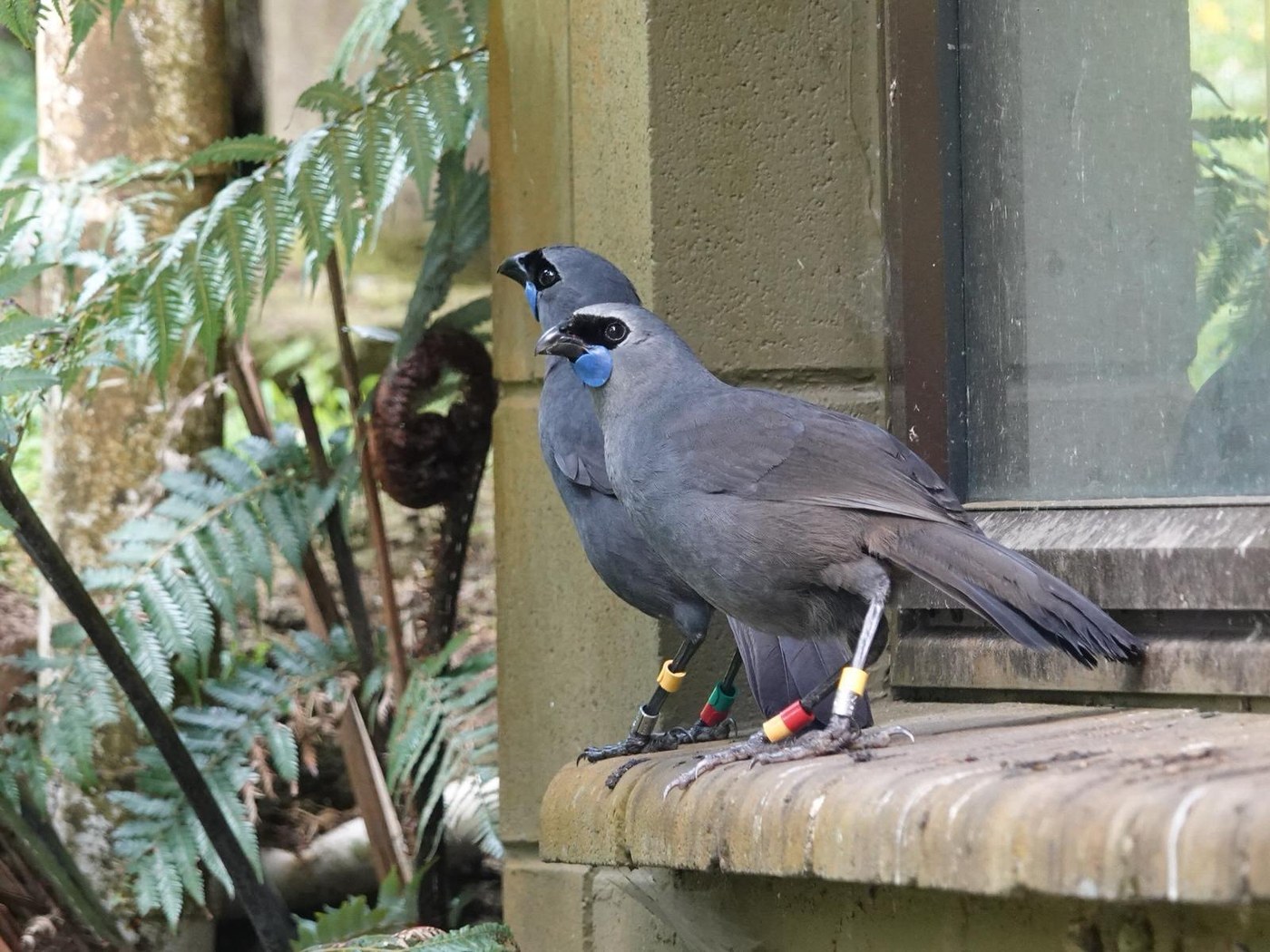
Overview
The North Island Kokako (Callaeas wilsoni) is a rare, slow-flying, forest-canopy bird belonging to New Zealand's endemic wattlebird family, closely related to the extinct Huia and the endangered Saddleback (tieke). Once widespread, it is now restricted to a limited number of well-managed forest sites due to predation by introduced mammals.
Key Field Marks
- Size & shape: Medium-large songbird, about 38 cm, with a long tail, short rounded wings, and strong legs adapted more for hopping and climbing through branches than for sustained flight.
- Plumage: Overall soft blue-grey plumage, darker on the wings and tail, paler on the belly.
- Face: Distinct black mask ("burglar's mask") across the face and around the base of the bill.
- Wattles: Bright blue, fleshy wattles hanging from either side of the base of the bill — the North Island form's wattles are entirely blue, distinguishing it from the extinct South Island Kokako, which reportedly had orange wattles with a blue base.
- Bill: Short, stout, black, slightly downcurved bill.
- Flight: Weak flier, generally gliding and flapping only short distances between trees, preferring to hop and bound along branches using strong legs — often more easily located by ear than by sight in the high canopy.
Similar Species
No other New Zealand bird combines blue-grey plumage with blue facial wattles and a black mask; it is unmistakable if seen well. The related North Island Saddleback (tieke) is smaller, blackish with a chestnut saddle and red-orange wattles, and behaves very differently, staying lower and being more vocal and conspicuous.
Habitat & Range
Endemic to New Zealand's North Island, historically widespread but now restricted to a scattering of protected forest reserves and predator-controlled sites such as Pureora Forest, Te Urewera, Kaharoa, Mapara, and reintroduced populations on some islands and mainland sanctuaries. Requires mature native forest with a diverse canopy providing fruit, leaves, and invertebrates.
Season
Resident and non-migratory year-round; breeding season runs roughly from October to February (the austral spring–summer), when pairs are most vocally active defending territories.
Behavior
Spends most of its time in the mid-to-upper forest canopy, moving through branches with powerful bounding hops and only occasional weak, gliding flights between trees. Feeds on leaves, fruit, flowers, and invertebrates. Pairs are highly territorial and duet together, and their song is considered one of the most beautiful and haunting in New Zealand forests, often carrying long distances at dawn.
Voice
A slow, deep, organ-like series of clear, resonant, haunting notes, often delivered as a duet between paired birds and highly variable between different forest populations ("dialects"); also gives various mewing, clicking, and coughing calls. The song is frequently the first and best clue to a kokako's presence in the canopy.
Frequently asked questions
What color are the North Island Kokako's wattles?
They are entirely blue, which distinguishes the living North Island Kokako from the presumed-extinct South Island Kokako, which was described as having orange wattles with a blue base.
Why is the Kokako hard to spot even when calling nearby?
It spends most of its time high in the forest canopy, moves by hopping and bounding along branches rather than flying, and its grey plumage blends into dappled canopy light, so it is often heard well before it is seen.
Where can I realistically see or hear a North Island Kokako?
Managed reserves with active predator control, such as Pureora Forest Park, Kaharoa, and Mapara Wildlife Reserve, offer the best chances, especially at dawn during the breeding season when pairs sing most.
Is the North Island Kokako endangered?
Yes, it is classified as threatened due to historical habitat loss and predation by introduced mammals, though intensive conservation and translocation efforts have allowed populations to recover at several protected sites.