
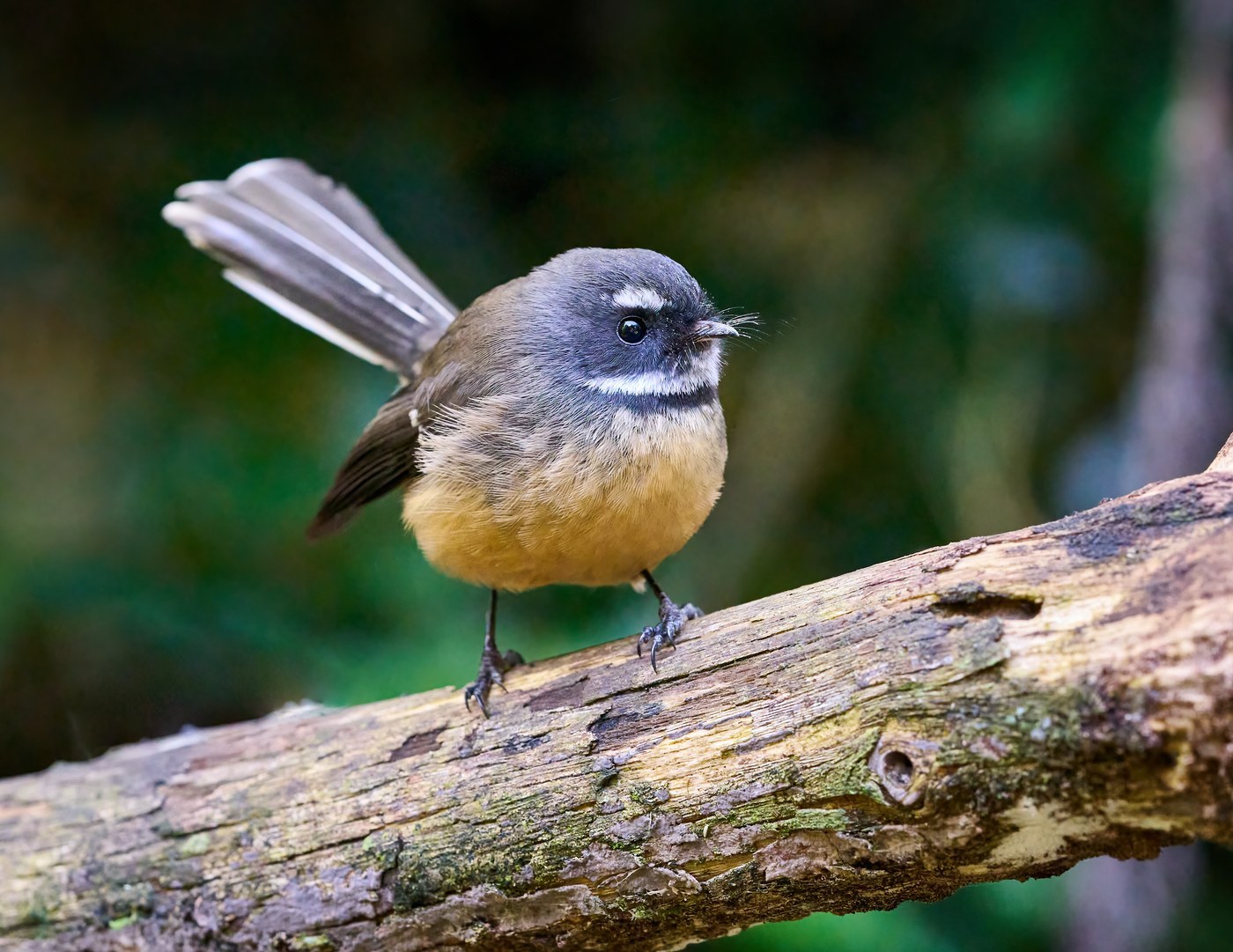
New Zealand Fantail
Rhipidura fuliginosa
A tiny, energetic New Zealand bird best known for its wide, fan-shaped tail and its habit of following walkers through the bush to snap up disturbed insects.
- Size
- 16 cm (6.3 in) long including tail
- Habitat
- native and exotic forest, scrub, and gardens throughout New Zealand
- Type
- songbird
Spotted a bird like this?
Identify any bird from a photo, free.
Overview
The New Zealand Fantail, known as piwakawaka in Maori, is one of the country's smallest and most instantly recognizable birds thanks to its broad, fan-shaped tail, which it flicks open constantly while foraging. Most birds show the common "pied" morph, with grey-brown upperparts, a black-and-white facial pattern, a black breast band, and a buffy-orange wash on the underparts, but a scarcer all-black morph, more frequent in the South Island, occurs as well.
Fantails are famously tame and inquisitive, often approaching walkers closely, drawn by insects stirred up from the ground and vegetation by human movement. Their constant, restless flitting and wide tail fanning make them one of the easiest native birds to observe up close in New Zealand forest and gardens alike.
How to identify it
Key field marks
- Small size with a broad, fan-shaped tail frequently spread open
- Grey-brown upperparts with a black-and-white facial pattern (pied morph)
- Black breast band above buffy-orange underparts (pied morph)
- Alternative all-black morph, more common in the South Island
- Constant active flitting and short sallying flights after insects
Similar species
- Tomtit is similarly small but has a shorter tail, a stubbier bill, and lacks the fantail's characteristic wide tail-fanning display.
- New Zealand Robin is larger, longer-legged, and forages more on the ground with an upright stance, without the fantail's constant tail motion.
Habitat & range
Range
Widespread throughout the North, South, and Stewart Islands of New Zealand, as well as many outlying islands, and closely related forms occur elsewhere in the southwest Pacific and Australia.
Habitat
Uses almost any wooded or shrubby habitat, including native forest, regenerating scrub, exotic plantations, and well-vegetated gardens and parks.
Migration
Mostly sedentary, though some altitudinal or local movement occurs outside the breeding season.
Behavior & voice
Behavior
Restless and highly active, constantly flitting between perches, fanning its tail, and making short aerial sallies to snatch insects, often in the company of larger birds or people whose movement disturbs prey.
Voice
A thin, high-pitched, repeated "tweet" or "chit" call, along with a soft warbling song from perched birds.
Feeding
An aerial insectivore, catching flying insects on short sallying flights and also gleaning insects from foliage and disturbed ground litter.
Nesting
Builds a distinctive cup nest with a long trailing "tail" of woven material hanging beneath it, placed on a thin horizontal branch; both parents incubate and feed the two to five chicks, and pairs may raise several broods in a season.
Frequently asked questions
Why do Fantails follow people in the bush?
Walking through vegetation stirs up insects, and fantails have learned to follow people (and other animals) closely to snap up the disturbed insects in flight.
Are all New Zealand Fantails the same color?
Most show the common pied pattern of grey-brown, black, and buffy-orange, but a black morph occurs at low frequency, more often in the South Island.
Why does the Fantail fan its tail so much?
Fanning the broad tail helps it maneuver sharply during short aerial sallies after insects and may also play a role in balance and display.
What is the Fantail's Maori name?
Piwakawaka.
New Zealand Fantail guides
In-depth guides for identifying, finding, and understanding New Zealand Fantail.
Other birds you may enjoy

Black Redstart
13-14.5 cm (5.1-5.7 in) long, 23-26 cm wingspan

Black-throated Sparrow
12-14 cm (4.7-5.5 in) long, about 19-20 cm (7.5-8 in) wingspan

Greater Bird-of-paradise
Body about 43 cm; males with additional flank plumes up to 50 cm and long tail wires

Blue Tit
11-12 cm (4.3-4.7 in) long, 17-20 cm wingspan

Red-billed Quelea
11.5–13 cm long, wingspan about 20–22 cm
White-plumed Antbird
13-14 cm (5-5.5 in) long

Pyrrhuloxia
19-22 cm (7.5-8.7 in) long, 30 cm wingspan

Blue-gray Tanager
16-18 cm (6-7 in) long

Blackburnian Warbler
11-13 cm (4.3-5.1 in) long, 20-22 cm wingspan

Bluethroat
13-14 cm (5.1-5.5 in) long, 20-22 cm wingspan

Eurasian Nuthatch
12-14.5 cm (4.7-5.7 in) long, 22.5-27 cm wingspan

Wood Thrush
19-21 cm (7.5-8.3 in) long, about 33 cm (13 in) wingspan