
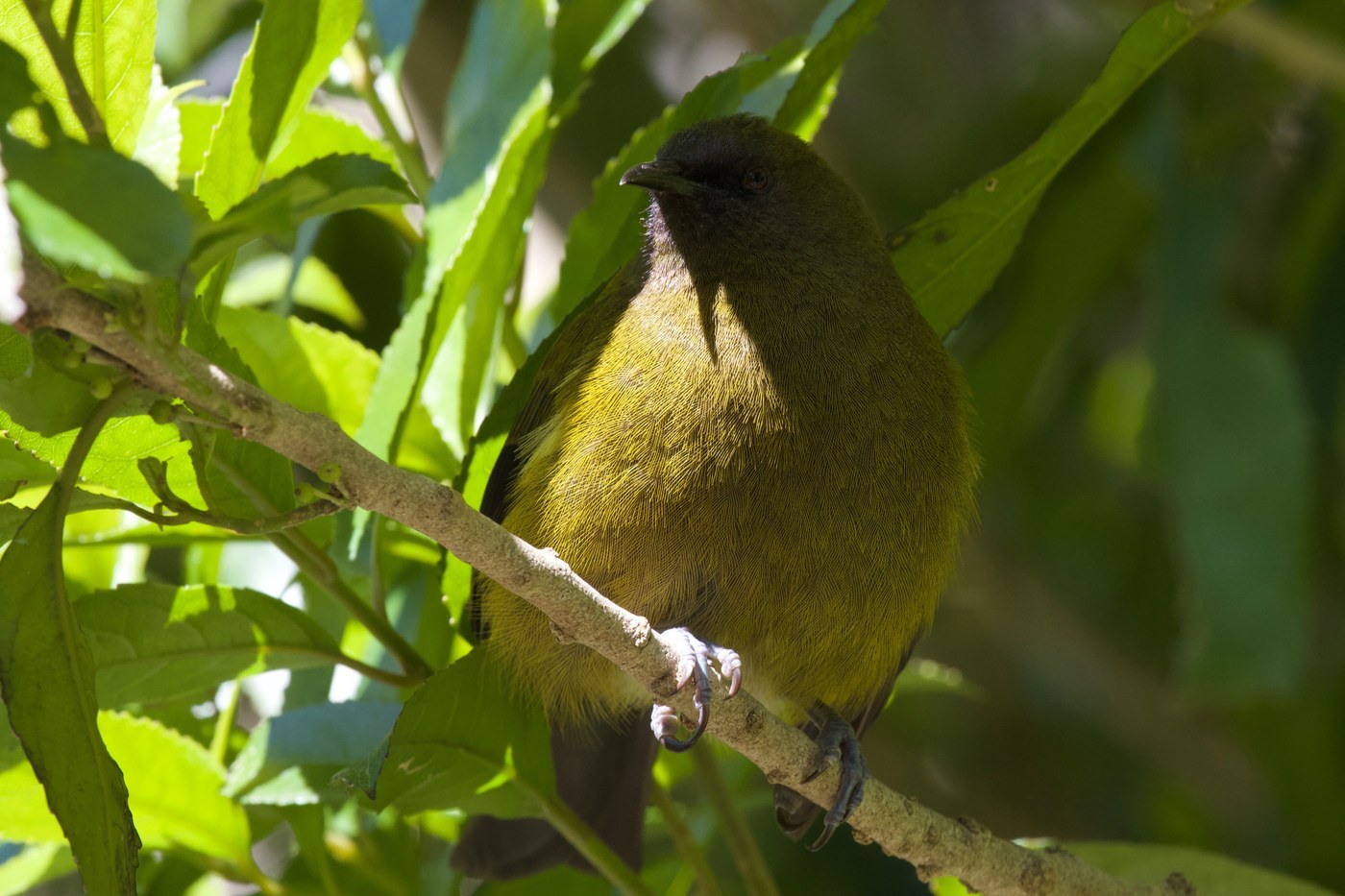
New Zealand Bellbird
Anthornis melanura
A plain olive-green New Zealand honeyeater renowned for its clear, melodious, bell-like song, often one of the first sounds heard at dawn in native forest.
- Size
- 17-20 cm (7-8 in) long
- Habitat
- native forest and scrub throughout New Zealand
- Type
- songbird
Spotted a bird like this?
Identify any bird from a photo, free.
Overview
The New Zealand Bellbird, known in Maori as korimako, is a modestly plumaged honeyeater whose beauty lies almost entirely in its voice. Males are olive-green overall with a subtle purplish gloss on the head and a faint dark line through the eye, while females are duller olive-brown with a small white-ish stripe near the bill and lack the male's head gloss.
Early European visitors to New Zealand famously described the dawn chorus, in which Bellbirds featured prominently alongside Tui, as one of the most beautiful sounds they had encountered anywhere in the world. Though far less flamboyant in appearance than the Tui, the Bellbird's pure, ringing, bell-like notes make it just as celebrated a voice of the New Zealand forest.
How to identify it
Key field marks
- Olive-green plumage, brightest and glossiest on the male's head
- Faint dark eye-line, more obvious in males
- Slightly downcurved, fine black bill
- Red eye, visible at close range
- Females duller and browner than males, with a small pale stripe near the gape
Similar species
- Tui is much larger, glossy black-green rather than plain olive, and has a distinctive white throat tuft absent in the Bellbird.
- Female and juvenile Bellbirds can appear nondescript but are best told by their smaller size, plain olive tones, and characteristic bell-like calls compared to any other New Zealand forest bird.
Habitat & range
Range
Widespread across the North, South, and Stewart Islands and many offshore islands of New Zealand, though scarce or absent from parts of the North Island where introduced predators have had a heavier impact.
Habitat
Found in native forest, forest edges, and regenerating scrub, from coastal areas to subalpine treeline, and increasingly in well-vegetated gardens near forest.
Migration
Mostly sedentary, with some local seasonal movement to track flowering and fruiting trees.
Behavior & voice
Behavior
Active and often heard well before it is seen, moving quickly through foliage while feeding, and defending flowering or fruiting trees from rivals including other Bellbirds and Tui.
Voice
A clear, resonant, bell-like song of chiming notes, often given as a dawn and dusk chorus; calls also include a harsher chattering scold when alarmed.
Feeding
Feeds on nectar using a brush-tipped tongue, as well as small fruit and insects gleaned from foliage, and is an important pollinator of native flowering plants.
Nesting
Builds a compact cup nest of twigs, grass, and moss in dense foliage; the female alone incubates two to four eggs, and both parents feed the chicks after hatching.
Frequently asked questions
Why is the Bellbird's song so famous?
Early European explorers and settlers described its clear, chiming song as part of an extraordinarily beautiful dawn chorus in New Zealand's native forests, a description still echoed by visitors today.
How do you tell a Bellbird from a Tui?
The Bellbird is smaller and plain olive-green with no throat tuft, while the Tui is larger, glossy black-green, and shows a distinctive curled white throat tuft.
What is the Maori name for the Bellbird?
Korimako (also sometimes makomako).
What does the Bellbird eat?
Mainly nectar from native flowers, along with small fruit and insects.
New Zealand Bellbird guides
In-depth guides for identifying, finding, and understanding New Zealand Bellbird.
Other birds you may enjoy

Black Redstart
13-14.5 cm (5.1-5.7 in) long, 23-26 cm wingspan

Black-throated Sparrow
12-14 cm (4.7-5.5 in) long, about 19-20 cm (7.5-8 in) wingspan

Greater Bird-of-paradise
Body about 43 cm; males with additional flank plumes up to 50 cm and long tail wires

Blue Tit
11-12 cm (4.3-4.7 in) long, 17-20 cm wingspan

Red-billed Quelea
11.5–13 cm long, wingspan about 20–22 cm
White-plumed Antbird
13-14 cm (5-5.5 in) long

Pyrrhuloxia
19-22 cm (7.5-8.7 in) long, 30 cm wingspan

Blue-gray Tanager
16-18 cm (6-7 in) long

Blackburnian Warbler
11-13 cm (4.3-5.1 in) long, 20-22 cm wingspan

Bluethroat
13-14 cm (5.1-5.5 in) long, 20-22 cm wingspan

Eurasian Nuthatch
12-14.5 cm (4.7-5.7 in) long, 22.5-27 cm wingspan

Wood Thrush
19-21 cm (7.5-8.3 in) long, about 33 cm (13 in) wingspan