
New Zealand Bellbird Identification Guide
A plain olive-green honeyeater of New Zealand forests, more often heard than seen, famous for its clear, bell-like ringing song that helped inspire early European explorers' accounts of the country's dawn chorus.
Read the full New Zealand Bellbird encyclopedia entry →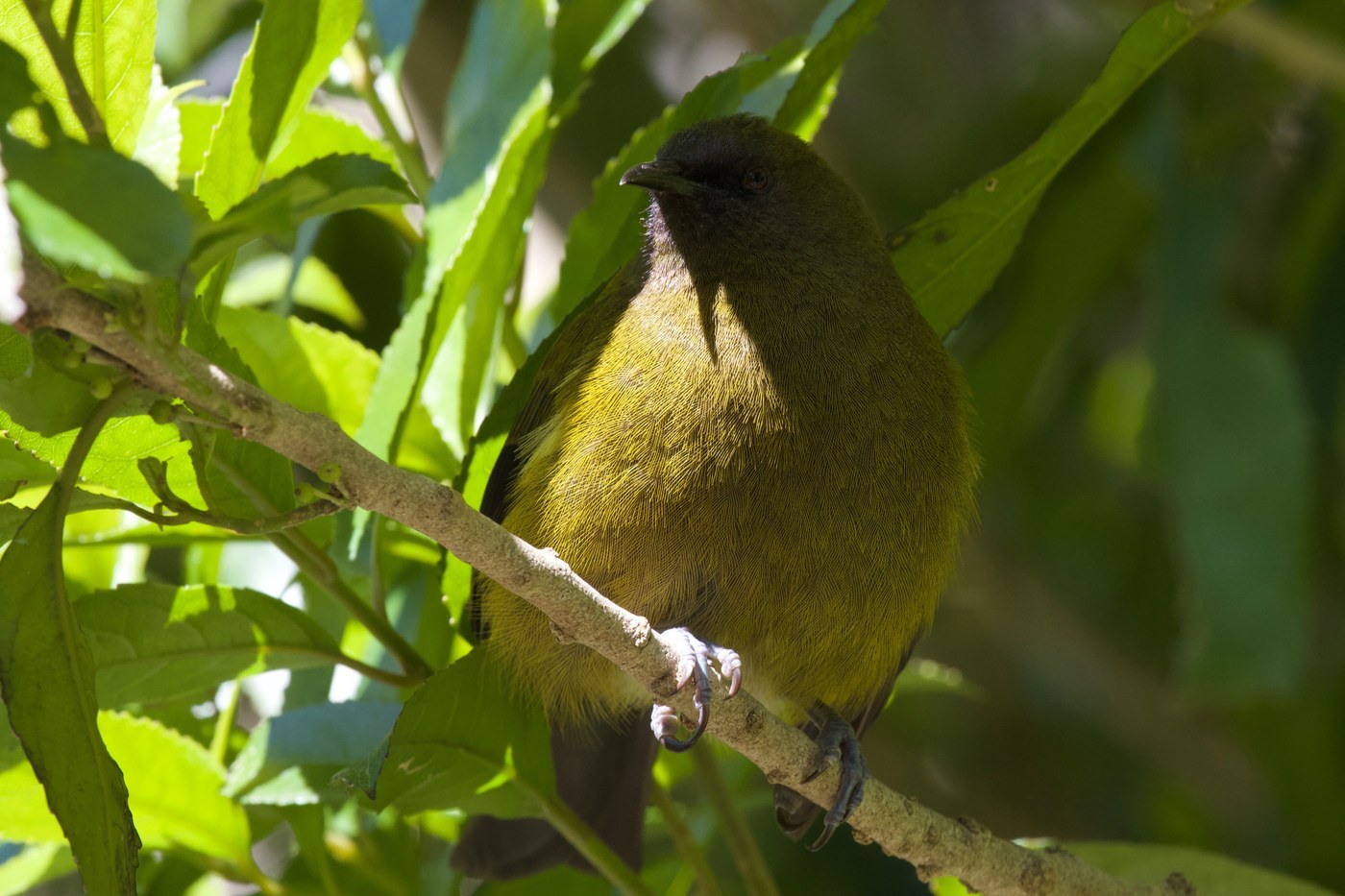
Overview
The New Zealand Bellbird, or korimako (Anthornis melanura), is a native honeyeater found only in New Zealand. Though plain in plumage, it is one of the country's most celebrated songbirds thanks to its rich, bell-toned voice.
Key Field Marks
- Size & shape: Small to medium songbird, about 17–20 cm, with a slim body, short slightly curved bill, and short tail — overall a fairly nondescript honeyeater shape.
- Plumage: Olive-green overall, males slightly brighter olive with a subtle purplish gloss on the head and a small violet-black band at the top of the tail; females are duller olive-brown with a distinct thin white-yellow stripe behind the eye (malar/cheek stripe) that males lack or show only faintly.
- Eye: Reddish eye in adults, useful at close range.
- Bill: Fine, slightly downcurved black bill adapted for nectar feeding.
- Sexual dimorphism: Males and females differ enough that female bellbirds are sometimes mistaken for a different species — always check for the pale face stripe of females.
Similar Species
- Tui: Much larger, glossier black-green with iridescent sheen, white throat tufts, and a very different, more complex and varied song with clicks and wheezes; bellbird is smaller, plainer olive, and lacks white throat tufts.
- Silvereye: Much smaller, with a conspicuous white eye-ring, greenish upperparts, and different, thinner call notes.
Habitat & Range
Endemic to New Zealand, found through native forest, scrub, and increasingly in well-vegetated urban parks and gardens on the North and South Islands and offshore islands, though historically it disappeared from parts of the North Island due to introduced predators and has been recovering with pest control and reintroductions. Prefers native forest with flowering and fruiting plants such as kowhai, flax, and rata.
Season
Resident year-round, non-migratory, though some local altitudinal movement occurs, with birds descending to lower elevations in winter to follow flowering plants.
Behavior
Feeds on nectar, fruit, and insects, often hanging acrobatically to reach flowers of kowhai or flax. Bellbirds are territorial and can be aggressive toward other nectar feeders including tui. Frequently one of the first species heard at dawn in native forest, giving rise to descriptions of a "bell-like" dawn chorus.
Voice
A clear, resonant, bell-like song of chiming notes, often described as sounding like distant tuned bells or a silver chime; song varies regionally with local "dialects." Also gives a harsher scolding chatter when alarmed or defending territory.
Frequently asked questions
How can I tell a male from a female New Zealand Bellbird?
Females are duller olive-brown with a thin pale stripe behind the eye, while males are brighter olive with a subtle purple sheen on the head and lack the obvious face stripe.
What is the difference between a Bellbird and a Tui?
Tui are considerably larger with glossy black-green iridescent plumage, white throat tufts, and a more complex, varied song, while Bellbirds are smaller, plain olive-green, and sing a purer, bell-like chime.
Why is the Bellbird's song famous?
Early European visitors to New Zealand, including on Captain Cook's voyages, wrote admiringly of the bell-like dawn chorus produced largely by bellbirds and tui in native forest.
Where is the best place to see a New Zealand Bellbird?
Predator-controlled native forest reserves and offshore islands, such as Tiritiri Matangi, as well as well-vegetated parks on the South Island, offer reliable sightings.