
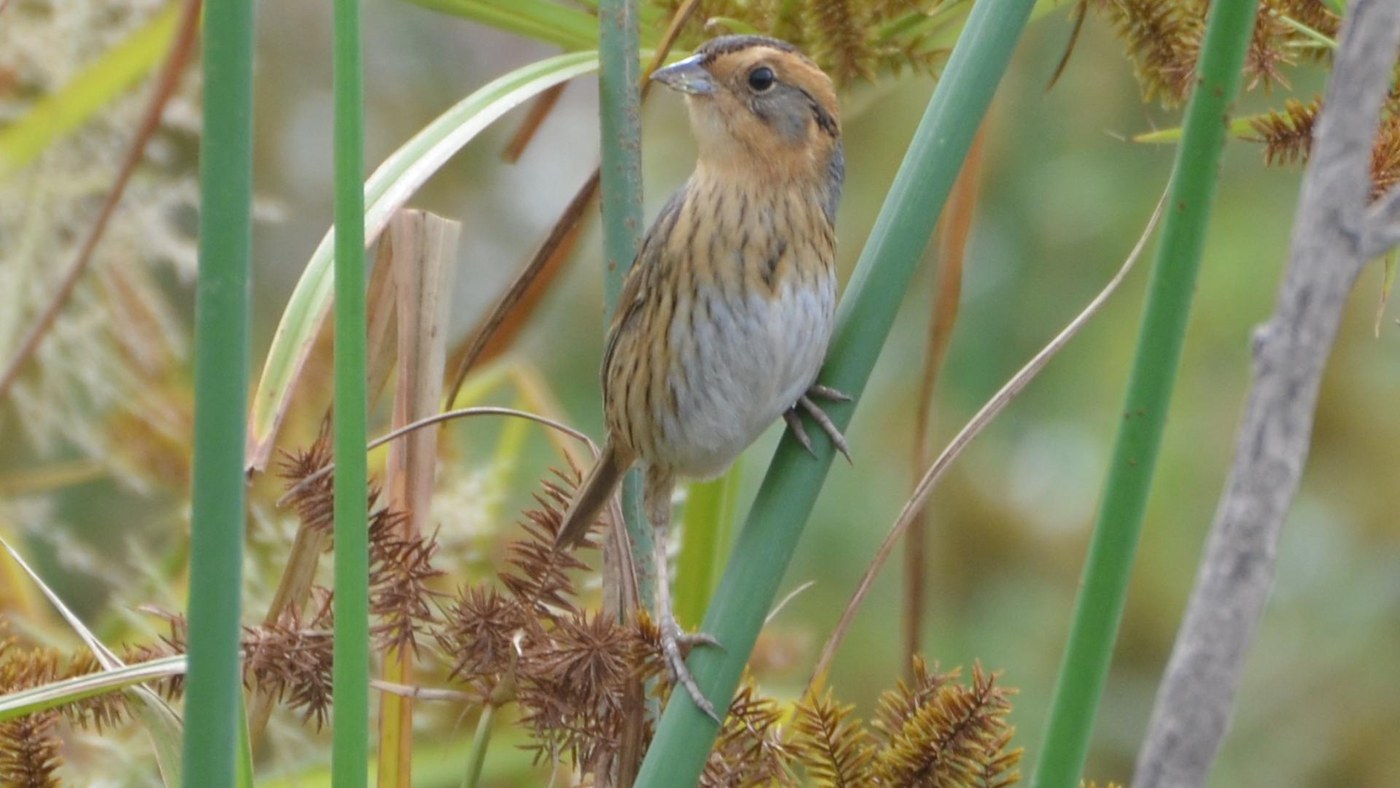
Nelson's Sparrow
Ammospiza nelsoni
A secretive marsh sparrow with an orange face triangle and soft, blurry streaking, breeding in both interior prairie marshes and coastal salt marsh.
- Size
- 11-13 cm (4.5-5 in) long, about 18 cm (7 in) wingspan
- Habitat
- freshwater and brackish marshes inland; salt marshes along the coast
- Type
- songbird
Spotted a bird like this?
Identify any bird from a photo, free.
Overview
The Nelson's Sparrow is a subtly beautiful marsh-dwelling sparrow that occupies two very different kinds of wetland: freshwater and brackish marshes in the interior prairies, and salt marshes along the Atlantic Coast. Until 1995 it was considered the same species as the Saltmarsh Sparrow, under the combined name Sharp-tailed Sparrow, and the two remain very similar in appearance.
Adults show a warm orange-buff triangle across the face, framing a contrasting gray cheek patch, with a plain gray nape and softly blurred (rather than crisp) dark streaking across the breast and flanks. The tail is short and appears somewhat spiky or pointed, a feature shared with its close relatives in the genus Ammospiza.
Like other marsh sparrows, it is secretive, staying low in dense marsh vegetation and generally reluctant to perch in the open for long.
How to identify it
Key Field Marks
- Orange-buff triangle across the face contrasting with a gray cheek patch
- Plain grayish nape
- Blurry, soft-edged streaking on breast and flanks (not crisp)
- Short, pointed tail
Similar Species
- Saltmarsh Sparrow: very similar but shows crisper, sharper black streaking on the breast, a longer bill, and is restricted to Atlantic salt marsh
- Le Conte's Sparrow: shares the orange face but has a purplish-chestnut nape and crisper streaking, and typically occurs in drier grassy habitat
Where Nelson's and Saltmarsh Sparrows overlap on the Atlantic Coast, hybridization occurs, and some individuals can be genuinely difficult to assign to species.
Habitat & range
Nelson's Sparrow has a split breeding distribution: one population nests in freshwater and brackish marshes of the northern Great Plains and prairie pothole region of the north-central United States and south-central Canada, while other populations breed in coastal salt and brackish marshes around James Bay, along the St. Lawrence River, and in Atlantic Canada and Maine.
In winter, the species moves to salt marshes along the Atlantic and Gulf coasts of the southeastern United States, where it forages low in dense cordgrass and other marsh vegetation.
Behavior & voice
Behavior
Nelson's Sparrows are secretive marsh birds, creeping through dense vegetation and generally avoiding open perches except briefly while singing.
Voice
The song is a soft, wheezy, hissing sound, sometimes rendered as 'pfft-slurrr,' quite unlike the clear whistled songs of many other sparrows and easy to overlook amid marsh sounds.
Feeding
Diet includes insects, small invertebrates, and seeds gleaned from marsh vegetation and mud.
Nesting and Breeding
Nests are built low in marsh grasses, sometimes just above the waterline, as a cup of woven grasses. Females raise young without assistance from males, which do not form pair bonds and instead mate with multiple females.
Frequently asked questions
What is the difference between Nelson's Sparrow and Saltmarsh Sparrow?
Nelson's Sparrow has blurrier, softer streaking and a plainer gray nape, while Saltmarsh Sparrow shows crisper, sharper black streaking and a longer bill; they were once considered one species called Sharp-tailed Sparrow.
Where does the Nelson's Sparrow breed?
It breeds in freshwater and brackish marshes of the north-central United States and Canadian prairies, as well as coastal marshes around James Bay and in Atlantic Canada and Maine.
What does the Nelson's Sparrow sound like?
It gives a soft, wheezy, hissing song, quite different from the clear whistles of many other sparrows.
Where does the Nelson's Sparrow spend winter?
It winters in salt marshes along the Atlantic and Gulf coasts of the southeastern United States.
Do Nelson's Sparrows form pairs?
No, males do not pair with females; instead they mate with multiple females, who then build nests and raise young alone.
Nelson's Sparrow guides
In-depth guides for identifying, finding, and understanding Nelson's Sparrow.
Other birds you may enjoy

Black Redstart
13-14.5 cm (5.1-5.7 in) long, 23-26 cm wingspan

Black-throated Sparrow
12-14 cm (4.7-5.5 in) long, about 19-20 cm (7.5-8 in) wingspan

Greater Bird-of-paradise
Body about 43 cm; males with additional flank plumes up to 50 cm and long tail wires

Blue Tit
11-12 cm (4.3-4.7 in) long, 17-20 cm wingspan

Red-billed Quelea
11.5–13 cm long, wingspan about 20–22 cm
White-plumed Antbird
13-14 cm (5-5.5 in) long

Pyrrhuloxia
19-22 cm (7.5-8.7 in) long, 30 cm wingspan

Blue-gray Tanager
16-18 cm (6-7 in) long

Blackburnian Warbler
11-13 cm (4.3-5.1 in) long, 20-22 cm wingspan

Bluethroat
13-14 cm (5.1-5.5 in) long, 20-22 cm wingspan

Eurasian Nuthatch
12-14.5 cm (4.7-5.7 in) long, 22.5-27 cm wingspan

Wood Thrush
19-21 cm (7.5-8.3 in) long, about 33 cm (13 in) wingspan