
Nelson's Sparrow Identification Guide
A secretive marsh sparrow with a soft orange-buff face and blurry-streaked breast, recognized by its buzzy, hissing song and mouse-like habits.
Read the full Nelson's Sparrow encyclopedia entry →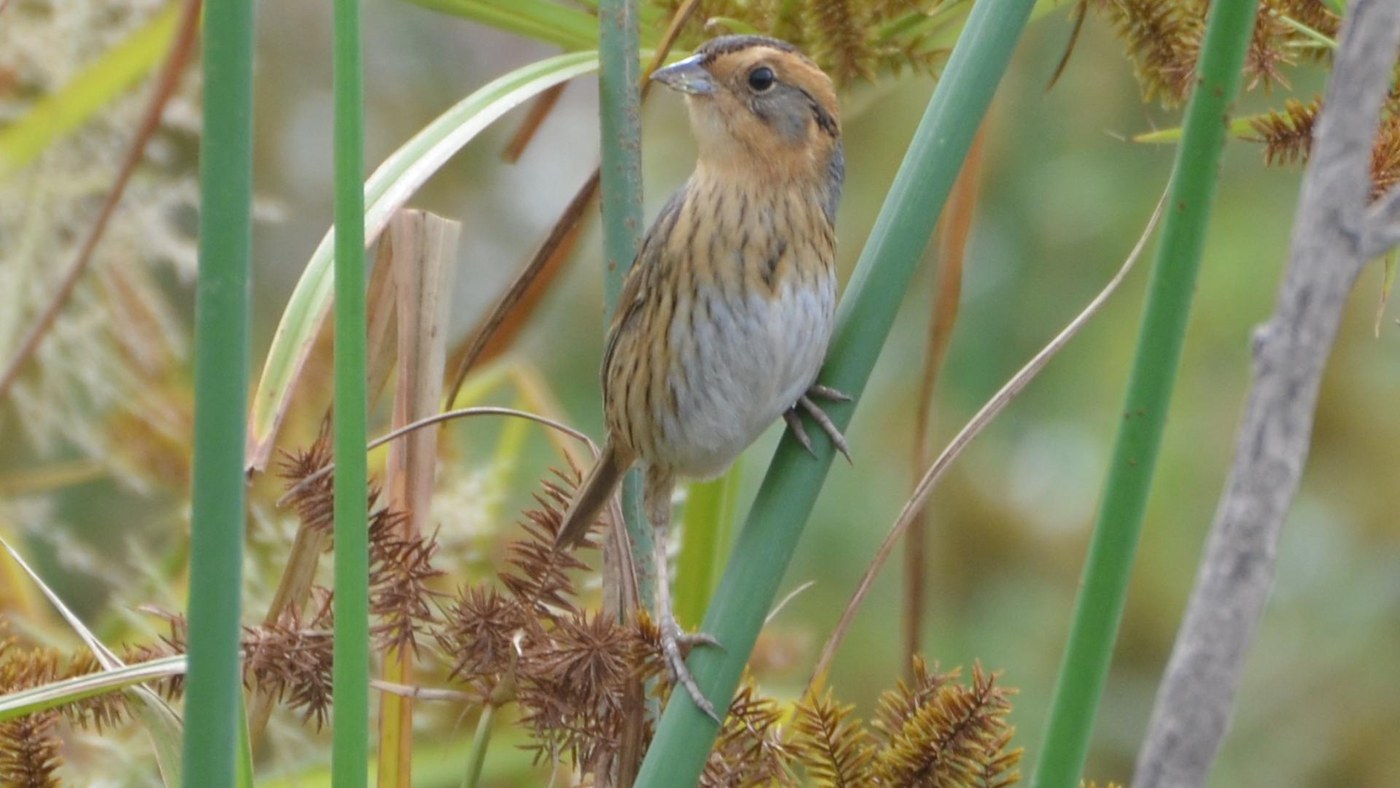
Key Field Marks
- Size & shape: A small, short-tailed sparrow with a flat head profile and a relatively short, pointed tail with somewhat spiky feather tips, giving rise to the older name "sharp-tailed sparrow."
- Face pattern: A distinctive orange-buff triangle frames a contrasting gray cheek patch (auricular), one of the most useful marks at close range.
- Underparts: Warm orange-buff wash across the breast and flanks with relatively diffuse, blurry (not crisp) dark streaking.
- Upperparts: Grayish nape contrasting somewhat with a streaked brown back; overall a soft, blended appearance rather than sharply patterned.
- Behavior: Extremely skulking, creeping and running mouse-like through dense marsh vegetation low to the ground or water, rarely flying far or high when flushed.
Separating It From Similar Species
- Saltmarsh Sparrow: Very similar and formerly considered the same species (as Sharp-tailed Sparrow); Saltmarsh Sparrow shows crisper, bolder, more contrasting black streaking on the breast and a whiter belly, and is restricted to Atlantic coastal salt marshes, while Nelson's Sparrow breeds more broadly (interior wet meadows and prairie marshes, plus separate coastal populations) and shows a softer, more blended pattern.
- LeConte's Sparrow: Paler and more strikingly patterned with a purplish-chestnut streaked nape and whiter underparts, and favors drier grassy meadows rather than tidal or wet marsh.
- Savannah Sparrow: Shows crisp streaking on a whiter breast, a shorter notched tail, and typically a yellowish supercilium, and is found in a wider range of open habitats beyond marshes.
Where and When to See It
Nelson's Sparrow breeds in two very different habitat types depending on subspecies: interior freshwater and brackish marshes and wet prairie meadows of the north-central US and south-central Canada, and separately in coastal salt marshes of eastern Canada and Maine. It winters in coastal salt marshes along the Atlantic and Gulf coasts of the southeastern US. Because of its skulking habits, it is best looked for by walking marsh edges slowly, watching for birds briefly perched on marsh grass stems, or using tidal flooding (in coastal marshes) to push birds into view.
Voice
The song is a short, buzzy, hissing exhalation often described as sounding like water dropped on a hot skillet: a soft introductory note followed by a sharp buzz, "pfft-tuck-shhhhhh." It lacks the musical quality of many other sparrow songs and is easy to overlook, so listening carefully near marsh vegetation at dawn or dusk during the breeding season improves detection.
Frequently asked questions
What is the best field mark for Nelson's Sparrow?
An orange-buff facial triangle surrounding a gray cheek patch, combined with soft, blurry (not crisp) streaking on an orange-buff breast.
How do you separate Nelson's Sparrow from Saltmarsh Sparrow?
Saltmarsh Sparrow shows crisper, bolder black breast streaking and a whiter belly and is limited to Atlantic coastal salt marsh, while Nelson's Sparrow has a softer, more blended pattern and breeds in both interior marshes and separate coastal areas.
Where does Nelson's Sparrow breed?
In interior wet prairie meadows and freshwater/brackish marshes of the north-central US and south-central Canada, and separately in coastal salt marshes of eastern Canada and Maine.
Why is Nelson's Sparrow so hard to see?
It is highly skulking, creeping mouse-like through dense marsh vegetation and rarely flying into the open, so most detections start with hearing its buzzy hissing song.