
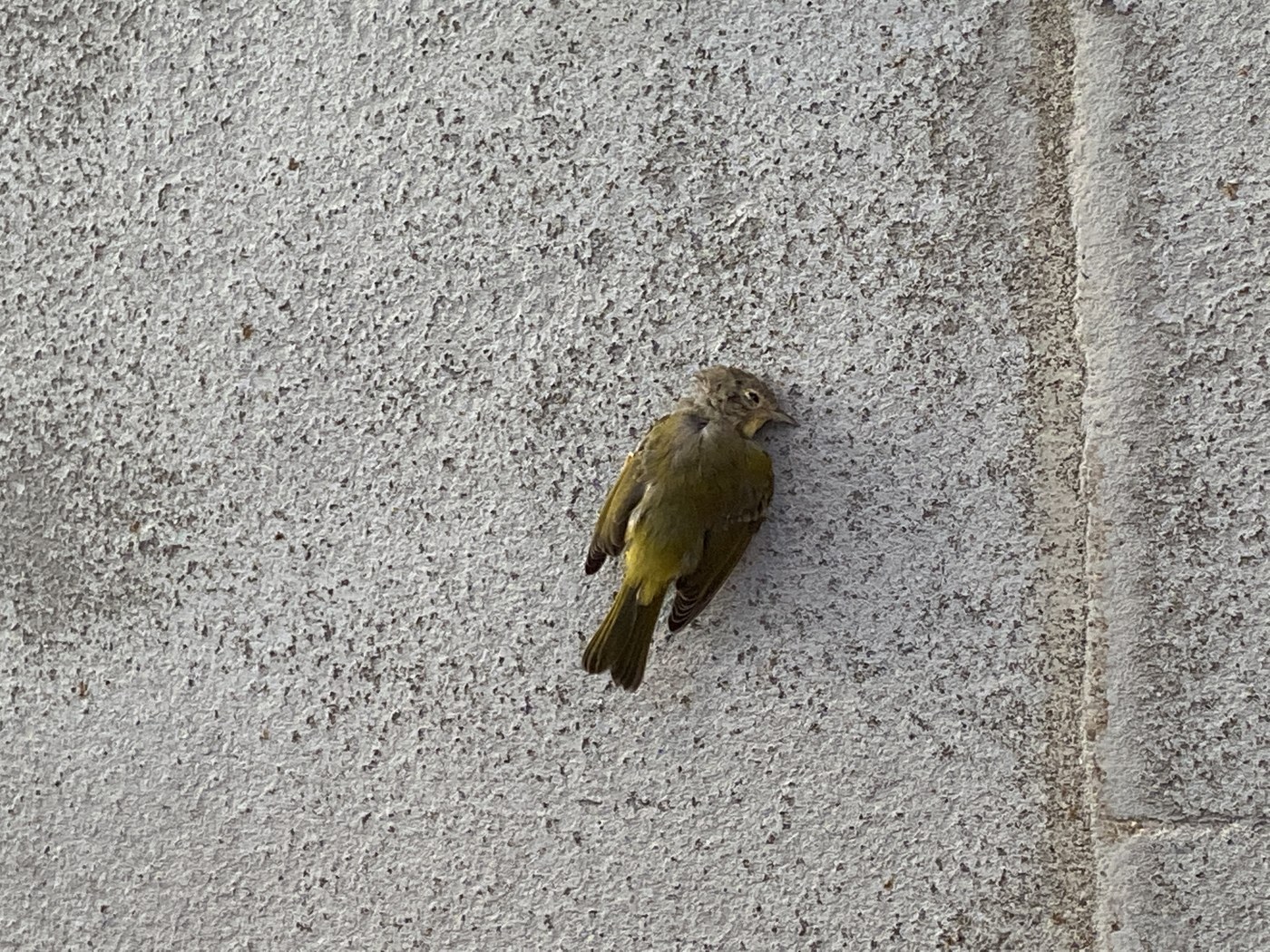
Nashville Warbler
Leiothlypis ruficapilla
A small, active warbler with a gray head, bold white eyering, olive back, and bright yellow underparts, occurring in two disjunct eastern and western breeding populations.
- Size
- 11-12 cm (4.3-4.7 in) long, 17-19 cm wingspan
- Habitat
- second-growth woodlands, bogs, and brushy clearings
- Type
- songbird
Spotted a bird like this?
Identify any bird from a photo, free.
Overview
The Nashville Warbler is a compact, energetic warbler notable for the striking contrast between its gray head and bright olive-green back. A bold, complete white eyering gives the face an alert, wide-eyed look, and the underparts are a clean lemon yellow. Males often show a small chestnut patch on the crown, though it is usually concealed and hard to see in the field.
Like the Tennessee Warbler, it is named for a chance encounter in Tennessee rather than any strong association with the state. Two geographically separated breeding populations exist, an eastern group centered on the Great Lakes and New England and a western group in the Pacific Northwest and California, which differ subtly in color and voice.
How to identify it
Key field marks
- Gray head contrasting sharply with an olive-green back
- Bold, complete white eyering
- Bright yellow throat and underparts, with white on the lower belly
- No wingbars
- Small, often-hidden chestnut crown patch
Similar species
The combination of gray head, white eyering, and yellow underparts without wingbars is distinctive, but Virginia's Warbler and MacGillivray's Warbler can cause confusion in the West. Virginia's Warbler is grayer overall with far less yellow, confined mainly to the breast and undertail coverts, while MacGillivray's Warbler is larger with a broken "spectacled" eye pattern rather than a complete eyering and lacks the Nashville's contrasting olive back.
Habitat & range
Nashville Warblers breed in a variety of second-growth and edge habitats, including regenerating clear-cuts, bogs with scattered shrubs, and brushy woodland borders. The eastern population favors mixed and coniferous second growth across the Great Lakes region and New England into eastern Canada, while the western population breeds in chaparral, oak woodland, and mixed forest edges from the Pacific Northwest south through California.
Both populations winter primarily in Mexico, with smaller numbers reaching Central America and the southern United States.
Behavior & voice
Behavior and voice
Nashville Warblers forage actively and low to the ground in dense shrubs, gleaning insects and spiders from leaves and twigs, and they will also make short flycatching sallies after flying insects.
The song is a distinctive two-parted phrase, often rendered as "seebit-seebit-seebit-seebit, titititititi," with a slower first section giving way to a rapid trill.
Nesting
The nest is a well-concealed cup built on or very near the ground, tucked into moss, a grass tussock, or the base of a shrub. Clutches typically contain 4-5 eggs, incubated by the female.
Frequently asked questions
Why is it called a Nashville Warbler?
It was named after a specimen first collected near Nashville, Tennessee, during migration in 1811, even though the species does not breed there and is only a passage migrant through the state.
Are there different populations of Nashville Warbler?
Yes, there are two disjunct breeding populations, an eastern group around the Great Lakes and New England and a western group in the Pacific Northwest and California, which differ slightly in plumage tone and song.
How do you identify a Nashville Warbler?
Look for a gray head, bold complete white eyering, contrasting olive-green back, and bright yellow underparts, with no wingbars.
What does a Nashville Warbler's song sound like?
A two-part song, a slower introductory "seebit-seebit-seebit" followed by a fast trilled "titititititi."
Where do Nashville Warblers spend the winter?
Most winter in Mexico, with smaller numbers reaching Central America and the southernmost United States.
Nashville Warbler guides
In-depth guides for identifying, finding, and understanding Nashville Warbler.
Other birds you may enjoy

Black Redstart
13-14.5 cm (5.1-5.7 in) long, 23-26 cm wingspan

Black-throated Sparrow
12-14 cm (4.7-5.5 in) long, about 19-20 cm (7.5-8 in) wingspan

Greater Bird-of-paradise
Body about 43 cm; males with additional flank plumes up to 50 cm and long tail wires

Blue Tit
11-12 cm (4.3-4.7 in) long, 17-20 cm wingspan

Red-billed Quelea
11.5–13 cm long, wingspan about 20–22 cm
White-plumed Antbird
13-14 cm (5-5.5 in) long

Pyrrhuloxia
19-22 cm (7.5-8.7 in) long, 30 cm wingspan

Blue-gray Tanager
16-18 cm (6-7 in) long

Blackburnian Warbler
11-13 cm (4.3-5.1 in) long, 20-22 cm wingspan

Bluethroat
13-14 cm (5.1-5.5 in) long, 20-22 cm wingspan

Eurasian Nuthatch
12-14.5 cm (4.7-5.7 in) long, 22.5-27 cm wingspan

Wood Thrush
19-21 cm (7.5-8.3 in) long, about 33 cm (13 in) wingspan