
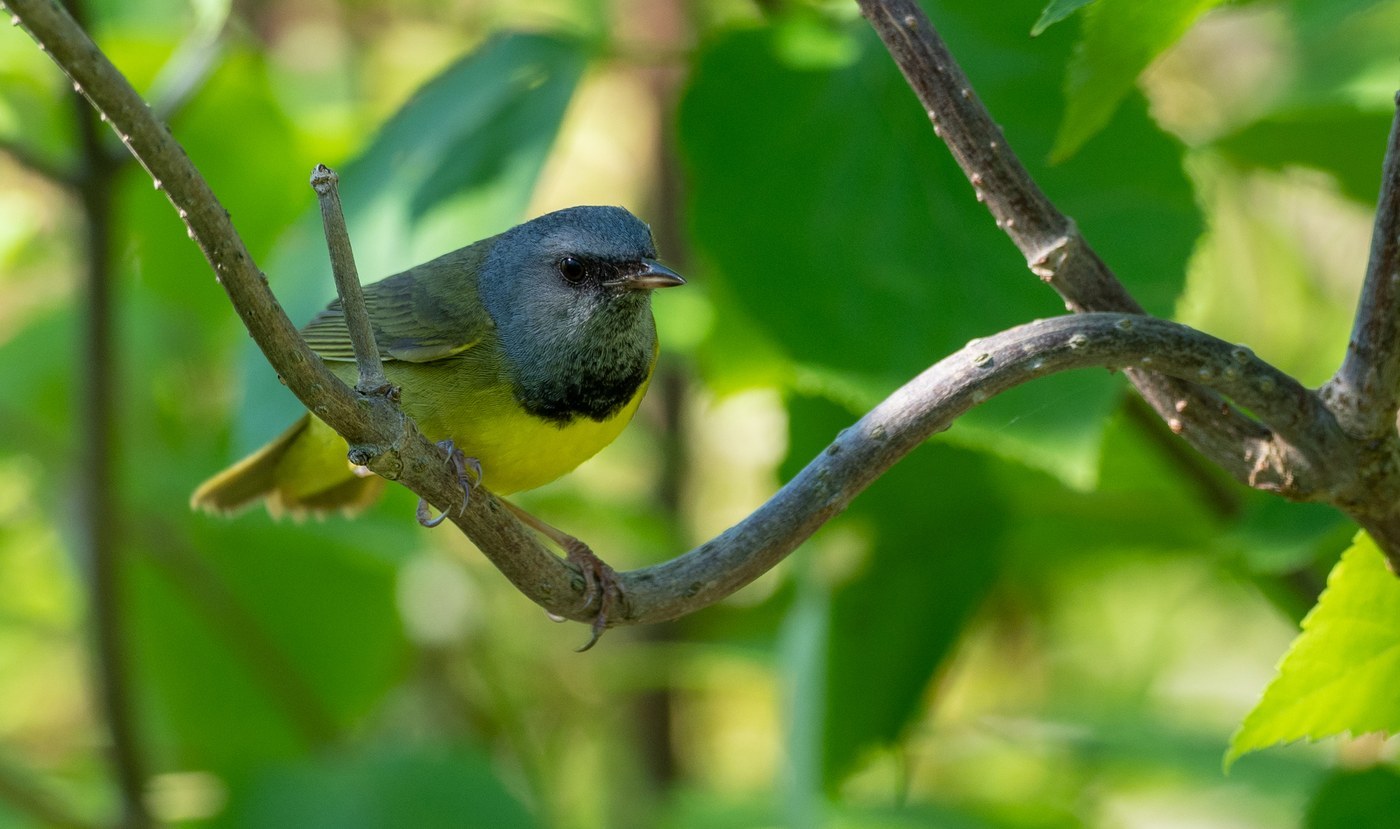
Mourning Warbler
Geothlypis philadelphia
A skulking gray-hooded warbler of dense northern thickets, whose breeding males show a dark, mourning-veil-like patch on the throat and breast.
- Size
- 13 cm (5.1 in) long, 18-19 cm wingspan
- Habitat
- dense shrubby second growth, forest clearings, and edges
- Type
- songbird
Spotted a bird like this?
Identify any bird from a photo, free.
Overview
The Mourning Warbler is a shy, ground-hugging warbler best known for the somber gray hood of the male, which includes a blackish patch across the lower throat and upper breast reminiscent of a mourning veil, a feature that gives the species its evocative name. The rest of the underparts are bright yellow, and the back is a clean olive-green with no wingbars.
Females and immatures are considerably duller, with a paler grayish-olive hood and little or no black on the breast, making them trickier to identify with confidence.
How to identify it
Key field marks
- Gray hood covering the head and upper breast (male)
- Blackish patch or mottling on the lower throat/breast in adult males
- Olive-green back, bright yellow underparts
- No eyering, or at most a very thin, broken one
- No wingbars
Similar species
MacGillivray's Warbler, the western counterpart, is very similar but shows bold broken white eye-crescents ("spectacles") above and below the eye, which Mourning Warbler lacks or shows only faintly. Connecticut Warbler has a complete bold white eyering and is a larger, longer-legged bird that walks rather than hops.
Habitat & range
Mourning Warblers breed across the boreal and northern hardwood forests of Canada and the northeastern/north-central United States, favoring dense, shrubby second growth such as regenerating clear-cuts, forest gaps, and overgrown clearings rather than mature closed-canopy forest.
They winter from Central America into northern South America, again favoring dense, shrubby forest understory and edge habitat.
Behavior & voice
Behavior and voice
Mourning Warblers are skulking and often stay low and hidden in dense tangled vegetation, gleaning insects and spiders and rarely venturing into the open, making them more often heard than seen.
The song is a rolling, rich series often rendered as "chirry-chirry-chirry-chorry-chorry," with a slightly descending, tumbling quality.
Nesting
The nest is built low in dense shrubs or brambles, sometimes nearly on the ground, made of grass, leaves, and bark strips. Clutches typically contain 3-5 eggs.
Frequently asked questions
Why is it called the Mourning Warbler?
The male's dark, blackish patch across the lower throat and breast, set against an otherwise gray hood, was likened to a mourning veil, inspiring the name.
How do you tell a Mourning Warbler from a MacGillivray's Warbler?
MacGillivray's Warbler shows bold broken white eye-crescents (spectacles) above and below the eye, which Mourning Warbler lacks or shows only very faintly. The two species have largely separate breeding ranges, with Mourning in the East and MacGillivray's in the West.
Is the Mourning Warbler easy to see?
No, it is a notably skulking species that tends to stay low and hidden in dense vegetation, making it more often detected by its song than by sight.
What habitat does the Mourning Warbler prefer?
Dense, shrubby second-growth habitat such as regenerating clear-cuts, forest gaps, and overgrown edges, rather than mature closed-canopy forest.
What does a female Mourning Warbler look like?
Females have a paler, grayish-olive hood without the male's dark breast patch, making them duller and less distinctly marked.
Mourning Warbler guides
In-depth guides for identifying, finding, and understanding Mourning Warbler.
Other birds you may enjoy

Black Redstart
13-14.5 cm (5.1-5.7 in) long, 23-26 cm wingspan

Black-throated Sparrow
12-14 cm (4.7-5.5 in) long, about 19-20 cm (7.5-8 in) wingspan

Greater Bird-of-paradise
Body about 43 cm; males with additional flank plumes up to 50 cm and long tail wires

Blue Tit
11-12 cm (4.3-4.7 in) long, 17-20 cm wingspan

Red-billed Quelea
11.5–13 cm long, wingspan about 20–22 cm
White-plumed Antbird
13-14 cm (5-5.5 in) long

Pyrrhuloxia
19-22 cm (7.5-8.7 in) long, 30 cm wingspan

Blue-gray Tanager
16-18 cm (6-7 in) long

Blackburnian Warbler
11-13 cm (4.3-5.1 in) long, 20-22 cm wingspan

Bluethroat
13-14 cm (5.1-5.5 in) long, 20-22 cm wingspan

Eurasian Nuthatch
12-14.5 cm (4.7-5.7 in) long, 22.5-27 cm wingspan

Wood Thrush
19-21 cm (7.5-8.3 in) long, about 33 cm (13 in) wingspan