
Mourning Warbler Identification Guide
A skulking gray-hooded warbler of dense northern thickets, best told from its lookalike by lacking a bold white eye-ring.
Read the full Mourning Warbler encyclopedia entry →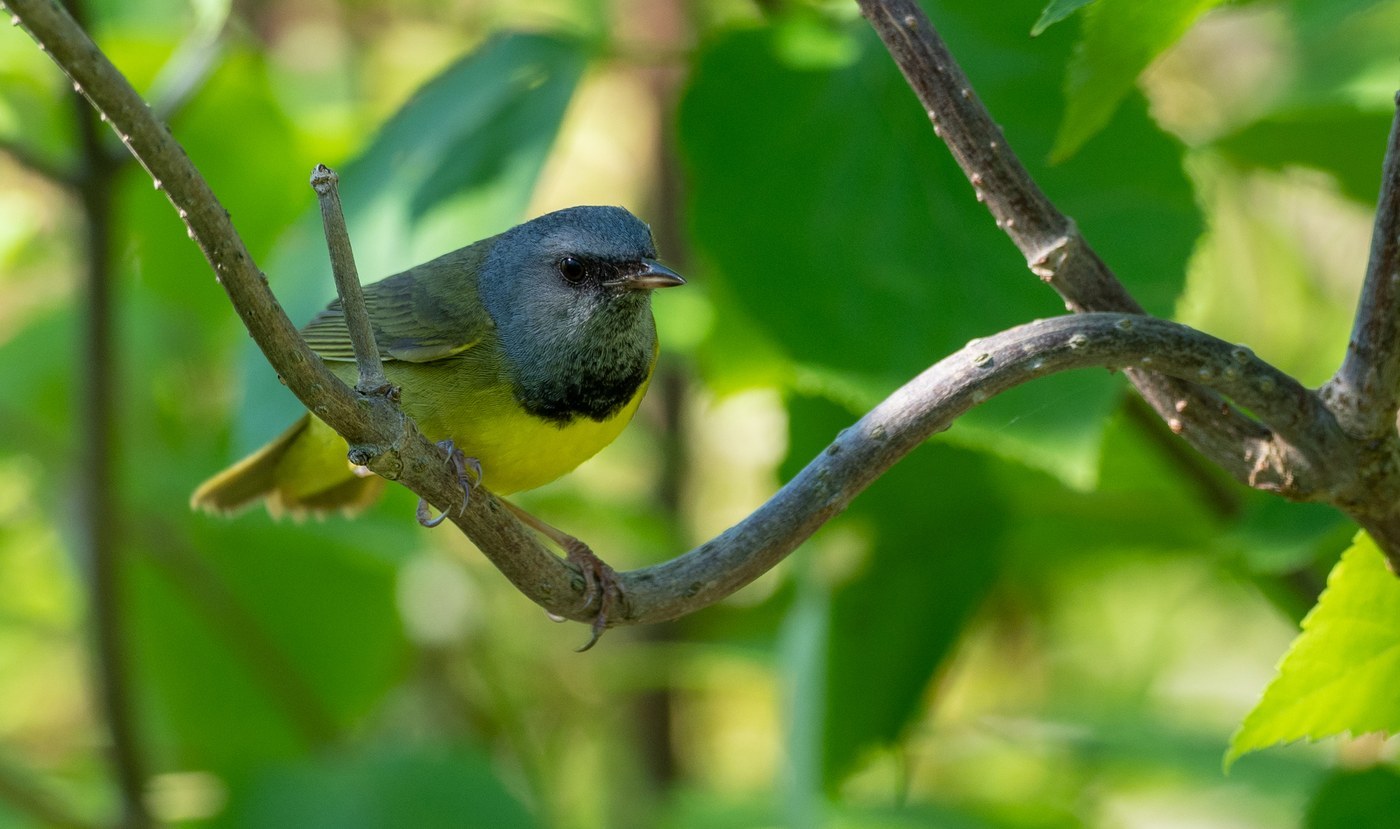
Key Field Marks
- Size & shape: A small, chunky wood warbler with a fairly short tail, a thick neck, and a stout bill adapted for foraging low in dense vegetation.
- Adult male: Solid gray hood over the head and throat, with a black "mourning" patch across the upper breast; olive-green back, wings, and tail; bright yellow underparts; no wing bars.
- Adult female / immature: Duller gray-olive hood without the black bib, sometimes showing a thin, incomplete pale eye-ring, but never the bold broken eye-ring of its lookalike.
- No eye-ring or wing bars: The clean, unmarked face is the single most useful mark on this species.
Separating It From Similar Species
- MacGillivray's Warbler: The western counterpart, virtually identical in plumage but shows a bold, broken white eye-ring (crescents above and below the eye) that Mourning Warbler lacks or shows only faintly. Ranges barely overlap, with MacGillivray's in the west and Mourning in the east and boreal Canada.
- Connecticut Warbler: Larger, with a complete bold white eye-ring, a longer undertail, and a habit of walking rather than hopping; also skulks but in different habitat (often more open bog edges).
- Common Yellowthroat: Males have a black facial mask, not a full gray hood, and both sexes lack the gray hood pattern entirely.
Where and When to See It
Mourning Warblers breed in dense second-growth thickets, forest edges, regenerating clearcuts, and shrubby bogs across southern Canada and the northeastern and north-central US, favoring tangles of raspberry, blackberry, and young saplings. They are notorious skulkers, staying low and often out of sight, so many birders identify them by song first. They winter in Central America and northern South America, and are seen elsewhere in the East mainly as a spring and fall migrant passing through similar brushy habitat.
Voice
The song is a rich, rolling series of paired notes, often rendered "churry churry churry chorry chorry," with the second half dropping in pitch. The call note is a flat, sharp "chik." Because the bird stays hidden in dense cover, learning this song is often the most reliable way to confirm its presence.
Frequently asked questions
What is the best way to tell Mourning Warbler from MacGillivray's Warbler?
Look for the eye-ring: MacGillivray's has a bold, broken white eye-ring while Mourning Warbler's face is mostly plain, with at most a faint partial ring. Range also helps, since MacGillivray's is western and Mourning is eastern.
Does the female Mourning Warbler have the black breast patch?
No, females and immatures lack the male's black bib and show a duller, more olive-gray hood.
Where do Mourning Warblers nest?
In dense low thickets and regenerating brushy habitat such as old clearcuts, forest edges, and shrubby bogs across the northeastern and north-central US and southern Canada.
Why is Mourning Warbler hard to see even when singing nearby?
It forages and sings from deep within dense low tangles and rarely comes into the open, so patient, quiet waiting near the sound is usually needed for a visual.