
Mountain Quail
Oreortyx pictus
A large, secretive Pacific-coast quail known for its long, straight head plume and rich chestnut flank stripes.
- Size
- 25-28 cm (10-11 in) long; the largest quail species in North America
- Habitat
- dense chaparral, brushy montane slopes, and forest edges along the Pacific coast
- Type
- gamebird
Spotted a bird like this?
Identify any bird from a photo, free.
Overview
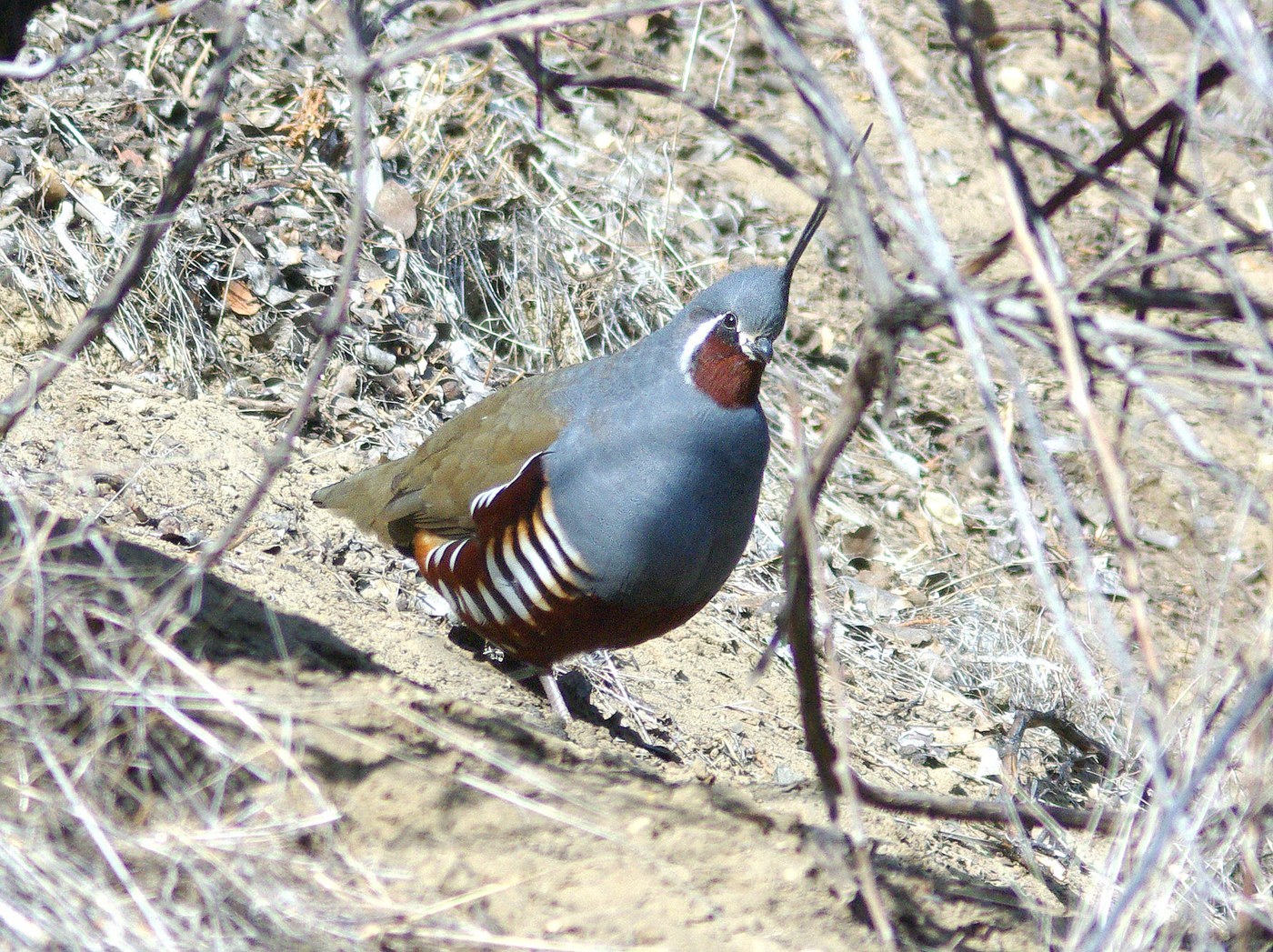
The Mountain Quail is the largest and arguably the most striking quail native to North America. It is a plump, ground-dwelling bird with a slate-gray breast, warm brown back, and bold chestnut-and-white barred flanks. Both sexes carry a single long, thin, straight black plume projecting from the crown, formed by two feathers held tightly together so they appear as one.
Despite its bold pattern, the Mountain Quail is famously hard to see, preferring to stay hidden in thick brush and running rather than flying when disturbed. It is best known to hikers and birders as a distant, far-carrying call echoing across steep canyon slopes.
How to identify it
Key field marks
- Long, straight, slender head plume (unlike the forward-curving plume of California and Gambel's Quail)
- Slate-gray face, throat, and breast with a chestnut throat patch bordered in white
- Bold chestnut flanks barred with white
- Larger and more upright-postured than other North American quail
Similar species
- California Quail and Gambel's Quail have a comma-shaped, forward-curving topknot rather than a straight plume, and lack the strongly barred chestnut flanks.
- Mountain Quail is also noticeably larger and more richly colored than either.
Habitat & range
Habitat and Range
Mountain Quail occupy dense chaparral, montane brush fields, and shrubby forest edges from sea level up to subalpine elevations, generally favoring steep, brushy slopes with reliable water sources nearby.
Range
They are found along the Pacific coast and interior mountain ranges from Washington south through Oregon, California, and into Baja California, with scattered populations in Nevada and Idaho (some introduced).
Migration
Mountain Quail make one of the few true altitudinal migrations among North American gamebirds, walking on foot from high-elevation summer brushfields down to lower, snow-free wintering slopes rather than flying long distances.
Behavior & voice
Behavior
Mountain Quail are wary and secretive, usually running for cover through dense brush rather than flushing into flight. Coveys are typically small compared to other quail.
Voice
The advertising call is a loud, single, far-carrying "took" or "whoo-took" repeated at intervals, often the only clue to the bird's presence in thick cover.
Feeding
They forage on the ground and in low shrubs for seeds, green leaves, bulbs, berries, and some insects.
Nesting and breeding
Nests are simple scrapes on the ground lined with grass and leaves, well concealed under brush. Clutches typically contain 6-10 eggs, and chicks are precocial, leaving the nest and following the parents almost immediately after hatching.
Frequently asked questions
How do you tell a Mountain Quail from a California Quail?
Look at the head plume: Mountain Quail has one long, straight plume, while California Quail has a shorter, forward-curving comma-shaped topknot. Mountain Quail is also larger with bold chestnut-and-white barred flanks.
Where do Mountain Quail live?
They live in dense chaparral and brushy mountain slopes along the Pacific coast from Washington to Baja California, generally in steeper, brushier terrain than other quail.
Why are Mountain Quail hard to see?
They are secretive and prefer to run through thick brush rather than fly, so they are usually detected by their loud, far-carrying call rather than by sight.
Do Mountain Quail migrate?
They make a unique on-foot altitudinal migration, walking downhill from high summer brushfields to lower wintering slopes rather than flying south.
Mountain Quail guides
In-depth guides for identifying, finding, and understanding Mountain Quail.
Other birds you may enjoy
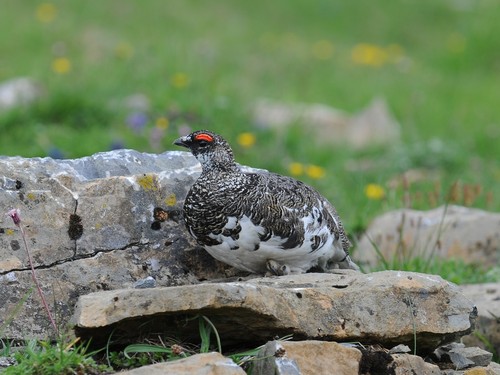
Rock Ptarmigan
34-36 cm (13-14 in) long
Congo Peafowl
Males about 64-70 cm long; females slightly smaller; no elaborate train
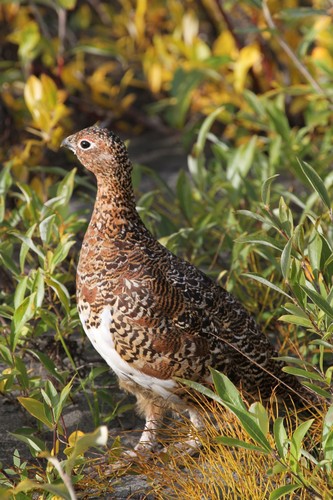
Willow Ptarmigan
37-42 cm (15-16.5 in) long
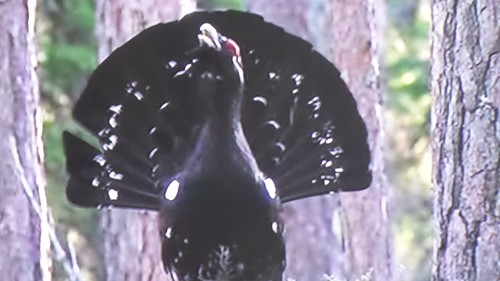
Western Capercaillie
male 74-90 cm (29-35 in), female 54-64 cm; male wingspan up to 125-130 cm
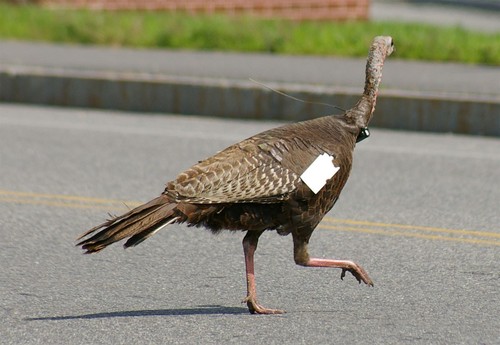
Wild Turkey
males 100-125 cm (39-49 in) long; females smaller, around 76-95 cm (30-37 in)
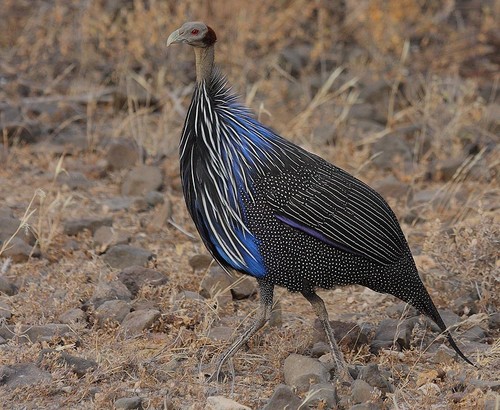
Vulturine Guineafowl
Length 61-71 cm, the largest guineafowl species, with a notably long neck and tail
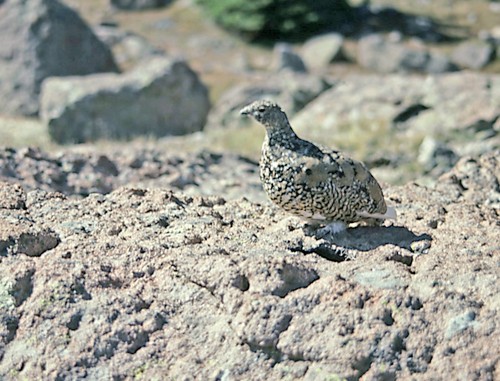
White-tailed Ptarmigan
30-33 cm (12-13 in) long; the smallest ptarmigan species
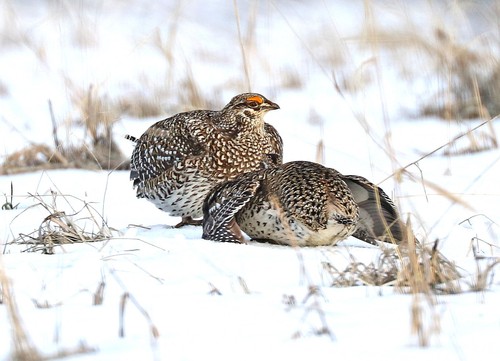
Sharp-tailed Grouse
38-48 cm (15-19 in) long
Ring-necked Pheasant
males 76-90 cm (30-35 in) long including a long tail; females smaller, 55-65 cm (22-26 in)
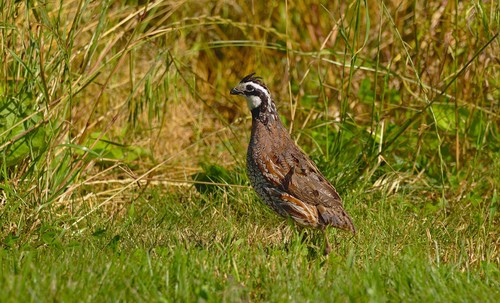
Northern Bobwhite
24-28 cm (9.5-11 in) long, 33-38 cm wingspan
Red-legged Partridge
32-34 cm (13 in) long, 47-50 cm wingspan
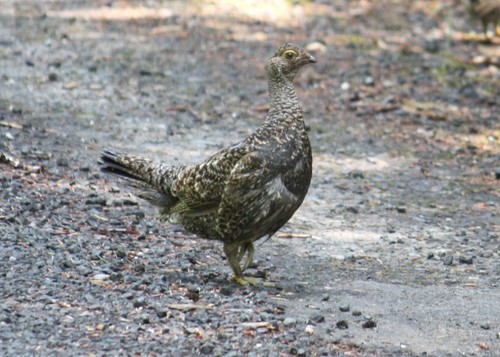
Sooty Grouse
43-48 cm (17-19 in) long; males larger than females