
Mountain Quail Identification Guide
North America's largest quail, told by its long straight head plume and chestnut throat patch on steep, brushy mountain slopes.
Read the full Mountain Quail encyclopedia entry →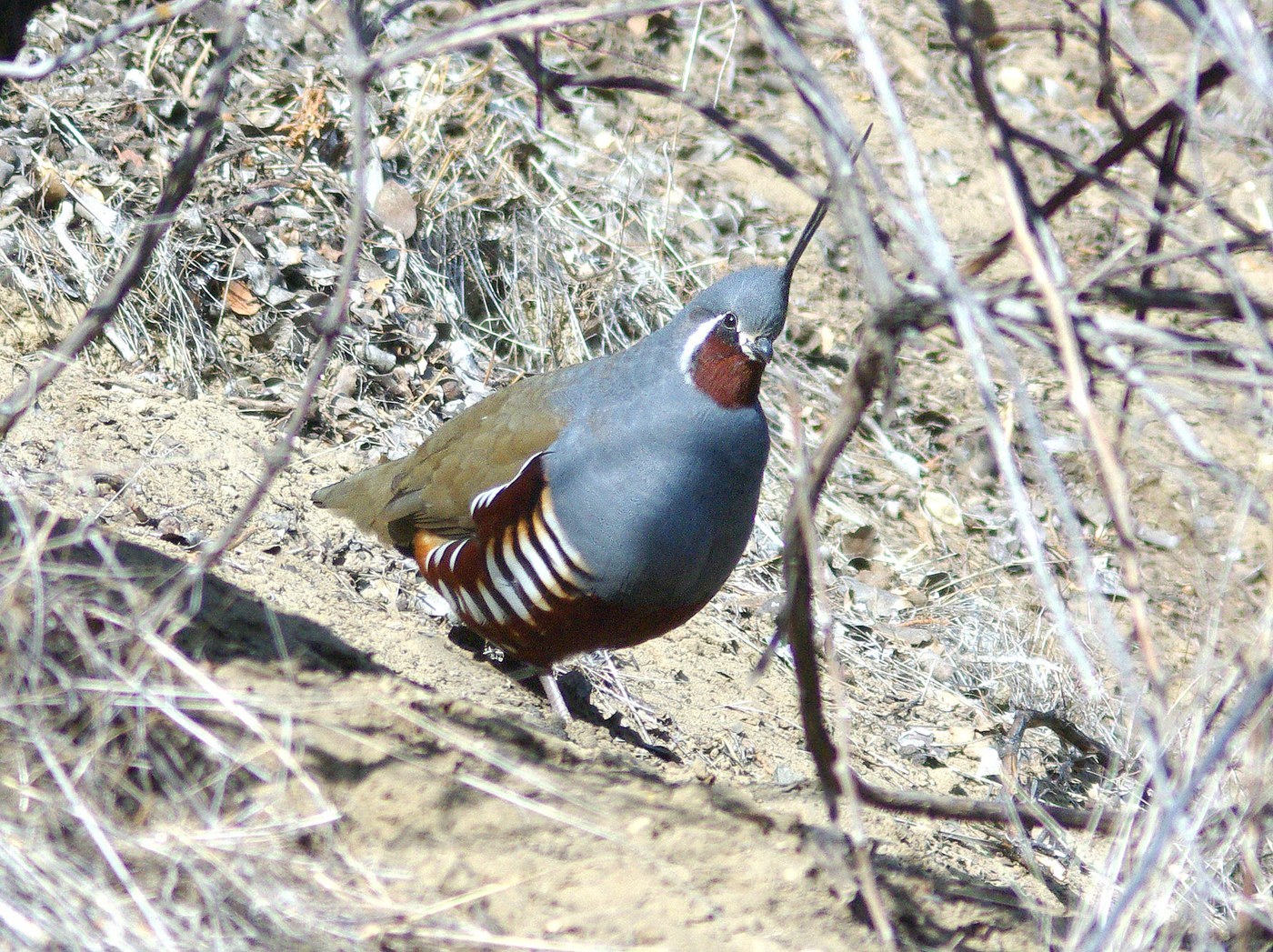
Key Field Marks
- Size & shape: The largest quail in North America, roughly 11 inches long, with a plump body, short rounded wings, and a fairly long tail.
- Head plume: A very long, thin, straight black plume (actually two feathers held together) projects up from the crown — unlike the short, forward-curving teardrop plume of California and Gambel's Quail.
- Face and throat: A chestnut throat patch bordered by a crisp white line stands out against a slate-gray face and breast.
- Body pattern: Flanks are boldly barred chestnut and white, giving a striped look along the sides; the back and wings are olive-brown.
- Bill and legs: Short, stout dark bill; sturdy grayish legs built for walking and running on steep terrain.
Separating It From Similar Species
- California Quail: Has a short, curved black plume, a scaled belly pattern, and lacks the chestnut-and-white barred flanks; found at lower elevations and more open, brushy or suburban habitat.
- Gambel's Quail: Desert specialist with a curved plume like California Quail, a black belly patch (males), and a different, more arid range that rarely overlaps with Mountain Quail habitat.
- Scaled Quail: Has a bushy whitish crest and overall scaly pattern, no long straight plume, and occupies dry southwestern grasslands rather than mountain brush.
Where and When to See It
Mountain Quail live in dense chaparral, manzanita thickets, and brushy mountain slopes of the Pacific Northwest, Sierra Nevada, and coastal ranges from Washington south through California, plus an introduced population in the interior Northwest. They are altitudinal migrants: birds move to higher, brushier slopes to breed in spring and summer, then walk downslope in coveys during fall and winter rather than flying long distances. They are notoriously secretive, preferring to run into cover instead of flushing, so patient watching along brushy roadcuts and streamside thickets at dawn or dusk gives the best chance of a sighting.
Voice
The advertising call is a loud, far-carrying single-note "whoy" or "quee-ark," often repeated at intervals from a low perch. Coveys also give soft clucking and chuckling contact notes while foraging in dense brush, which is often the first clue to their presence since the birds themselves stay hidden.
Frequently asked questions
What is the easiest way to identify a Mountain Quail?
Look for a very long, thin, straight head plume combined with a chestnut throat bordered in white and bold chestnut-and-white barring on the flanks — no other North American quail shows this combination.
How is Mountain Quail different from California Quail?
Mountain Quail has a long straight plume and barred flanks, while California Quail has a short curved plume and a scaled belly; Mountain Quail also favors steeper, brushier mountain habitat.
Where do Mountain Quail live?
They inhabit dense chaparral and brushy slopes in mountain ranges of the Pacific Northwest and California, moving to lower elevations on foot in winter.
Why are Mountain Quail hard to see?
They are shy, run rather than fly when disturbed, and stay hidden in thick brush, so most sightings come from hearing their loud whistled call first.