
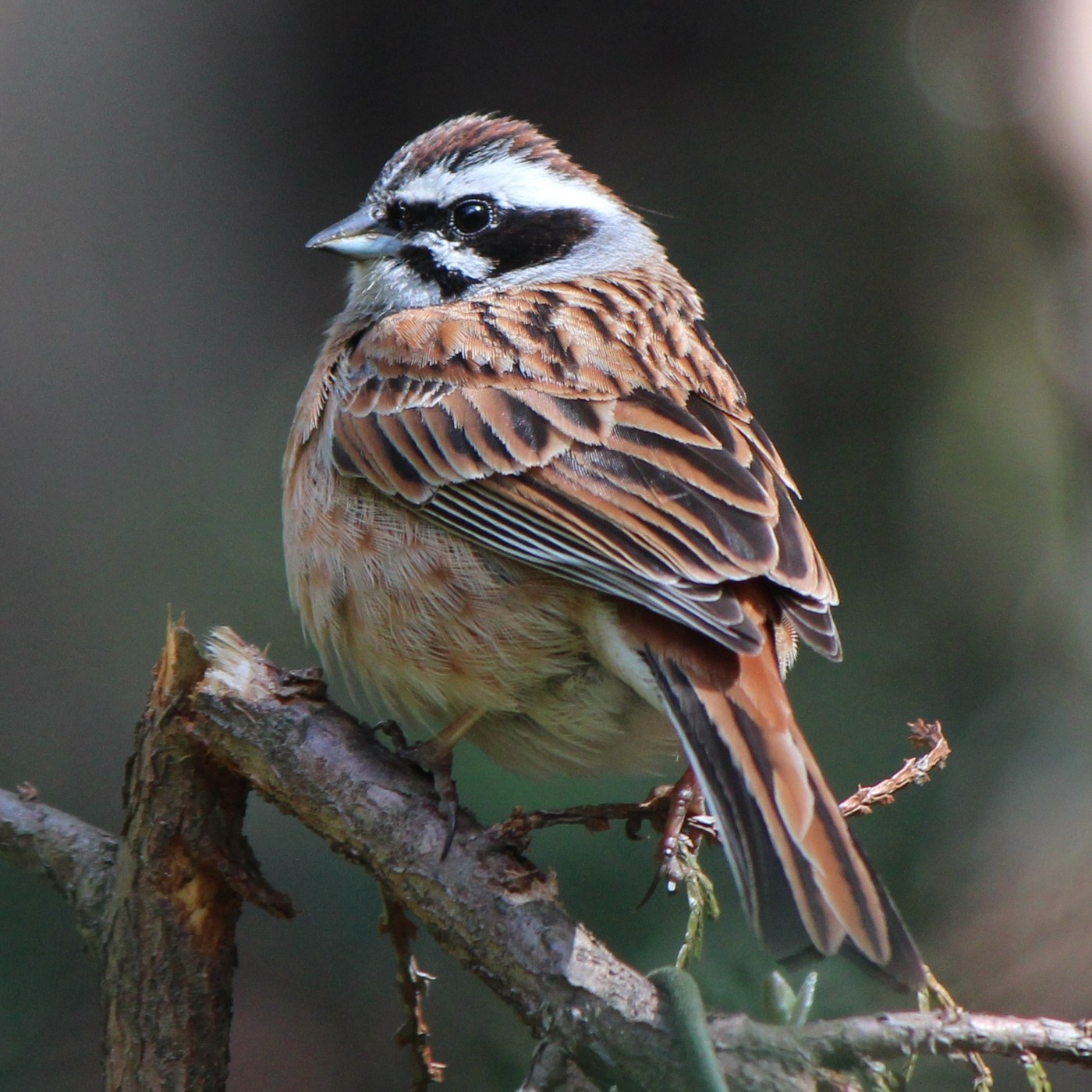
Meadow Bunting
Emberiza cioides
A warm chestnut-backed bunting with a bold black-and-white striped face and a rufous wash across the breast.
- Size
- 15-17 cm (6-6.7 in) long
- Habitat
- open scrub, farmland, grassy hillsides, and forest edge
- Type
- songbird
Spotted a bird like this?
Identify any bird from a photo, free.
Overview
The Meadow Bunting is a medium-sized bunting with a rich chestnut-brown back streaked with black, and a distinctively patterned head showing a grey crown and cheek bordered by black stripes above and below a pale supercilium and moustachial stripe. The underparts show a warm rufous-buff wash across the breast and flanks, fading to a paler belly.
It favors open, scrubby country and is often seen perched on low bushes, fence posts, or wires, singing its simple, rhythmic song, especially in spring, when males are highly vocal in defending breeding territories.
How to identify it
Key field marks
- Chestnut-brown back streaked with black
- Grey crown and cheek framed by bold black stripes
- Pale supercilium and moustachial stripe
- Rufous-buff wash on the breast and flanks
Similar species
- Chestnut-eared Bunting has a chestnut ear patch (not a grey cheek) and a heavily streaked breast with a distinct necklace.
- Black-faced Bunting lacks the chestnut back and rufous breast wash, showing an olive-grey head instead.
Habitat & range
Habitat
Favors open scrub, grassy hillsides, farmland edges, and rocky or bushy slopes, generally avoiding dense forest.
Range
Widespread across a broad area of East Asia, including China, the Korean Peninsula, Japan, and parts of Mongolia and Russia.
Migration
Mostly resident or short-distance migrant, with some northern populations moving south for milder winters.
Behavior & voice
Behavior
Often perches in the open on low shrubs, fences, or wires, particularly while singing; forages mainly on or near the ground in open, scrubby habitat.
Voice
A simple, rhythmic, jangling song, along with a sharp "tsik" call note.
Feeding
Eats seeds for most of the year, switching to insects during the breeding season, especially when feeding young.
Nesting
Builds a cup nest on or near the ground, hidden in grass or low scrub; lays 4-5 pale eggs with darker markings.
Frequently asked questions
How do you identify a Meadow Bunting?
Look for a chestnut-brown streaked back, a grey crown and cheek bordered by bold black stripes, and a rufous-buff wash across the breast.
What does a Meadow Bunting eat?
Mainly seeds, with insects added to the diet during the breeding season.
Where does the Meadow Bunting live?
In open scrub, grassy hillsides, and farmland edges across China, Korea, Japan, Mongolia, and Russia.
How can you distinguish a Meadow Bunting from a Chestnut-eared Bunting?
The Meadow Bunting has a grey cheek bordered by black stripes and lacks heavy breast streaking, while the Chestnut-eared Bunting has a chestnut ear patch and a streaked breast necklace.
Meadow Bunting guides
In-depth guides for identifying, finding, and understanding Meadow Bunting.
Other birds you may enjoy

Black Redstart
13-14.5 cm (5.1-5.7 in) long, 23-26 cm wingspan

Black-throated Sparrow
12-14 cm (4.7-5.5 in) long, about 19-20 cm (7.5-8 in) wingspan

Greater Bird-of-paradise
Body about 43 cm; males with additional flank plumes up to 50 cm and long tail wires

Blue Tit
11-12 cm (4.3-4.7 in) long, 17-20 cm wingspan

Red-billed Quelea
11.5–13 cm long, wingspan about 20–22 cm
White-plumed Antbird
13-14 cm (5-5.5 in) long

Pyrrhuloxia
19-22 cm (7.5-8.7 in) long, 30 cm wingspan

Blue-gray Tanager
16-18 cm (6-7 in) long

Blackburnian Warbler
11-13 cm (4.3-5.1 in) long, 20-22 cm wingspan

Bluethroat
13-14 cm (5.1-5.5 in) long, 20-22 cm wingspan

Eurasian Nuthatch
12-14.5 cm (4.7-5.7 in) long, 22.5-27 cm wingspan

Wood Thrush
19-21 cm (7.5-8.3 in) long, about 33 cm (13 in) wingspan