
Meadow Bunting Identification Guide
A slim, long-tailed Asian bunting with a rufous back, chestnut breast band, and a bold black-and-white striped head pattern in breeding males, found in open scrubby country and farmland edges across East Asia.
Read the full Meadow Bunting encyclopedia entry →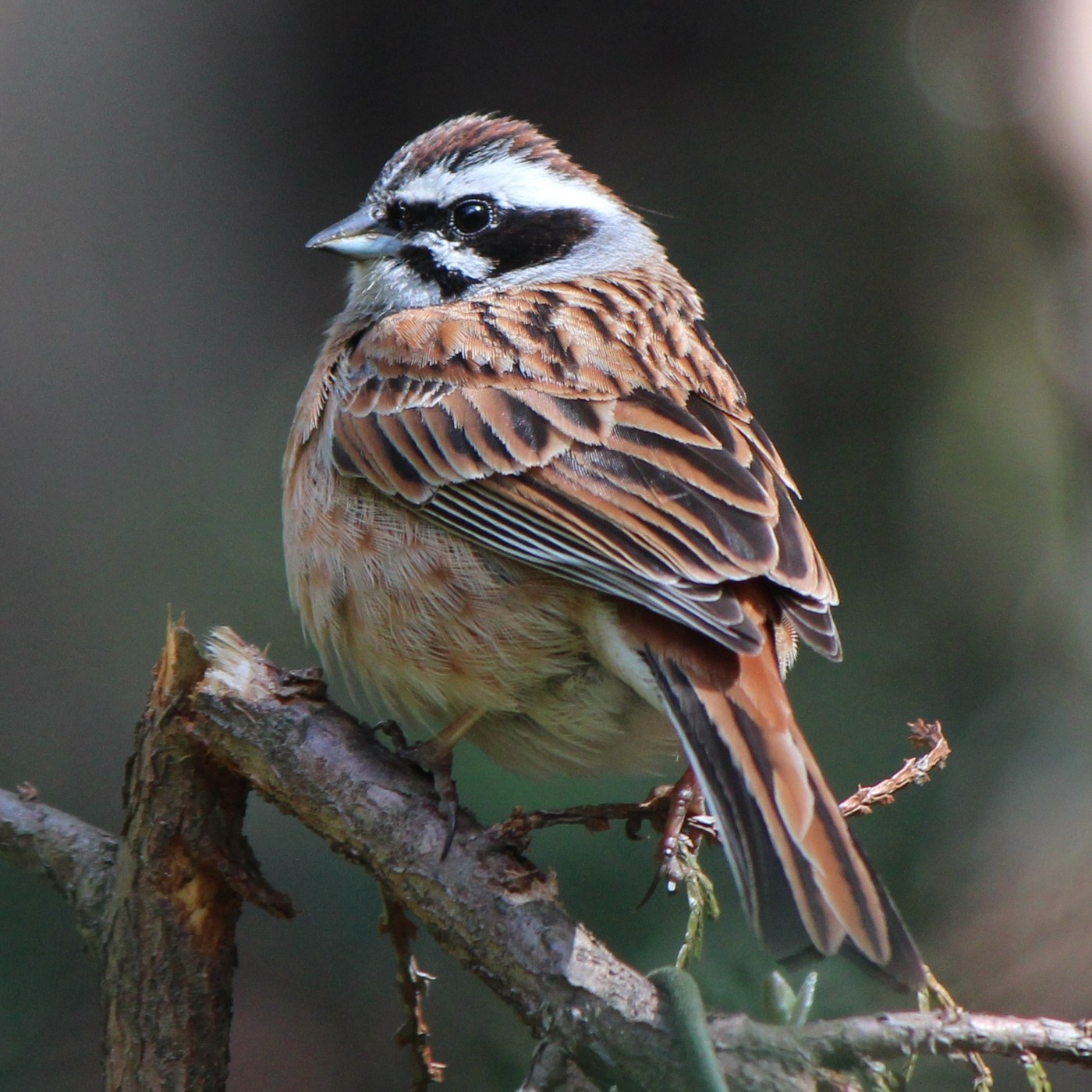
Key Field Marks
- Size & shape: A slender bunting about 15–17 cm (6–6.5 in) long with a distinctly long, graduated tail, often flicked or pumped while perched.
- Head pattern: Breeding males show a striking black-and-white striped head — black crown sides, a white supercilium (eyebrow), black eye-stripe, and a white submoustachial stripe against a black malar/throat border; females and non-breeding birds show a much muted, browner version of the same pattern.
- Upperparts: Warm rufous-chestnut back streaked with black, contrasting with a grey rump in some races.
- Underparts: Whitish to buffy belly with a chestnut wash or band across the breast, deeper and more defined in males.
- Bill: Small, conical, pale pinkish-grey bunting bill.
- Behavior: Often perches conspicuously on low bushes, fences, wires, or rocks in open country, frequently flicking its long tail sideways or up-and-down.
Similar Species
- Chestnut-eared Bunting (Emberiza fucata): Shares chestnut tones but has streaked underparts and a chestnut ear patch rather than the striped black-and-white head of Meadow Bunting.
- Jankowski's Bunting (Emberiza jankowskii): A rare, similar-looking bunting of restricted range in Northeast China; note range and streak pattern to separate from more widespread Meadow Bunting.
- Rock Bunting (Emberiza cia): Occurs further west (Europe/Central Asia); has a blue-grey head with black stripes rather than black-and-white, and a plainer chestnut back without the crisp facial contrast of Meadow Bunting.
Where & When to See It
- Range: Widespread resident across much of East Asia, including eastern Russia, Mongolia, China, the Korean Peninsula, and Japan.
- Habitat: Open, scrubby hillsides, grassy slopes, farmland edges, hedgerows, and low bushy vegetation — avoids dense forest, favoring edge and open country.
- Season: Largely resident/sedentary across much of its range, though northern populations withdraw somewhat southward in winter; visible year-round in much of Japan, Korea, and eastern China.
Voice
- Song is a bright, variable warbling series of clear notes, often delivered from an exposed perch — typical bunting song structure but with its own distinctive rhythm.
- Call is a sharp, thin "tsip" or "zit," given in flight or when flushed from cover.
Frequently asked questions
What is the most distinctive feature of a breeding male Meadow Bunting?
Its bold black-and-white striped head pattern combined with a rufous-chestnut back and breast band, making it one of the more strikingly patterned buntings in its range.
Where is Meadow Bunting typically found?
Open scrubby hillsides, grassy slopes, and farmland edges across East Asia, including China, Mongolia, Korea, Japan, and the Russian Far East.
Is Meadow Bunting migratory?
It is largely resident, though the northernmost breeding populations shift somewhat south in winter; in much of its range it can be seen year-round.
How do I tell a female Meadow Bunting from a male?
Females show the same overall pattern as males but much more muted and browner, lacking the crisp black-and-white contrast on the head.