
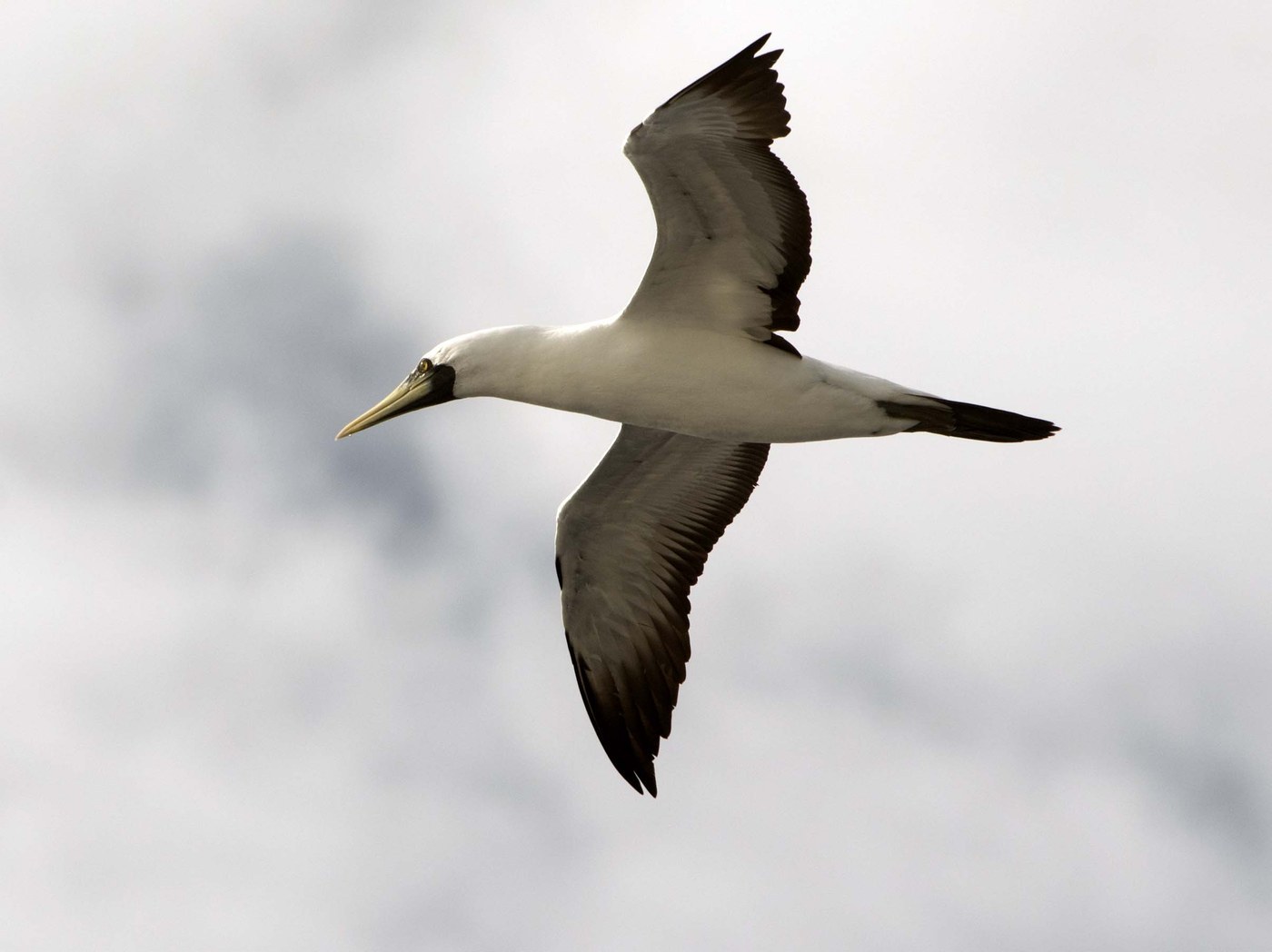
Masked Booby
Sula dactylatra
The largest booby species, brilliant white with black flight feathers, a dark facial mask, and a bright yellow bill.
- Size
- 74-86 cm (29-34 in) long, about 152 cm wingspan
- Habitat
- remote tropical and subtropical islands, open pelagic ocean
- Type
- seabird
Spotted a bird like this?
Identify any bird from a photo, free.
Overview
The Masked Booby is the largest and most striking of the white-bodied boobies, with clean white plumage set off by crisp black flight feathers and tail, and a distinctive dark facial "mask" of bare skin surrounding the eyes and bill base that gives the species its name. The heavy yellow bill and pale eyes complete a bold, high-contrast look that is unmistakable at close range.
Breeding on remote, often predator-free tropical islands, Masked Boobies form colonies alongside other seabirds and can be approached quite closely, showing little fear of humans in the absence of historical predation pressure.
How to identify it
Key field marks
- Large size, largest of the booby species
- White body with black flight feathers and black tail
- Dark facial skin forming a mask around the bill and eyes
- Heavy, straight yellow bill
Similar species
- Nazca Booby is extremely similar and was once considered the same species; it is best distinguished by its orange-pink (not yellow) bill.
- Cape and Australasian Gannets are similar in overall pattern but occur outside the tropics and have golden-buff heads rather than a distinct dark mask.
- Juveniles are mottled brown-and-white with a dusky head, gradually acquiring the adult mask and clean white body over a few years.
Habitat & range
Masked Boobies nest on remote tropical and subtropical islands across the Atlantic, Pacific, and Indian Oceans, favoring flat, open ground on isolated cays and atolls far from mainland predators. They are highly pelagic outside the breeding season, ranging widely over open ocean far from any land.
Colonies are often shared with other seabirds, including frigatebirds and other booby species, on islands that provide the isolation these ground-nesting birds require for successful breeding.
Behavior & voice
Behavior
Masked Boobies are powerful plunge-divers, dropping from considerable heights to spear fast-swimming prey like flying fish, and they can also pursue prey in shallow underwater chases.
Voice
At the colony, birds give deep honking and hissing calls during territorial and courtship displays; they are largely silent while at sea.
Feeding
Flying fish and squid form the bulk of the diet, typically captured through steep plunge-dives well offshore.
Nesting and breeding
A simple ground scrape serves as the nest, and while two eggs are typically laid, the older, stronger chick usually kills its younger sibling shortly after hatching, a behavior known as obligate siblicide.
Frequently asked questions
How big is a Masked Booby?
It is the largest booby species, reaching up to about 86 cm in length with a wingspan around 152 cm.
How can you tell a Masked Booby from a Nazca Booby?
The clearest difference is bill color: Masked Boobies have a yellow bill, while Nazca Boobies have an orange-pink bill.
Why do Masked Booby chicks kill their siblings?
Masked Boobies typically lay two eggs, but the first-hatched, stronger chick usually evicts or kills the younger sibling, an adaptation called obligate siblicide that ensures at least one chick survives.
Where do Masked Boobies nest?
They nest on remote, often predator-free tropical and subtropical islands across the Atlantic, Pacific, and Indian Oceans.
What does a Masked Booby eat?
Primarily flying fish and squid, caught by plunge-diving from height over open ocean.
Masked Booby guides
In-depth guides for identifying, finding, and understanding Masked Booby.
Other birds you may enjoy
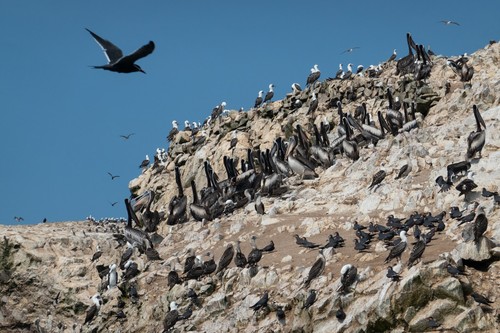
Peruvian Pelican
137-152 cm (54-60 in) long, up to 228 cm wingspan
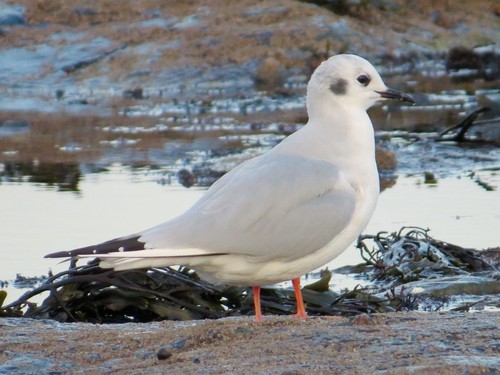
Bonaparte's Gull
28-33 cm (11-13 in) long, 76-84 cm wingspan
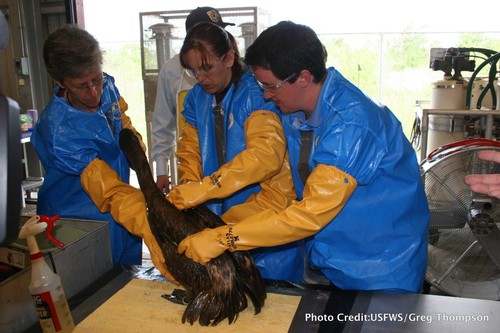
Brown Pelican
106-137 cm (42-54 in) long, 200-230 cm wingspan
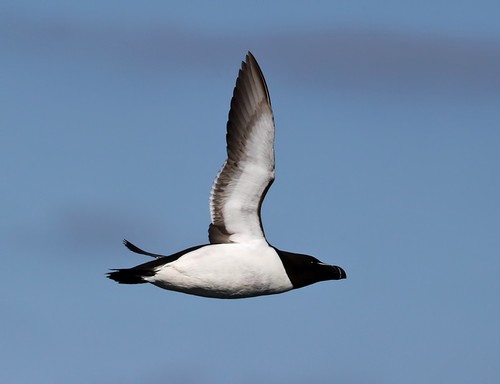
Razorbill
37-39 cm (15-15.5 in) long, 63-68 cm wingspan
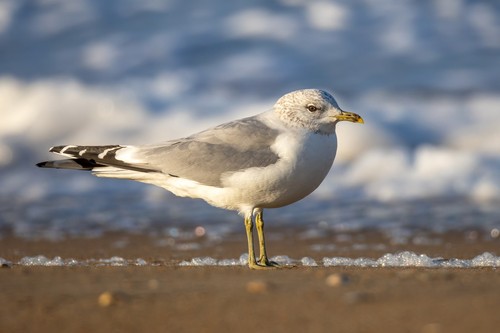
Common Gull
40-46 cm (16-18 in) long, 110-130 cm wingspan
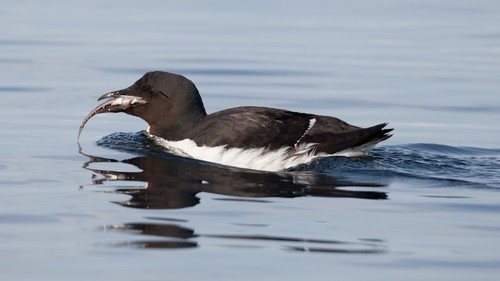
Thick-billed Murre
40-48 cm (16-19 in) long, 65-75 cm wingspan
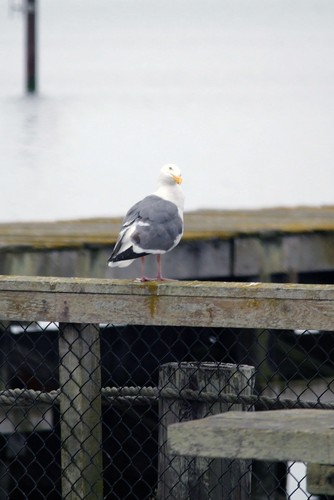
Western Gull
55-68 cm (22-27 in) long, 130-144 cm wingspan
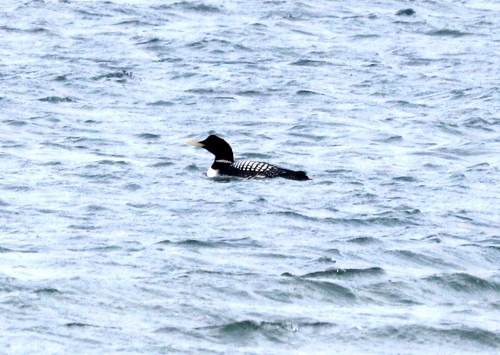
Yellow-billed Loon
76-97 cm (30-38 in) long, 135-152 cm wingspan
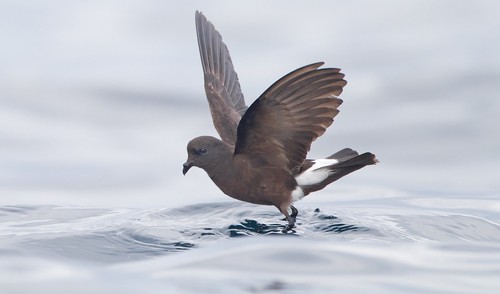
Wilson's Storm-Petrel
15-19 cm (6-7.5 in) long, wingspan 38-42 cm (15-16.5 in)
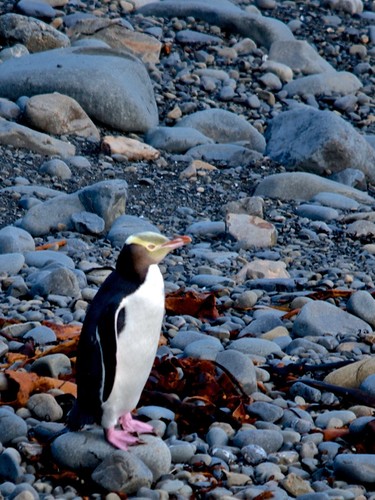
Yellow-eyed Penguin
62-79 cm (24-31 in) tall, 3-8.5 kg (6.6-18.7 lb)
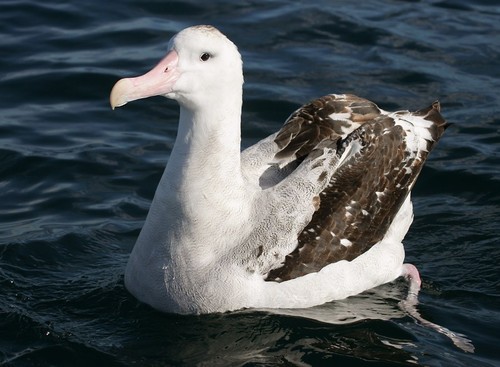
Wandering Albatross
107-135 cm (42-53 in) long, wingspan up to 3.5 m (11.5 ft)
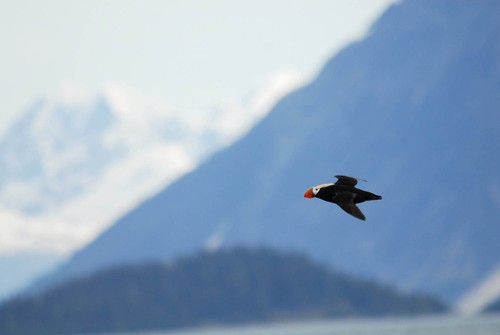
Tufted Puffin
35-41 cm (14-16 in) long, about 63-70 cm wingspan