
Masked Booby Identification Guide
The largest booby species, gleaming white with black flight feathers, a black facial mask, and a bright yellow bill, found on tropical islands worldwide.
Read the full Masked Booby encyclopedia entry →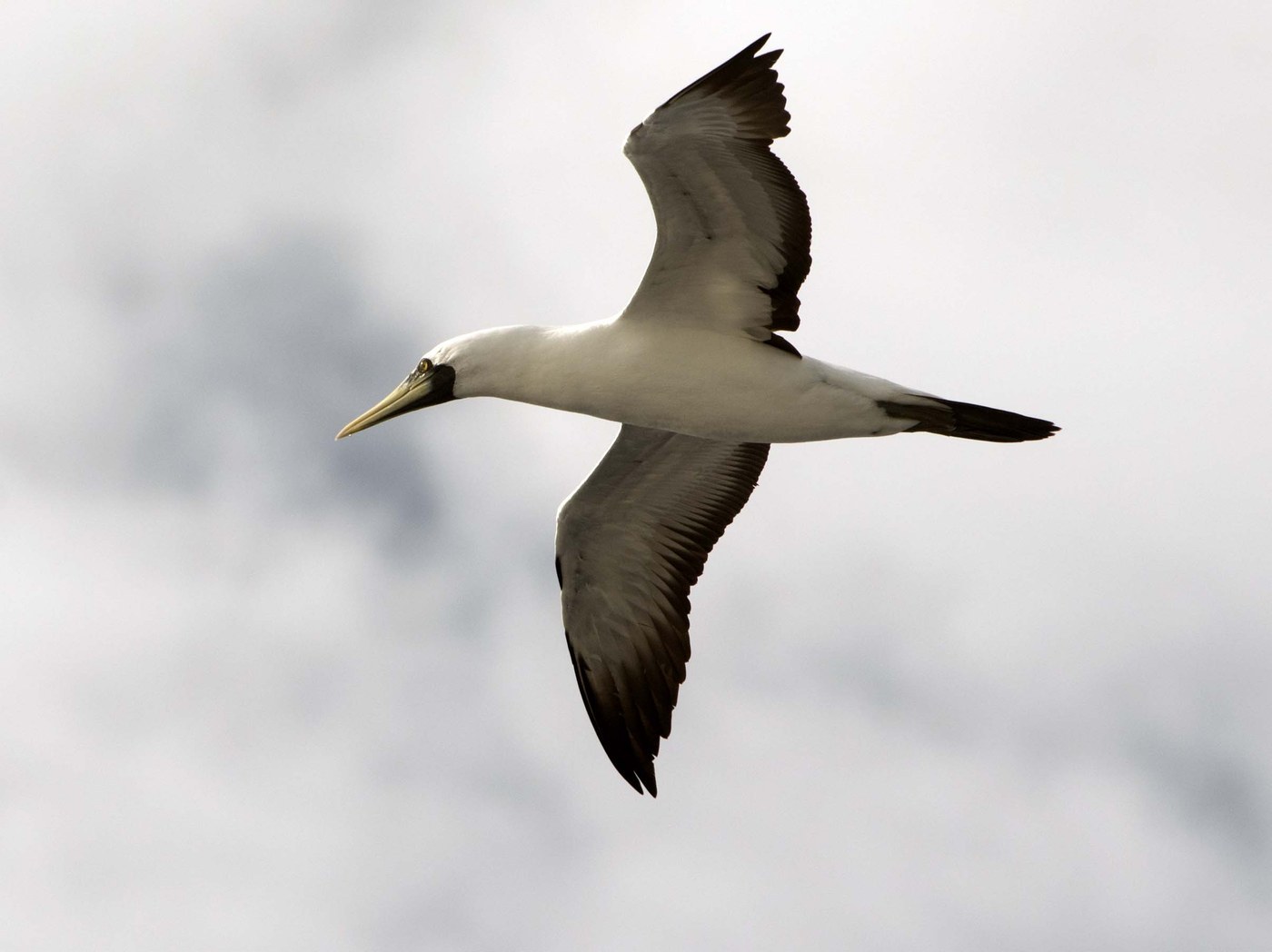
Key Field Marks
- Size & shape: The largest of the boobies, 75-85 cm, with a heavy, pointed bill and long, pointed wings suited to plunge-diving.
- Adult plumage: Brilliant white body with black flight feathers (both primaries and secondaries) and a black tail, giving a bold white-bodied, black-winged look in flight.
- Face & bill: A black bare-skin 'mask' surrounds the base of the bill and eyes; the bill itself is bright yellow in males and a slightly duller yellow-green in females. Legs and feet are pale grey, unlike the colorful feet of Blue-footed or Red-footed Booby.
- Juvenile: Brown head and neck with a white collar around the hindneck, brownish upperparts, and white underparts — the white collar is a key mark separating it from juvenile Brown Booby.
Separating It From Similar Species
- Nazca Booby, found mainly in the eastern tropical Pacific (e.g., Galápagos), is very similar but has an orange or pink bill rather than yellow, and averages slightly smaller.
- Brown Booby is smaller with sharply demarcated brown upperparts and breast against a white belly, and yellow (not grey) legs and feet — quite different from the white-bodied, black-winged Masked Booby.
- Northern Gannet, found in cooler Atlantic waters, is similar in overall pattern but larger, with a golden-buff wash on the head and black restricted mainly to the wingtips rather than the entire trailing edge of the wing.
Where & When to See One
- Habitat: Open tropical and subtropical ocean; nests colonially on remote islands, cliffs, and coral atolls, often alongside other seabirds.
- Range: Pantropical, found across the Atlantic, Pacific, and Indian Oceans, including sites such as the Dry Tortugas (Florida), Caribbean islands, and remote Pacific island groups.
- Season: Present at breeding colonies year-round in many locations, with breeding timing varying by colony; birds disperse widely over open ocean outside the breeding season.
Voice
- Largely silent at sea; at breeding colonies, males give thin, reedy whistles while females give harsher, honking or quacking calls during courtship and nest defense.
Frequently asked questions
How do you tell Masked Booby from Nazca Booby?
The key difference is bill color: Masked Booby has a bright yellow bill, while Nazca Booby (found mainly in the eastern tropical Pacific) has an orange or pink bill; Nazca is also slightly smaller on average.
What makes the Masked Booby different from Brown Booby?
Masked Booby is larger with a clean white body and black flight feathers, plus pale grey legs, while Brown Booby has sharply demarcated brown upperparts and breast against a white belly, along with yellow legs and feet.
How can you identify a juvenile Masked Booby?
Juveniles have a brown head and neck with a distinctive white collar around the hindneck, brown upperparts, and white underparts — the white collar helps separate it from juvenile Brown Booby, which lacks this feature.
Where does the Masked Booby nest?
It nests colonially on remote tropical and subtropical islands, cliffs, and coral atolls across the Atlantic, Pacific, and Indian Oceans.