
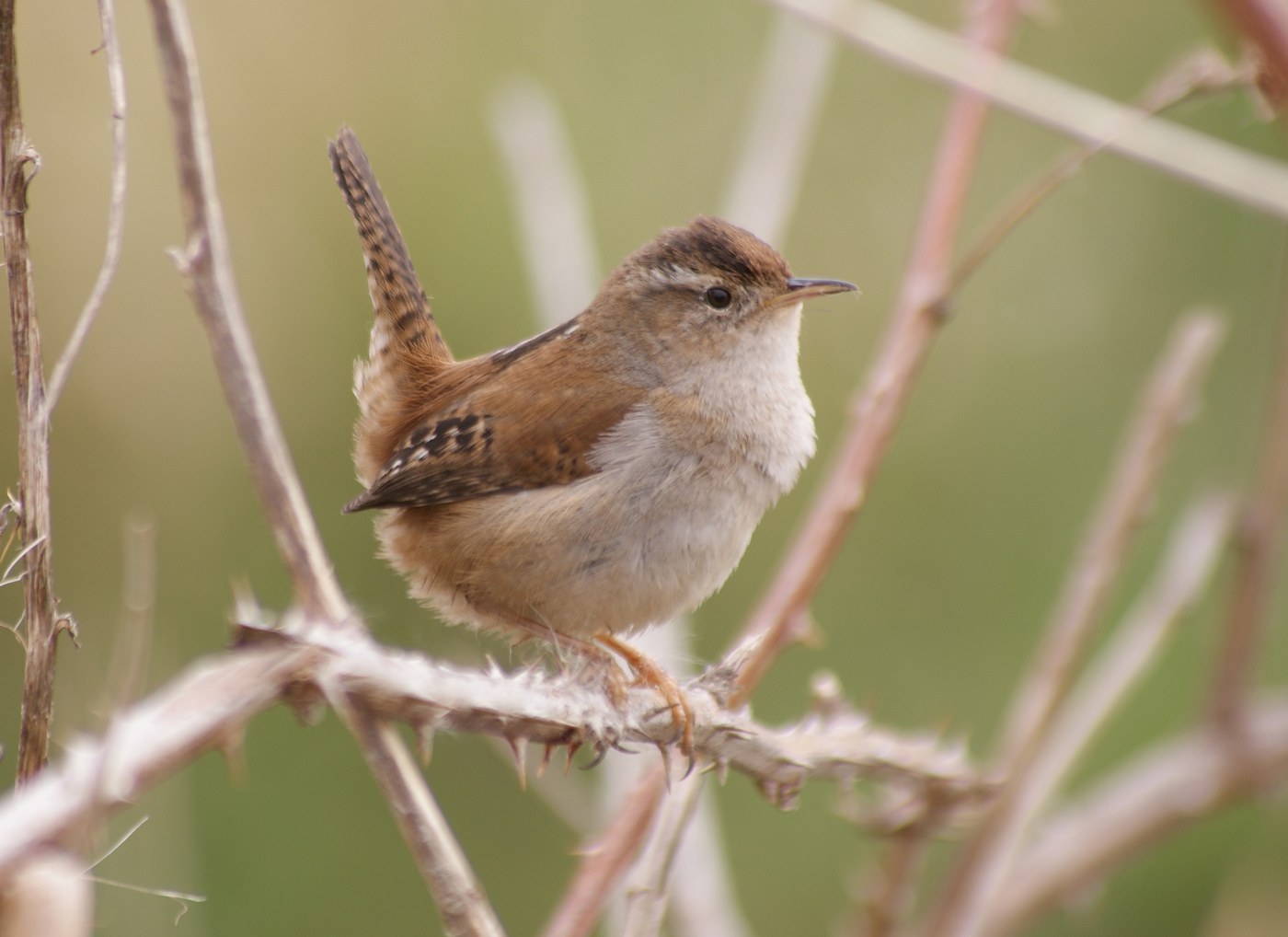
Marsh Wren
Cistothorus palustris
A small, energetic wren of cattail marshes, known for its loud, gurgling song and the male's habit of building multiple decoy nests.
- Size
- 11-14 cm (4.3-5.5 in) long, 15-17 cm wingspan
- Habitat
- freshwater and brackish marshes with cattails, bulrushes, and reeds across North America
- Type
- songbird
Spotted a bird like this?
Identify any bird from a photo, free.
Overview
The Marsh Wren is a small, feisty wren tightly bound to wetland vegetation, showing a streaked brown-and-black back, plain warm-brown crown, bold white eyebrow stripe, and pale underparts. Its short, often cocked tail and constant activity make it a lively presence within its reedy habitat, though its skulking behavior means it is often heard well before it is seen.
A distinctive aspect of Marsh Wren biology is the male's habit of building numerous globe-shaped "dummy" nests within his territory — often five or more — in addition to the one nest the female ultimately selects and finishes lining for egg-laying, a behavior thought to help defend territory and possibly confuse predators.
How to identify it
Key Field Marks
- Streaked black-and-white patch on the upper back — a key diagnostic mark
- Bold white eyebrow stripe
- Plain, unstreaked brown crown
- Short tail, often cocked upward
- Skulking behavior within dense marsh vegetation
Similar Species
- Sedge Wren: smaller, with a finely streaked (not plain) crown and a less bold eyebrow, and prefers drier sedge meadows rather than deep cattail marsh.
- House Wren: lacks the bold white eyebrow and back streaking, and occupies drier upland habitat.
- Bewick's Wren: longer-tailed with white tail spots, found in brushy uplands rather than marsh.
Habitat & range
Habitat
Marsh Wrens are closely tied to freshwater and brackish marshes with dense stands of cattails, bulrushes, or reeds, and are rarely found far from such wetland vegetation.
Range
The species breeds across much of North America, from southern Canada through the northern and western United States, with additional populations along both coasts and wintering birds found across the southern United States and Mexico.
Migration
Northern and interior populations are migratory, wintering in the southern United States and Mexico, while some coastal and southern populations are largely resident year-round.
Behavior & voice
Behavior
Marsh Wrens are active and pugnacious, aggressively defending nesting territory and sometimes destroying the eggs of neighboring wrens or other marsh-nesting birds; they tend to stay low and hidden within dense marsh vegetation.
Voice
The song is a loud, gurgling, mechanical-sounding series of trills and rattles, often given persistently, including at night; males may know dozens of distinct song types.
Feeding
Diet consists almost entirely of insects and spiders gleaned from marsh vegetation, sometimes including aquatic insects near the water's surface.
Nesting
Males build multiple globe-shaped nests woven from marsh vegetation and attached to reeds or cattails above water, of which the female selects one to line and use for egg-laying; the surplus "dummy" nests may help deter predators or rival males. Clutches typically number 3-10 eggs.
Frequently asked questions
Why do male Marsh Wrens build multiple nests?
Males construct several unlined 'dummy' nests within their territory, likely to help attract a mate, defend territory, and possibly confuse predators, while the female chooses and finishes one nest for actual egg-laying.
How do I tell a Marsh Wren from a Sedge Wren?
Marsh Wren has an unstreaked brown crown and inhabits deeper cattail and bulrush marsh, while Sedge Wren has a finely streaked crown and prefers drier sedge meadows and wet grassy fields.
Where does the Marsh Wren live?
In freshwater and brackish marshes with dense cattails, bulrushes, or reeds across much of North America.
Is the Marsh Wren aggressive toward other birds?
Yes, it can be quite territorial and has been documented destroying the eggs of neighboring wrens and other marsh-nesting birds.
Does the Marsh Wren sing at night?
Yes, its loud, gurgling song is sometimes given after dark as well as throughout the day, especially during the breeding season.
Marsh Wren guides
In-depth guides for identifying, finding, and understanding Marsh Wren.
Other birds you may enjoy

Black Redstart
13-14.5 cm (5.1-5.7 in) long, 23-26 cm wingspan

Black-throated Sparrow
12-14 cm (4.7-5.5 in) long, about 19-20 cm (7.5-8 in) wingspan

Greater Bird-of-paradise
Body about 43 cm; males with additional flank plumes up to 50 cm and long tail wires

Blue Tit
11-12 cm (4.3-4.7 in) long, 17-20 cm wingspan

Red-billed Quelea
11.5–13 cm long, wingspan about 20–22 cm
White-plumed Antbird
13-14 cm (5-5.5 in) long

Pyrrhuloxia
19-22 cm (7.5-8.7 in) long, 30 cm wingspan

Blue-gray Tanager
16-18 cm (6-7 in) long

Blackburnian Warbler
11-13 cm (4.3-5.1 in) long, 20-22 cm wingspan

Bluethroat
13-14 cm (5.1-5.5 in) long, 20-22 cm wingspan

Eurasian Nuthatch
12-14.5 cm (4.7-5.7 in) long, 22.5-27 cm wingspan

Wood Thrush
19-21 cm (7.5-8.3 in) long, about 33 cm (13 in) wingspan