
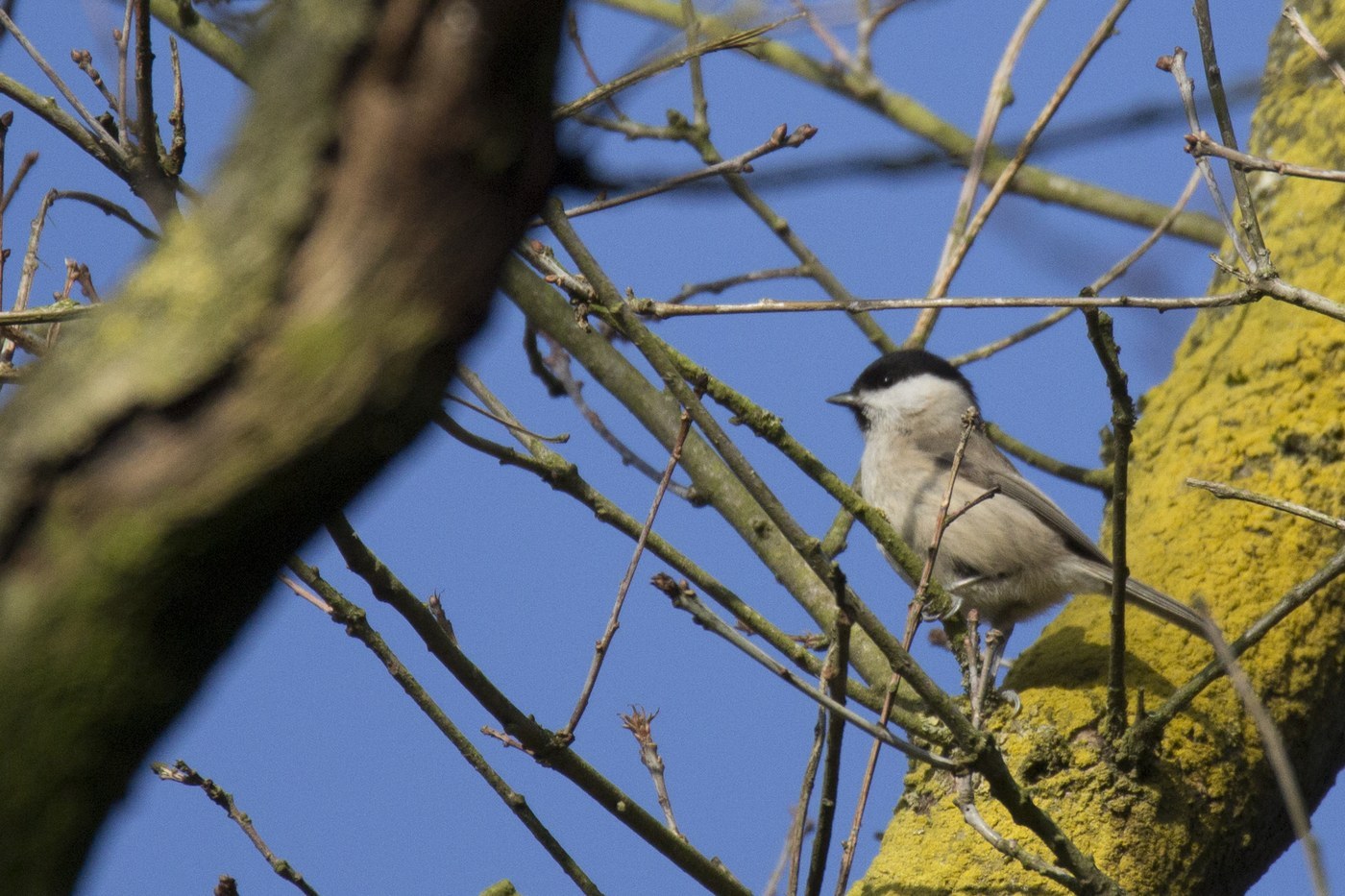
Marsh Tit
Poecile palustris
A small, plain brown-gray tit with a glossy black cap and neat black bib, closely resembling the Willow Tit but favoring drier, more mature woodland.
- Size
- 11.5-12.5 cm (4.5-5 in) long, 18-19.5 cm wingspan
- Habitat
- deciduous woodlands, hedgerows, and parks
- Type
- songbird
Spotted a bird like this?
Identify any bird from a photo, free.
Overview
The Marsh Tit is a small, understated tit with a glossy black cap, a neat small black bib under the bill, pale buff-brown underparts, and plain gray-brown upperparts lacking any bold wing panel. Despite its name, it is not particularly associated with marshes, instead favoring mature deciduous woodland with a dense shrub layer.
It is notoriously difficult to distinguish from the closely related Willow Tit, and the two species were only recognized as distinct in the early 20th century; voice is usually the most reliable way to separate them in the field.
How to identify it
Key field marks
- Glossy, shiny black cap
- Small, neat black bib
- Plain gray-brown upperparts with no pale wing panel
- Buff-brown underparts
Similar species
- Willow Tit looks nearly identical but has a duller, matte black cap, a slightly larger bib, and often a pale panel on the closed wing; voice is the most reliable distinguishing feature.
- Coal Tit has a white nape patch, absent in the Marsh Tit.
Habitat & range
Habitat
Favors mature deciduous woodland with a well-developed shrub layer, as well as parks and large gardens with mature trees; despite the name, not tied to wetlands.
Range
Widespread across much of Europe and temperate Asia, generally absent from the far north and Ireland.
Migration
Sedentary and highly site-faithful, rarely moving far from its territory year-round.
Behavior & voice
Behavior
Forages actively through branches and shrubs, often in pairs that hold permanent territories year-round; caches food less extensively than some other tits.
Voice
A distinctive, explosive "pitchoo" call is the most reliable way to separate it from the Willow Tit; song is a repeated, ringing "schip-schip-schip."
Feeding
Eats insects and spiders in the breeding season, switching to seeds in autumn and winter; visits feeders for sunflower seeds.
Nesting
Nests in an existing tree cavity, unlike the Willow Tit, which excavates its own; lays 6-9 white eggs with fine red-brown speckling.
Frequently asked questions
How do you tell a Marsh Tit from a Willow Tit?
The Marsh Tit has a glossy black cap and a smaller bib, while the Willow Tit has a duller matte cap and often a pale wing panel; their calls are the most reliable difference, with the Marsh Tit giving an explosive "pitchoo."
Does the Marsh Tit live in marshes?
Despite its name, it actually favors mature deciduous woodland with dense shrub cover rather than wetlands.
Does the Marsh Tit excavate its own nest hole?
No, unlike the Willow Tit, the Marsh Tit uses existing tree cavities rather than excavating its own nest hole in rotten wood.
Are Marsh Tits migratory?
No, they are highly sedentary, with pairs typically remaining on the same territory year-round.
Marsh Tit guides
In-depth guides for identifying, finding, and understanding Marsh Tit.
Other birds you may enjoy

Black Redstart
13-14.5 cm (5.1-5.7 in) long, 23-26 cm wingspan

Black-throated Sparrow
12-14 cm (4.7-5.5 in) long, about 19-20 cm (7.5-8 in) wingspan

Greater Bird-of-paradise
Body about 43 cm; males with additional flank plumes up to 50 cm and long tail wires

Blue Tit
11-12 cm (4.3-4.7 in) long, 17-20 cm wingspan

Red-billed Quelea
11.5–13 cm long, wingspan about 20–22 cm
White-plumed Antbird
13-14 cm (5-5.5 in) long

Pyrrhuloxia
19-22 cm (7.5-8.7 in) long, 30 cm wingspan

Blue-gray Tanager
16-18 cm (6-7 in) long

Blackburnian Warbler
11-13 cm (4.3-5.1 in) long, 20-22 cm wingspan

Bluethroat
13-14 cm (5.1-5.5 in) long, 20-22 cm wingspan

Eurasian Nuthatch
12-14.5 cm (4.7-5.7 in) long, 22.5-27 cm wingspan

Wood Thrush
19-21 cm (7.5-8.3 in) long, about 33 cm (13 in) wingspan