
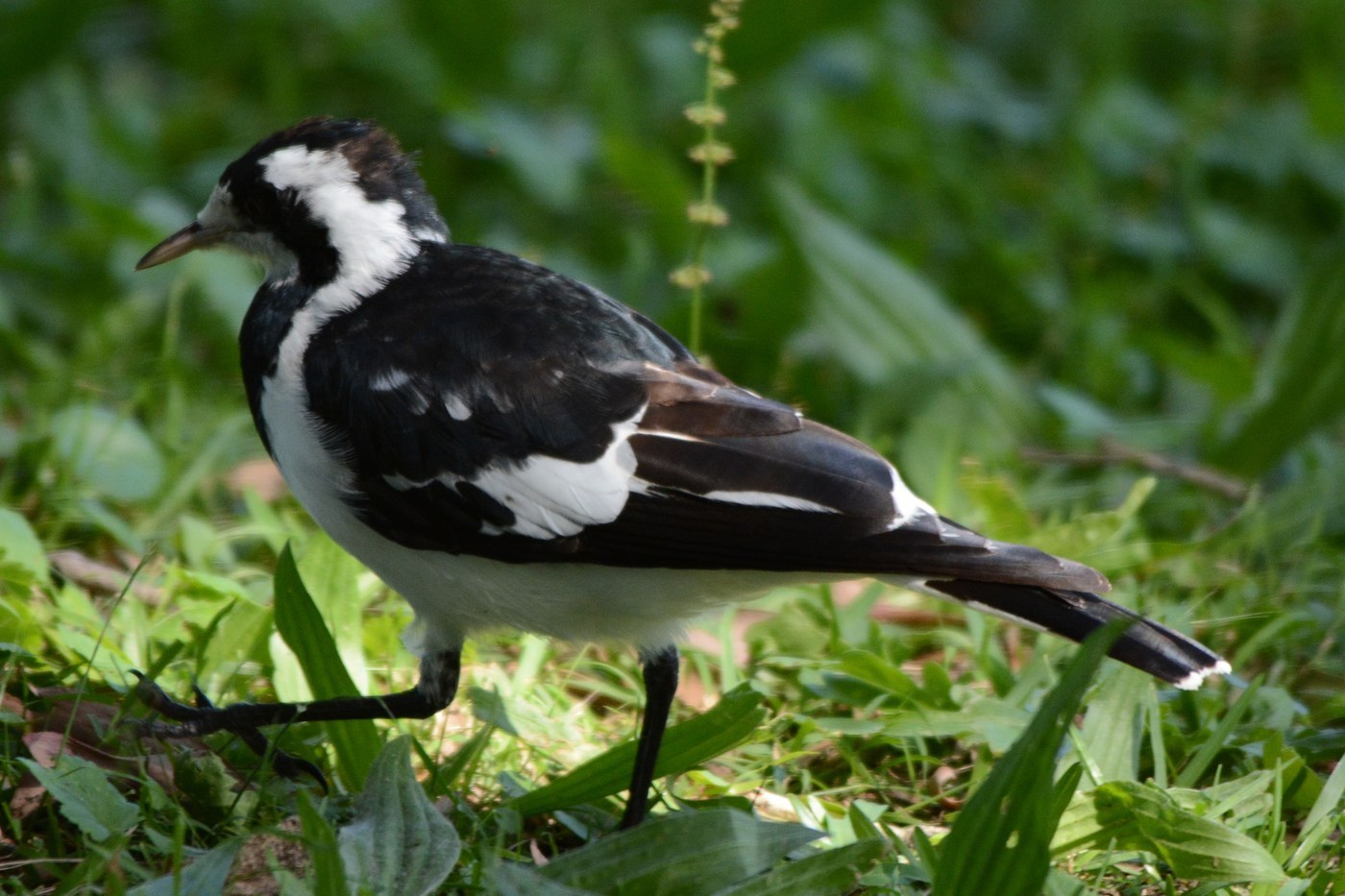
Magpie-lark
Grallina cyanoleuca
A common black-and-white Australian bird, smaller than a magpie, known for its distinctive 'pee-wee' call and mud-bowl nest.
- Size
- 26-30 cm (10-12 in) long
- Habitat
- open country, farmland, wetland edges, and parks across most of Australia
- Type
- songbird
Spotted a bird like this?
Identify any bird from a photo, free.
Overview
The Magpie-lark is a familiar black-and-white bird of open country across Australia, roughly the size of a large thrush and considerably smaller and slimmer-billed than the Australian Magpie despite the superficial similarity in coloring. Males and females differ in facial pattern: males show a white eyebrow stripe and black throat, while females have a white throat and black extending through the area around the eye, lacking the white eyebrow.
Despite the name, the Magpie-lark is neither a true magpie nor a lark; it belongs to its own small family of mud-nest builders and is one of Australia's most widely recognized birds, familiar from its far-carrying call and habit of building a solid mud bowl nest.
How to identify it
Key field marks
- Black-and-white plumage, smaller and slimmer-billed than the Australian Magpie
- Male: white eyebrow stripe, black throat
- Female: white throat, black through the eye area, no white eyebrow
- Often seen walking on open ground with a jerky, striding gait
Similar species
- Australian Magpie: much larger, straighter and heavier bill, different plumage pattern with a black-and-white body.
- Pied Butcherbird: solid black hood rather than the more patterned face of the Magpie-lark, and a heavy hooked bill.
- Willie Wagtail: smaller, with a constantly wagging tail and a plain black-and-white pattern without the Magpie-lark's differing male/female facial markings.
Habitat & range
Habitat
Magpie-larks favor open country, farmland, wetland edges, playing fields, and parks, generally avoiding dense forest and true desert, and are often found near water where mud is available for nest building.
Range
The species is found across almost all of mainland Australia, largely absent only from the driest deserts, and also occurs in southern New Guinea.
Migration
Mostly sedentary, with resident pairs defending territories, though non-breeding birds can form loose flocks and move locally.
Behavior & voice
Behavior
Magpie-larks are usually seen in pairs or small groups, foraging on open ground with a distinctive striding walk, and are known for a duetting call performed by paired birds, often accompanied by a synchronized wing-raising display.
Voice
The call is a loud, ringing "pee-wee" or "tee-hee," often given as a duet between the male and female with matched wing movements, and is one of the most familiar bird sounds across Australia.
Feeding
Diet consists of insects and other invertebrates, including aquatic prey such as small crustaceans and snails, foraged from open ground, mudflats, and shallow water.
Nesting and breeding
Magpie-larks build a distinctive solid bowl nest made of mud reinforced with grass and hair, placed on a horizontal branch, often over or near water. Clutches typically contain three to five pale, spotted eggs, incubated by both parents, who also share chick-rearing duties.
Frequently asked questions
Is a Magpie-lark related to the Australian Magpie?
No, despite the name and similar black-and-white coloring, the Magpie-lark belongs to a separate family and is not closely related to the true Australian Magpie.
Why is the Magpie-lark called a Peewee?
It gets this nickname from its loud, ringing 'pee-wee' call, often given as a duet between paired birds.
How can you tell male and female Magpie-larks apart?
Males have a white eyebrow stripe and black throat, while females have a white throat and lack the white eyebrow, with black extending around the eye instead.
What kind of nest does a Magpie-lark build?
It builds a solid, bowl-shaped nest made of mud reinforced with grass and hair, usually placed on a horizontal branch near water.
What do Magpie-larks eat?
Mainly insects and other invertebrates, including aquatic prey like small crustaceans and snails, foraged from open ground and shallow water.
Magpie-lark guides
In-depth guides for identifying, finding, and understanding Magpie-lark.
Other birds you may enjoy

Black Redstart
13-14.5 cm (5.1-5.7 in) long, 23-26 cm wingspan

Black-throated Sparrow
12-14 cm (4.7-5.5 in) long, about 19-20 cm (7.5-8 in) wingspan

Greater Bird-of-paradise
Body about 43 cm; males with additional flank plumes up to 50 cm and long tail wires

Blue Tit
11-12 cm (4.3-4.7 in) long, 17-20 cm wingspan

Red-billed Quelea
11.5–13 cm long, wingspan about 20–22 cm
White-plumed Antbird
13-14 cm (5-5.5 in) long

Pyrrhuloxia
19-22 cm (7.5-8.7 in) long, 30 cm wingspan

Blue-gray Tanager
16-18 cm (6-7 in) long

Blackburnian Warbler
11-13 cm (4.3-5.1 in) long, 20-22 cm wingspan

Bluethroat
13-14 cm (5.1-5.5 in) long, 20-22 cm wingspan

Eurasian Nuthatch
12-14.5 cm (4.7-5.7 in) long, 22.5-27 cm wingspan

Wood Thrush
19-21 cm (7.5-8.3 in) long, about 33 cm (13 in) wingspan