
Magpie-lark Identification Guide
A common, bold black-and-white Australian bird, often called peewee or mudlark, known for its loud duetting calls and mud-bowl nests.
Read the full Magpie-lark encyclopedia entry →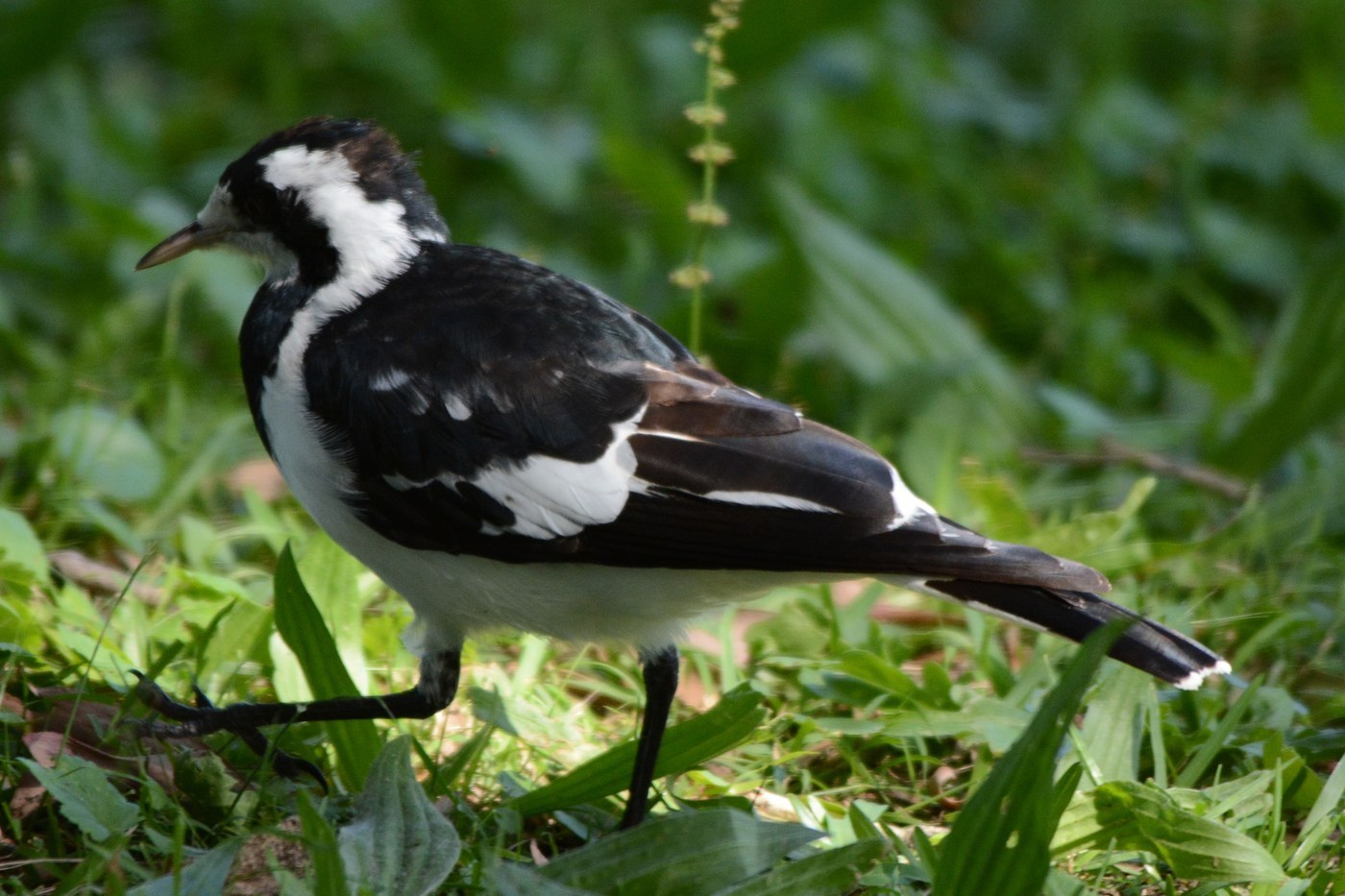
Key Field Marks
- Size & shape: A medium-sized, long-legged songbird (around 27 cm) with an upright posture, long tail, and a distinctive walking gait on the ground.
- Plumage: Bold black-and-white pattern overall; males have a black throat and face with a white eyebrow-like stripe, while females have an all-white throat and face.
- In flight: Shows large white wing patches and white outer tail feathers, flashing conspicuously against the black body.
- Bill: Fairly long, straight, pale grayish-white bill.
Behavior
Highly conspicuous and confiding, often seen walking or running on lawns, playing fields, and bare ground in pairs, probing and picking for invertebrates. Builds a distinctive bowl-shaped nest made of mud and grass, plastered onto a horizontal tree branch, fence, or even artificial structures, and reused or rebuilt in the same spot across seasons. Pairs frequently perform loud antiphonal duets, throwing their heads back in a coordinated display.
Separating It From Similar Species
- Australian Magpie: Larger, with a heavier bill, black-and-white pattern arranged very differently (white nape/back rather than the Magpie-lark's pied wing/tail pattern), and a much more melodious, warbling song rather than the sharp duet calls.
- Pied Butcherbird: Larger and bulkier with a hooked, powerful bill for a predatory lifestyle, and a rich, flute-like song, unlike the Magpie-lark's sharp "pee-o-wee" calls.
- Willie Wagtail: Much smaller, all black above and white below with a fanned tail constantly wagged side to side, lacking the Magpie-lark's bold pied wing pattern and larger size.
Where & When to See It
Found throughout mainland Australia (absent from Tasmania as a natural resident, though occasional vagrants occur) and parts of southern New Guinea, in virtually any open habitat including woodlands, farmland, parks, and suburban gardens, almost always near some water or damp ground for nest-building mud. A common, non-migratory resident seen year-round, often in pairs that maintain territories.
Voice
Named for its calls, it gives a loud, ringing "pee-o-wee" or "tee-hee" duet, with paired birds calling in near-perfect unison while flicking their wings, a familiar sound across Australian towns and countryside.
Frequently asked questions
Is the Magpie-lark related to the Australian Magpie?
No, despite the similar name and black-and-white pattern, Magpie-lark belongs to a different family (mudlarks, monarch flycatcher relatives) and is not closely related to the Australian Magpie.
How can you tell male and female Magpie-larks apart?
Males have a black throat and face with a white eyebrow stripe, while females have an entirely white throat and face.
Why is the Magpie-lark also called 'mudlark'?
Because it builds a distinctive bowl-shaped nest out of mud and grass, plastered onto a horizontal branch or similar support.
What does a Magpie-lark's call sound like?
A loud, ringing 'pee-o-wee' or 'tee-hee' often given as a duet by paired birds calling in near-unison, sometimes with synchronized wing-flicking.
Where in Australia can you find Magpie-larks?
Across most of mainland Australia in open country, farmland, parks, and suburban areas near water or damp ground, typically in resident pairs year-round.