
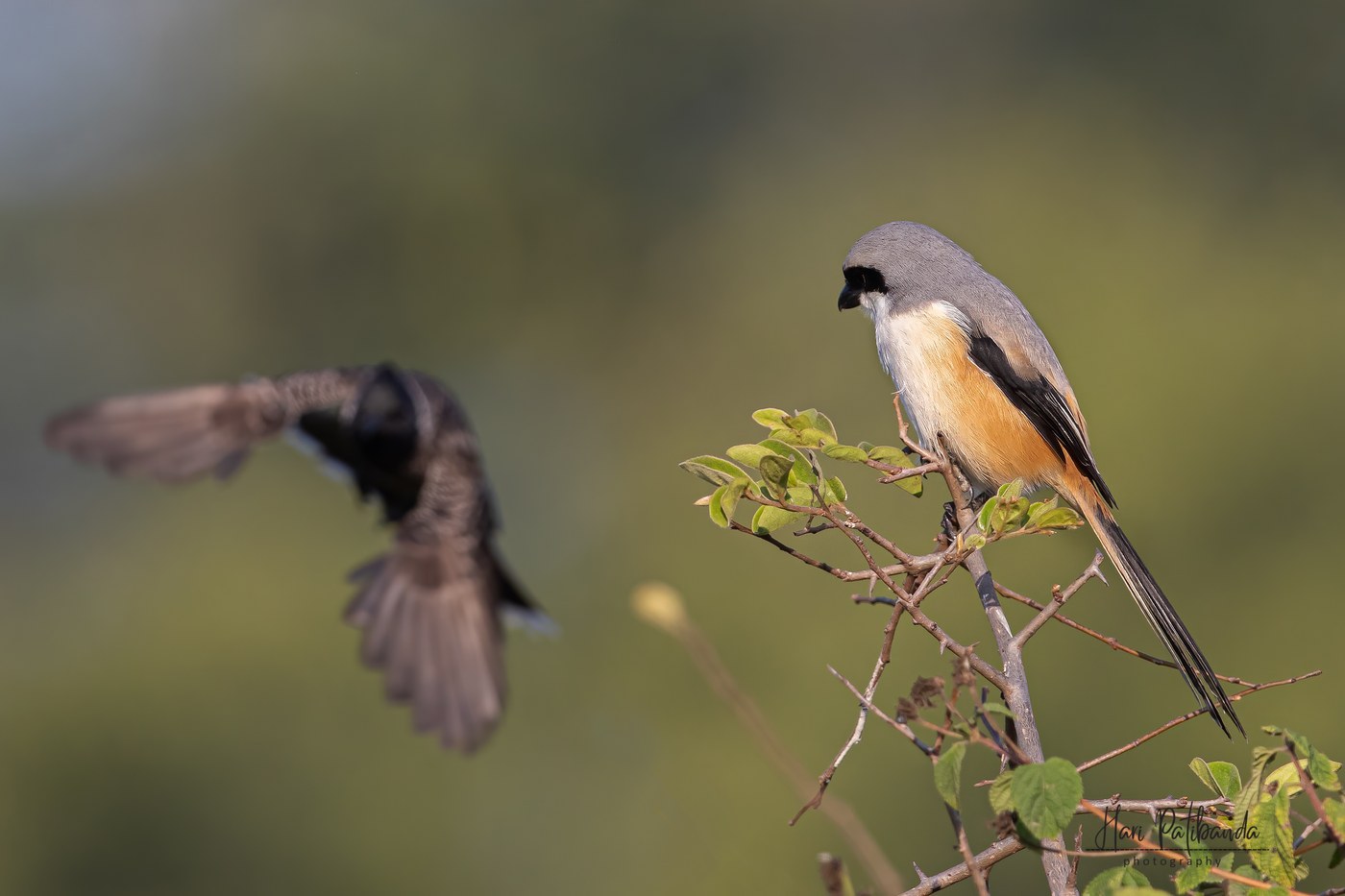
Long-tailed Shrike
Lanius schach
A grey, black, and rufous predatory songbird with a black mask, long tail, and a habit of impaling prey on thorns.
- Size
- 25 cm (10 in) long including long graduated tail
- Habitat
- open scrub, farmland, grassland, and open country with scattered bushes across South and Southeast Asia
- Type
- songbird
Spotted a bird like this?
Identify any bird from a photo, free.
Overview
The Long-tailed Shrike is a striking, predatory songbird combining a pale grey head and mantle, a bold black mask through the eye, rufous-chestnut lower back, rump, and flanks, and a long, graduated black tail. Despite being a passerine, shrikes behave much like miniature raptors, perching prominently and pouncing on prey, which they sometimes impale on thorns or barbed wire — a habit that has earned shrikes the nickname "butcherbird" in some regions.
Several subspecies vary somewhat in the extent of black on the head and the shade of rufous on the body, but the combination of grey head, black mask, rufous flanks, and long tail is consistent across the species' wide range.
How to identify it
Key field marks
- Grey crown and mantle, black mask through the eye
- Chestnut-rufous rump, flanks, and lower back
- Long, narrow, graduated black tail
- Stout, hook-tipped bill typical of shrikes
- Often perches prominently on wires, fences, or bush tops, scanning for prey
Similar species
The Brown Shrike lacks the grey head and rufous rump, being uniformly rufous-brown above without the strong grey/rufous contrast. Other shrike species in the region differ in the extent and pattern of black, grey, and rufous, but the Long-tailed Shrike's combination of features and notably long tail are distinctive.
Habitat & range
Long-tailed Shrikes range widely from Central and South Asia through China and Southeast Asia. They favor open habitats with scattered bushes or small trees for hunting perches: scrub, farmland, grassland, and cultivated land, generally avoiding dense forest.
Most populations are resident, though some northern populations show partial migratory movement south in winter.
Behavior & voice
Voice
A harsh, scratchy series of notes mixed with occasional mimicry of other birds; calls include grating alarm notes given from an exposed perch.
Feeding
Long-tailed Shrikes hunt from a prominent perch, dropping onto large insects, small reptiles, rodents, and occasionally small birds, and are known for impaling surplus prey on thorns or barbed wire, both to store food and to help tear apart prey too large to swallow whole.
Nesting and breeding
The nest is a bulky cup of twigs and grass built in a thorny bush or small tree. Both parents help feed the chicks, and pairs vigorously defend their hunting territory against intruders.
Frequently asked questions
Why does the Long-tailed Shrike impale prey on thorns?
This behavior helps it store surplus food for later and gives it a way to anchor prey while tearing it apart, since shrikes lack the strong grasping feet of true raptors.
How do you identify a Long-tailed Shrike?
Look for a grey head with a black mask, chestnut-rufous flanks and rump, and a long, narrow, graduated black tail, often seen perched on a wire or bush top.
How is the Long-tailed Shrike different from the Brown Shrike?
The Long-tailed Shrike has a contrasting grey head and rufous rump/flanks, while the Brown Shrike is more uniformly rufous-brown above without that grey-and-chestnut contrast.
What does a Long-tailed Shrike eat?
Large insects, small reptiles, rodents, and occasionally small birds, caught by pouncing from a perch.
Long-tailed Shrike guides
In-depth guides for identifying, finding, and understanding Long-tailed Shrike.
Other birds you may enjoy

Black Redstart
13-14.5 cm (5.1-5.7 in) long, 23-26 cm wingspan

Black-throated Sparrow
12-14 cm (4.7-5.5 in) long, about 19-20 cm (7.5-8 in) wingspan

Greater Bird-of-paradise
Body about 43 cm; males with additional flank plumes up to 50 cm and long tail wires

Blue Tit
11-12 cm (4.3-4.7 in) long, 17-20 cm wingspan

Red-billed Quelea
11.5–13 cm long, wingspan about 20–22 cm
White-plumed Antbird
13-14 cm (5-5.5 in) long

Pyrrhuloxia
19-22 cm (7.5-8.7 in) long, 30 cm wingspan

Blue-gray Tanager
16-18 cm (6-7 in) long

Blackburnian Warbler
11-13 cm (4.3-5.1 in) long, 20-22 cm wingspan

Bluethroat
13-14 cm (5.1-5.5 in) long, 20-22 cm wingspan

Eurasian Nuthatch
12-14.5 cm (4.7-5.7 in) long, 22.5-27 cm wingspan

Wood Thrush
19-21 cm (7.5-8.3 in) long, about 33 cm (13 in) wingspan