
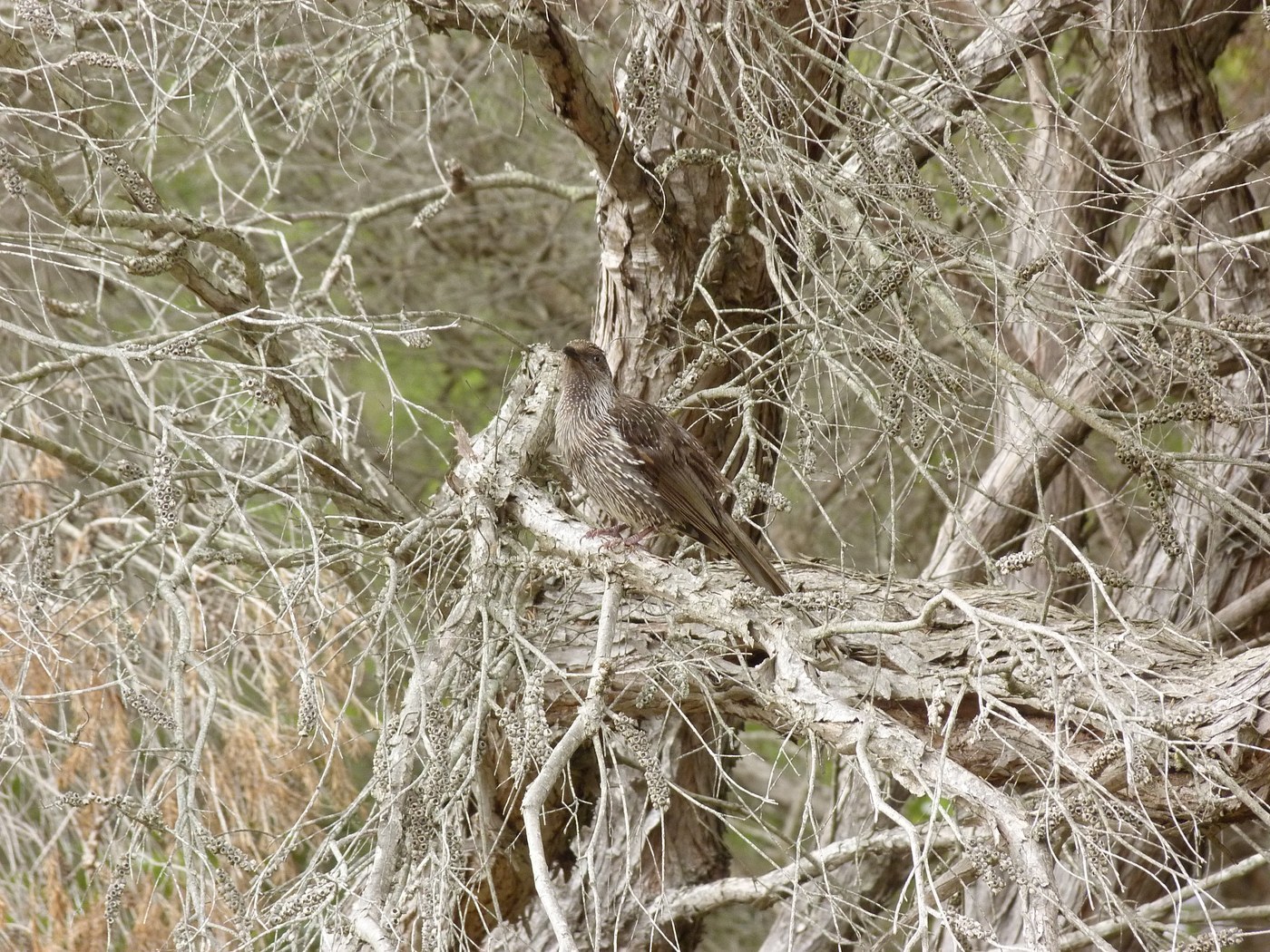
Little Wattlebird
Anthochaera chrysoptera
A streaky brown-grey honeyeater with a rufous wing patch, one of Australia's larger honeyeaters, despite lacking the fleshy face wattles of its close relatives.
- Size
- 26-31 cm (10-12 in) long
- Habitat
- heathland, banksia scrub, and woodland in southern and eastern Australia
- Type
- songbird
Spotted a bird like this?
Identify any bird from a photo, free.
Overview
The Little Wattlebird is a large, streaky brown-grey honeyeater closely related to the Red and Yellow Wattlebirds, but distinguished by the absence of the fleshy facial wattles that give those species their name, hence its alternative name, Brush Wattlebird, in some regions. The body is heavily streaked grey-brown, with a rufous-chestnut patch visible in the wing, a small reddish eye, and a slender, slightly downcurved bill suited to probing flowers for nectar.
Despite lacking wattles, the species is unmistakably built along wattlebird lines: relatively large for a honeyeater, noisy, and often highly conspicuous as it moves between flowering shrubs and trees.
How to identify it
Key field marks
- Heavily streaked grey-brown body plumage
- Rufous-chestnut patch in the wing, visible in flight and at rest
- Small reddish eye
- Slender, slightly downcurved bill
- No fleshy facial wattles (unlike Red and Yellow Wattlebirds)
Similar species
- Red Wattlebird: larger, with obvious pink-red fleshy wattles hanging from the face and a yellow belly patch.
- Yellow Wattlebird: even larger, with prominent wattles and found mainly in Tasmania.
- Overall streaky brown pattern and rufous wing patch, combined with the lack of wattles, are the best clues for this species.
Habitat & range
Habitat
Little Wattlebirds favor heathland, banksia and other proteaceous shrubland, coastal scrub, and open woodland with a shrubby understory rich in nectar-producing plants.
Range
The species occurs across southern and eastern Australia, including southwestern Western Australia and a broader range from South Australia through Victoria, Tasmania, and up the New South Wales coast into southern Queensland.
Migration
Mostly sedentary, though some local and seasonal movement occurs in response to flowering patterns of key nectar sources such as banksias.
Behavior & voice
Behavior
Little Wattlebirds are active, often aggressive honeyeaters, frequently seen chasing other birds away from favored flowering shrubs, and moving conspicuously between banksias, grevilleas, and other nectar-rich plants.
Voice
Calls are loud, harsh, and varied, including coughing, gurgling, and chattering notes, quite different from the more melodic songs of many smaller honeyeaters.
Feeding
Diet is centered on nectar from banksias, eucalypts, and other native flowering plants, supplemented by insects caught in flight or gleaned from foliage, and some fruit.
Nesting and breeding
Nests are untidy cups of twigs and bark built in dense shrubs. Clutches typically contain two to three pale, spotted eggs, incubated mainly by the female, with both parents helping feed the chicks once hatched.
Frequently asked questions
Why doesn't the Little Wattlebird have wattles?
Despite being closely related to the Red and Yellow Wattlebirds, the Little Wattlebird lacks the fleshy facial wattles those species are named for, which is why it is also sometimes called the Brush Wattlebird.
How do you identify a Little Wattlebird?
Look for heavily streaked grey-brown plumage, a rufous-chestnut wing patch, a small reddish eye, and a slender downcurved bill, without any fleshy wattles on the face.
What does a Little Wattlebird eat?
Mainly nectar from banksias, eucalypts, and other native flowering plants, along with insects and some fruit.
Where do Little Wattlebirds live?
They are found in heathland, banksia scrub, and woodland across southern and eastern Australia, including southwestern Western Australia.
Little Wattlebird guides
In-depth guides for identifying, finding, and understanding Little Wattlebird.
Other birds you may enjoy

Black Redstart
13-14.5 cm (5.1-5.7 in) long, 23-26 cm wingspan

Black-throated Sparrow
12-14 cm (4.7-5.5 in) long, about 19-20 cm (7.5-8 in) wingspan

Greater Bird-of-paradise
Body about 43 cm; males with additional flank plumes up to 50 cm and long tail wires

Blue Tit
11-12 cm (4.3-4.7 in) long, 17-20 cm wingspan

Red-billed Quelea
11.5–13 cm long, wingspan about 20–22 cm
White-plumed Antbird
13-14 cm (5-5.5 in) long

Pyrrhuloxia
19-22 cm (7.5-8.7 in) long, 30 cm wingspan

Blue-gray Tanager
16-18 cm (6-7 in) long

Blackburnian Warbler
11-13 cm (4.3-5.1 in) long, 20-22 cm wingspan

Bluethroat
13-14 cm (5.1-5.5 in) long, 20-22 cm wingspan

Eurasian Nuthatch
12-14.5 cm (4.7-5.7 in) long, 22.5-27 cm wingspan

Wood Thrush
19-21 cm (7.5-8.3 in) long, about 33 cm (13 in) wingspan