
Little Wattlebird Identification Guide
A large, streaky Australian honeyeater with a rufous wing patch and only a tiny pink wattle, distinguishing it from its larger red-wattled relative.
Read the full Little Wattlebird encyclopedia entry →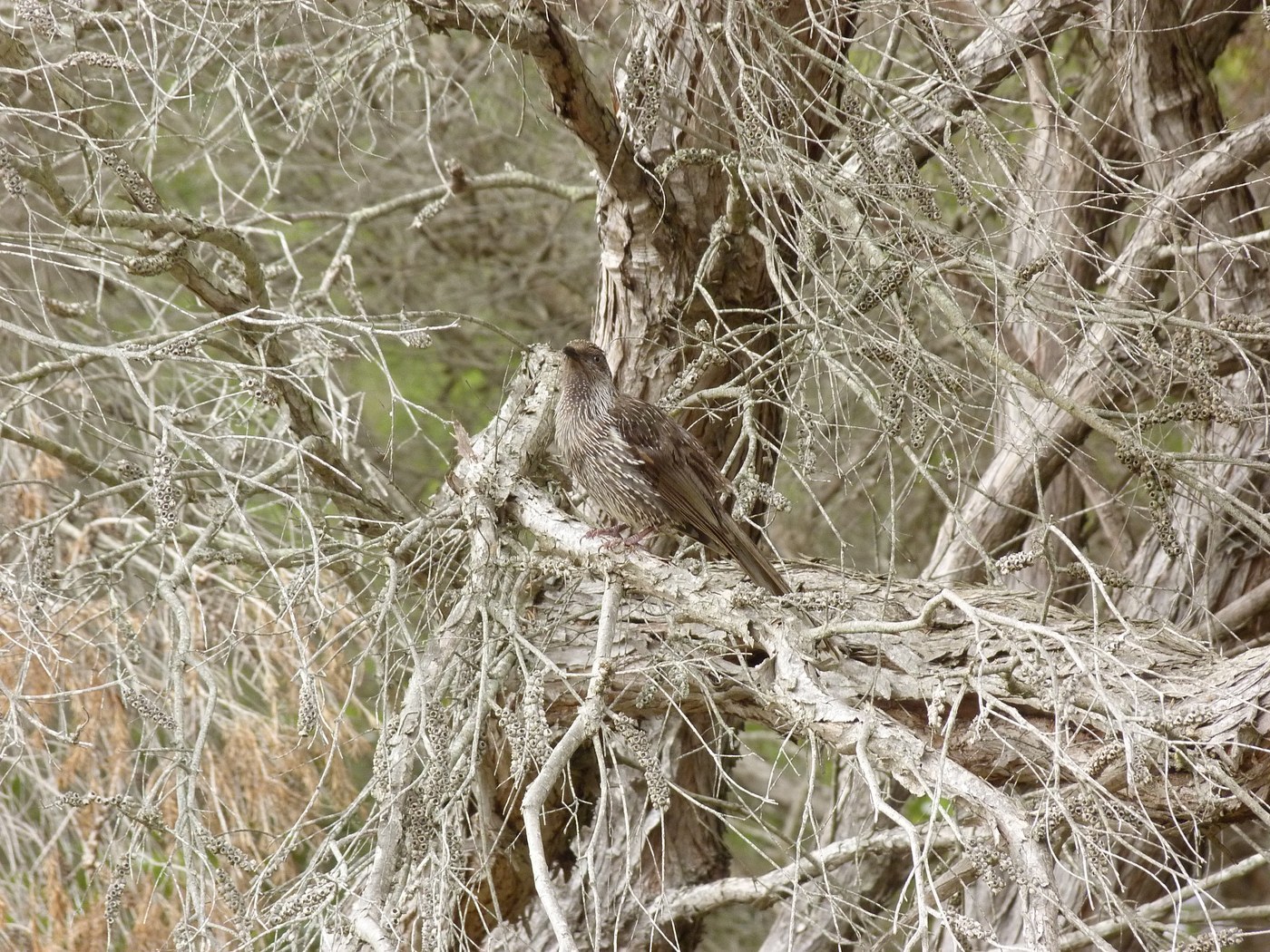
Key Field Marks
- Size & shape: A large honeyeater, about 26–31 cm, with a longish tail and a moderately long, slightly downcurved bill suited to nectar feeding.
- Plumage: Grey-brown overall with fine pale streaking on the body; a rich rufous-chestnut patch on the wing is conspicuous in flight and often visible at rest.
- Face: A small, easily overlooked pinkish wattle (fleshy lobe) behind the eye — much reduced compared to relatives, giving rise to the "little" in its name.
- Behavior: Active and often noisy, feeding on nectar from banksias, grevilleas, and eucalypts, as well as insects and fruit; frequently chases other birds from flowering plants.
Separating It From Similar Species
- Red Wattlebird: Larger, with prominent bright red wattles below the eye and a distinct white tip to the tail; Little Wattlebird's wattle is tiny and pale pink, and its tail lacks the white tip.
- Little Friarbird: Has a bald, dark grey-blue head with no feathers and no wattle at all, quite different from the feathered head and small wattle of the Little Wattlebird.
- Brush Wattlebird: An alternate/older name for the same species in some regions — not a separate species to worry about.
Where & When to See It
- Habitat: Banksia woodlands, coastal heath, dry sclerophyll forest, and increasingly suburban gardens planted with native nectar-rich shrubs.
- Range: Southeastern and southwestern Australia, including Tasmania.
- Season: Largely resident, though some populations move locally following the flowering of key food plants through the seasons.
Voice
- Loud, harsh, coughing or gurgling calls, often likened to a cork being pulled from a bottle, interspersed with chattering notes.
Frequently asked questions
How can you tell a Little Wattlebird from a Red Wattlebird?
Red Wattlebird is larger with obvious bright red facial wattles and a white-tipped tail, while Little Wattlebird has only a tiny, easily missed pink wattle and no white tail tip.
What is the rufous patch seen on a Little Wattlebird?
It is a chestnut-rufous patch on the wing, most visible when the bird is in flight or stretching, and helps distinguish it from other streaky honeyeaters.
What does the Little Wattlebird eat?
Primarily nectar from banksias, grevilleas, and eucalypts, supplemented with insects and some fruit.
Is 'Brush Wattlebird' a different species from 'Little Wattlebird'?
No, 'Brush Wattlebird' is simply an alternate common name historically used for the same species.