
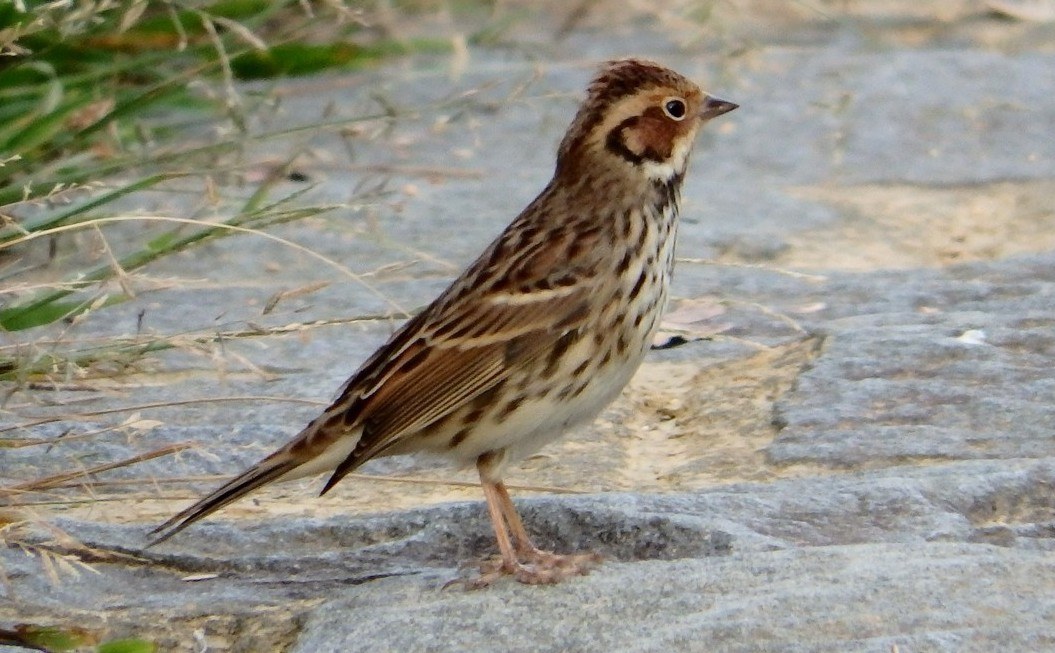
Little Bunting
Emberiza pusilla
A diminutive, chestnut-faced bunting of the far northern taiga, a scarce but regular vagrant to western Europe outside its core Siberian and Asian range.
- Size
- 12-14 cm (4.7-5.5 in) long, 18-20 cm wingspan
- Habitat
- breeds at the edge of northern taiga and tundra scrub; winters in open farmland, grassland, and scrub in Asia
- Type
- songbird
Spotted a bird like this?
Identify any bird from a photo, free.
Overview
The Little Bunting is a small, neat bunting that breeds across the subarctic taiga and tundra-forest edge of northern Europe and Siberia, wintering mainly in southern and southeastern Asia. It occurs as a scarce but regular vagrant further west and south, delighting birders with its subtle but distinctive plumage.
Appearance
A compact bunting with a chestnut-tinged crown and face bordered by dark lateral crown stripes and a dark eye-stripe, a pale, complete eye-ring, and finely streaked underparts on a whitish background. The overall effect is a small, warm-faced bunting noticeably smaller than the more familiar Reed Bunting.
How to identify it
Key Field Marks
- Small size, distinctly smaller than Reed Bunting
- Chestnut crown stripe and cheek patch bordered by darker lines
- Complete, pale eye-ring
- Fine dark streaking on white underparts
- Pinkish legs and a small, neat bill
Similar Species
Reed Bunting is larger with a different head pattern lacking the rich chestnut tones and complete eye-ring. Rustic Bunting, another rare vagrant to western Europe, is larger with a small crest and more strongly rufous flank streaking. The Little Bunting's small size, warm chestnut face, and neat pale eye-ring are the most useful combination of features.
Habitat & range
Habitat and Range
The species breeds in low scrub and stunted trees at the northern edge of the taiga and along the tundra-forest transition zone across northern Scandinavia and Siberia. It winters mainly in open farmland, grassy fields, and scrub across parts of South and Southeast Asia.
Migration
Little Buntings are long-distance migrants. While their core migration route runs largely through Asia, small numbers regularly overshoot or drift west, making the species a genuine, if scarce, annual vagrant to western Europe, particularly in autumn.
Behavior & voice
Behavior
On its wintering and migration grounds, the Little Bunting tends to be a quiet, somewhat skulking bird, often feeding unobtrusively on the ground among low vegetation or crop stubble, sometimes in the company of other small buntings or finches.
Voice
The flight call is a short, sharp "tik" or "tsik," while the song, heard on the remote breeding grounds, is a short, simple warbling phrase, less often encountered by observers outside the breeding range.
Nesting and Breeding
Nests are built on or near the ground in low scrub or tussocky vegetation at the forest-tundra edge, a cup of grass and moss. Clutches typically contain 4-5 eggs, incubated mainly by the female for around 11-13 days, though details of the species' breeding biology are less well studied than those of more southerly buntings.
Frequently asked questions
Where does the Little Bunting breed?
It breeds in low scrub at the edge of the taiga and tundra-forest transition across northern Scandinavia and much of Siberia.
Is the Little Bunting ever seen in western Europe?
Yes, small numbers occur as scarce but regular vagrants each year, most often found on the coast during autumn migration.
How do you identify a Little Bunting?
Look for its small size, chestnut-tinged crown and face bordered by dark lines, a complete pale eye-ring, and finely streaked white underparts.
Where does the Little Bunting spend the winter?
Mainly in open farmland and grassy habitats across South and Southeast Asia.
Little Bunting guides
In-depth guides for identifying, finding, and understanding Little Bunting.
Other birds you may enjoy

Black Redstart
13-14.5 cm (5.1-5.7 in) long, 23-26 cm wingspan

Black-throated Sparrow
12-14 cm (4.7-5.5 in) long, about 19-20 cm (7.5-8 in) wingspan

Greater Bird-of-paradise
Body about 43 cm; males with additional flank plumes up to 50 cm and long tail wires

Blue Tit
11-12 cm (4.3-4.7 in) long, 17-20 cm wingspan

Red-billed Quelea
11.5–13 cm long, wingspan about 20–22 cm
White-plumed Antbird
13-14 cm (5-5.5 in) long

Pyrrhuloxia
19-22 cm (7.5-8.7 in) long, 30 cm wingspan

Blue-gray Tanager
16-18 cm (6-7 in) long

Blackburnian Warbler
11-13 cm (4.3-5.1 in) long, 20-22 cm wingspan

Bluethroat
13-14 cm (5.1-5.5 in) long, 20-22 cm wingspan

Eurasian Nuthatch
12-14.5 cm (4.7-5.7 in) long, 22.5-27 cm wingspan

Wood Thrush
19-21 cm (7.5-8.3 in) long, about 33 cm (13 in) wingspan