
Little Bunting Identification Guide
A tiny, compact Eurasian bunting with a chestnut-brown cheek patch outlined in black, a thin pale eye-ring, and crisply streaked underparts, often mistaken for a small sparrow.
Read the full Little Bunting encyclopedia entry →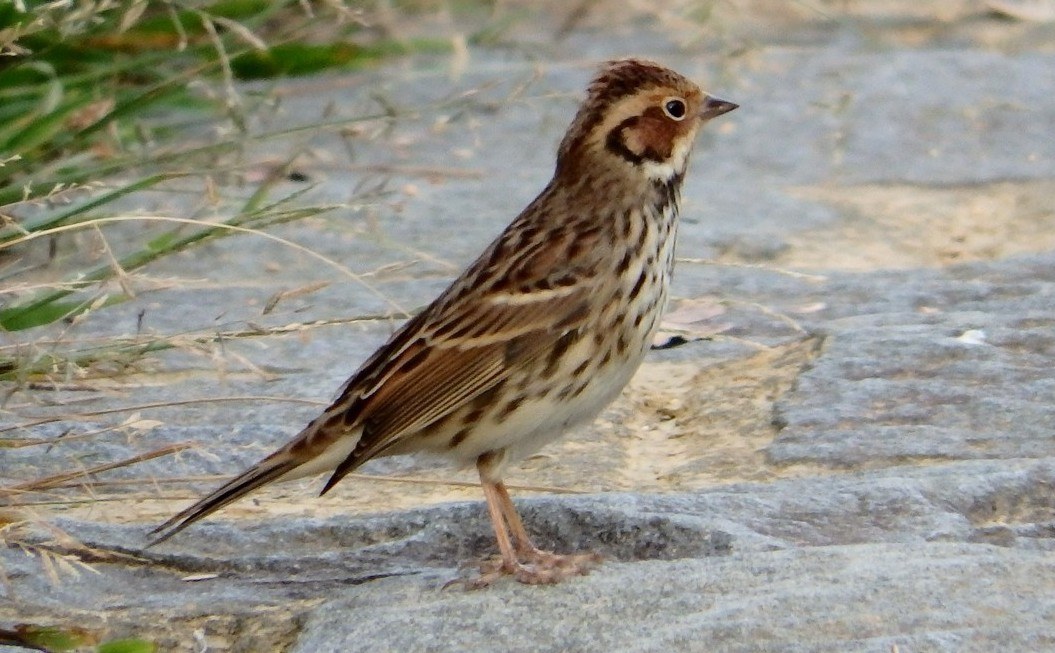
Key Field Marks
- Size and shape: One of the smallest buntings, only about 12–13.5 cm (5 in) long, with a compact, rounded body, short conical bill, and fairly short tail with white outer tail feathers.
- Plumage: Streaked brown upperparts with a warm chestnut crown stripe and cheek (ear-covert) patch outlined by a thin dark border, giving a distinctive framed appearance to the face. Underparts are whitish with fine dark streaking concentrated on the breast and flanks.
- Face pattern: A narrow but complete whitish eye-ring is a key mark, along with a pale supercilium above the chestnut ear patch and a dark lateral crown stripe.
- Bill: Small, neat, and grayish-pink, proportionally smaller than many other buntings.
Separating from Similar Species
- Rustic Bunting: Larger with a more prominent crest, bolder head pattern, and rustier flank streaking; lacks Little Bunting's neat, thin eye-ring as a standout feature.
- Reed Bunting (non-breeding/female): Larger and longer-tailed with a plainer face lacking the warm chestnut ear patch, and a heavier bill.
- Sparrows (e.g., Eurasian Tree Sparrow): Superficially similar brownish streaked birds, but sparrows lack the fine, crisp breast streaking and distinctive chestnut-and-black framed face pattern of Little Bunting.
- The tight combination of chestnut ear patch bordered in black, thin complete eye-ring, and fine breast streaking on a small, compact body is diagnostic.
Habitat and Range
Breeds across the boreal and subarctic zones of northern Europe and Siberia, in scrubby tundra edge, birch and willow thickets, and boggy taiga clearings. A long-distance migrant, wintering mainly in South and Southeast Asia (India, Nepal, southern China, Southeast Asia). A rare but regular vagrant to Western Europe, and an exceptional vagrant to North America (chiefly Alaska and along the Pacific coast).
Season
Migrates in spring (roughly April–May) to breeding grounds and again in fall (September–October) to wintering areas; a classic "eastern vagrant" pattern of occurrence in Western Europe and the Americas, typically appearing during fall migration when overshooting or reverse-migrating individuals show up far outside the normal range.
Behavior
Forages unobtrusively on the ground and in low vegetation, often in small flocks or mixed with other buntings and sparrows outside the breeding season, picking seeds and, during breeding season, insects. Tends to be somewhat skulking, flushing low into cover rather than perching in the open.
Voice
A short, sharp "tik" or "tzik" call note, often the first indication of its presence, especially useful for detecting vagrant individuals. Song, given on the breeding grounds, is a simple, quiet warbling series of notes, less elaborate than some other buntings.
Frequently asked questions
What is the best way to identify a Little Bunting?
Look for a very small bunting with a chestnut ear patch outlined in black, a thin complete pale eye-ring, and fine dark streaking on white underparts.
How does Little Bunting differ from Reed Bunting?
Little Bunting is smaller and more compact with a warm chestnut face patch and a distinctive thin eye-ring, while Reed Bunting is larger, longer-tailed, and has a plainer facial pattern.
Where does Little Bunting breed and winter?
It breeds across subarctic scrub and taiga edge in northern Europe and Siberia, and winters mainly in South and Southeast Asia, including India and southern China.
Is Little Bunting ever seen in North America?
Yes, but only as a rare vagrant, primarily recorded in Alaska and occasionally along the Pacific coast during migration periods.
What call does Little Bunting make?
A short, sharp 'tik' or 'tzik' note is its most frequently heard call, often the clue that first draws birders' attention to it.