
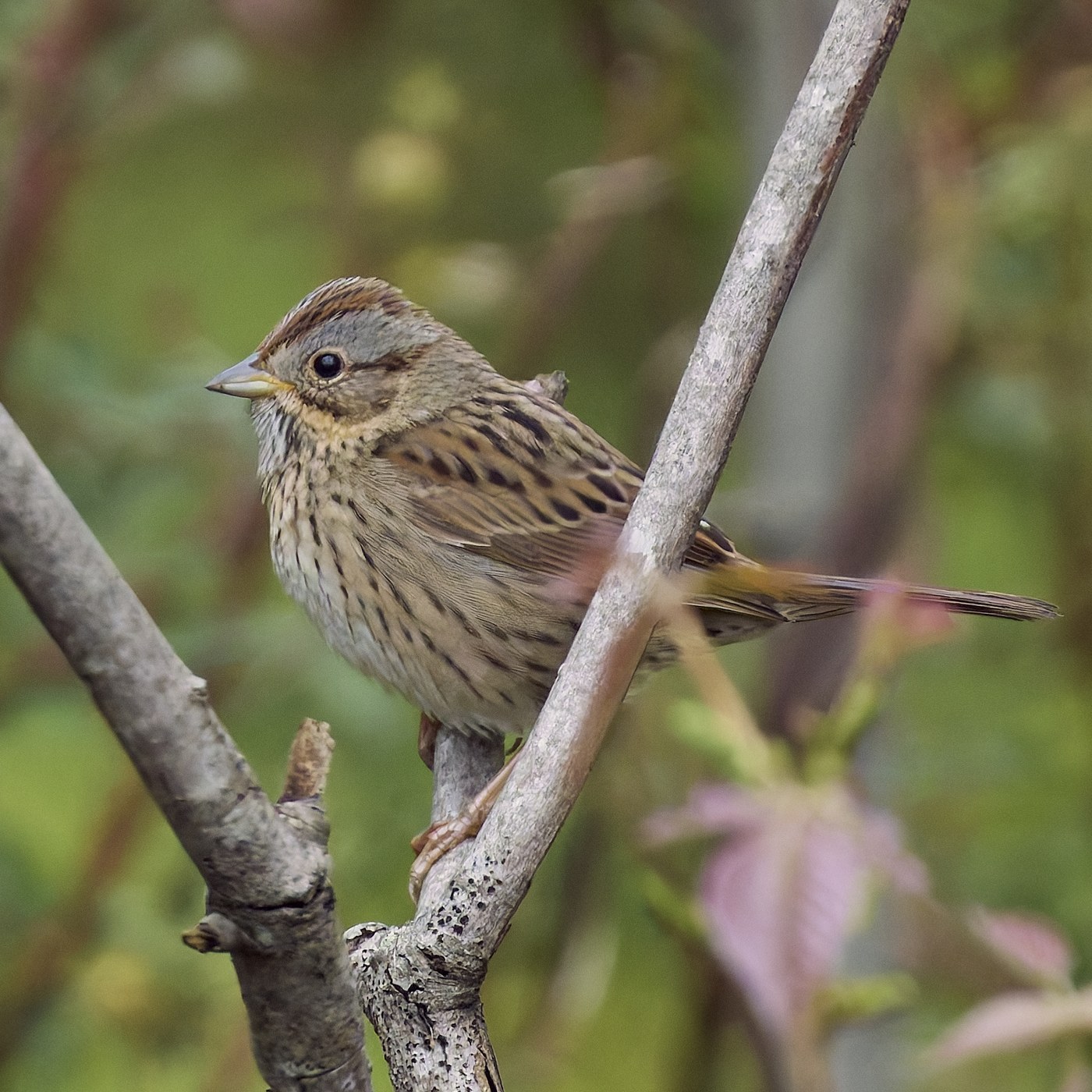
Lincoln's Sparrow
Melospiza lincolnii
A shy, finely streaked sparrow with a buffy breast band, often described as the best-dressed sparrow, that skulks low in dense cover.
- Size
- 13-15 cm (5.1-5.9 in) long, 18-22 cm wingspan
- Habitat
- boggy thickets and shrubby wet meadows for breeding; dense brush and thickets on migration and in winter
- Type
- songbird
Spotted a bird like this?
Identify any bird from a photo, free.
Overview
Lincoln's Sparrow is a subtly beautiful, secretive sparrow, often praised by birders for its neat, finely detailed plumage. A broad buffy-orange wash crosses the breast and flanks, finely streaked with crisp black lines, and set off by a gray face with a buffy eye-ring and a fine gray-and-buff crown stripe.
Compared to the closely related Song and Swamp Sparrows, Lincoln's Sparrow appears smaller, neater, and more finely marked, with an overall crisp, delicate pattern rather than bold, heavy streaking.
How to identify it
Key field marks
- Broad buffy wash across the breast and flanks with fine, crisp black streaking
- Gray face with a buffy eye-ring
- Fine, neat streaking overall, giving a delicate appearance
- Often raises a slight crest on the crown when alert
Similar species
- Song Sparrow is larger with coarser, heavier streaking on a whiter (not buffy) breast, often forming a central blotch.
- Swamp Sparrow has a plain gray, unstreaked breast and richer rufous wings, unlike Lincoln's finely streaked buffy breast band.
Habitat & range
Lincoln's Sparrows breed across the boreal forest of Canada and Alaska, and in shrubby subalpine meadows and bogs of the western mountains and parts of the northeastern US, favoring wet, shrubby areas with dense low cover. They are among the more secretive sparrows even on their breeding grounds.
During migration and winter the species occurs across most of the United States, Mexico, and Central America, staying low and hidden in dense brush, weedy field edges, and thickets, and is often overlooked despite being fairly common.
Behavior & voice
Lincoln's Sparrows are notably shy and skulking, typically staying low in dense vegetation and diving for cover at the slightest disturbance rather than perching in the open like some other sparrows. Patient, quiet observation is usually needed to get a good look.
The song is a rich, bubbling, wren-like warble, often delivered with more musical complexity and variability than the songs of related sparrows; the call is a flat, dry "tsup." Diet consists mainly of insects during the breeding season, shifting toward seeds in migration and winter. Nests are well concealed on or near the ground in dense low vegetation, often in mossy or boggy areas, with typical clutches of three to five eggs.
Frequently asked questions
How do you identify a Lincoln's Sparrow?
Look for a shy, finely streaked sparrow with a buffy wash across a crisply black-streaked breast, a gray face, and a buffy eye-ring; it tends to skulk low in dense cover.
What does a Lincoln's Sparrow sound like?
A rich, bubbling, wren-like warbling song, more musically complex than many other sparrow songs, plus a flat 'tsup' call note.
Where do Lincoln's Sparrows live?
They breed in boggy thickets and shrubby wet meadows across boreal Canada, Alaska, and western mountains, and winter across the southern US, Mexico, and Central America in dense brush and thickets.
What is the difference between a Lincoln's Sparrow and a Song Sparrow?
Lincoln's Sparrow is smaller with finer streaking on a buffy (not white) breast, while the Song Sparrow is larger with coarser, heavier streaking, often forming a central breast spot.
Who was Lincoln's Sparrow named after?
It was named by John James Audubon for his traveling companion Thomas Lincoln, who collected the first specimen in Labrador in 1833; it has no connection to President Abraham Lincoln.
Lincoln's Sparrow guides
In-depth guides for identifying, finding, and understanding Lincoln's Sparrow.
Other birds you may enjoy

Black Redstart
13-14.5 cm (5.1-5.7 in) long, 23-26 cm wingspan

Black-throated Sparrow
12-14 cm (4.7-5.5 in) long, about 19-20 cm (7.5-8 in) wingspan

Greater Bird-of-paradise
Body about 43 cm; males with additional flank plumes up to 50 cm and long tail wires

Blue Tit
11-12 cm (4.3-4.7 in) long, 17-20 cm wingspan

Red-billed Quelea
11.5–13 cm long, wingspan about 20–22 cm
White-plumed Antbird
13-14 cm (5-5.5 in) long

Pyrrhuloxia
19-22 cm (7.5-8.7 in) long, 30 cm wingspan

Blue-gray Tanager
16-18 cm (6-7 in) long

Blackburnian Warbler
11-13 cm (4.3-5.1 in) long, 20-22 cm wingspan

Bluethroat
13-14 cm (5.1-5.5 in) long, 20-22 cm wingspan

Eurasian Nuthatch
12-14.5 cm (4.7-5.7 in) long, 22.5-27 cm wingspan

Wood Thrush
19-21 cm (7.5-8.3 in) long, about 33 cm (13 in) wingspan