
Lesser Whitethroat
Curruca curruca
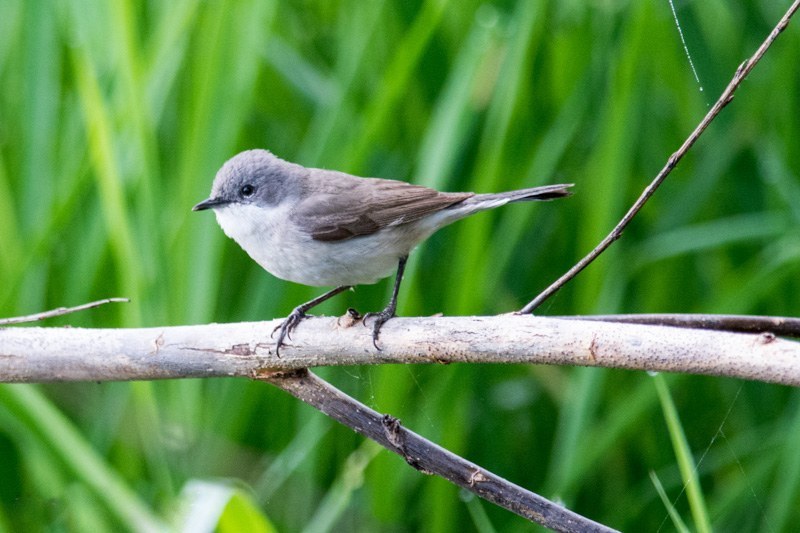
A neat, grey-toned warbler distinguished from its cousin the Common Whitethroat by a darker face mask and a distinctive, unmusical rattling song.
- Size
- 12.5-13.5 cm (5-5.3 in) long, 17-19.5 cm wingspan
- Habitat
- dense scrub, thick hedgerows, and thorny thickets
- Type
- songbird
Spotted a bird like this?
Identify any bird from a photo, free.
Overview
The Lesser Whitethroat is a compact, rather grey warbler that shares the white throat patch of its more colourful relative but differs in overall tone and pattern. The upperparts are a cooler grey-brown, without the warm chestnut wing fringes of the Common Whitethroat, and a darker patch around the eye and ear coverts gives the face a slightly masked appearance.
It is a shy and often skulking bird, more often heard than seen, spending much of its time working through dense thorny cover.
The species is best identified by voice: its song opens with a quiet, indistinct warble before switching abruptly into a loud, monotonous rattle on a single note, quite unlike the scratchy warbling song of the Common Whitethroat.
How to identify it
Key field marks
- Grey-brown upperparts without chestnut wing fringing
- Darker grey patch around the eye and ear coverts, giving a masked look
- White throat, though slightly less bright and contrasting than Common Whitethroat
- Fairly short, dark bill and dark legs
- Compact, neat overall shape
Similar species
- Common Whitethroat: warmer brown overall with a chestnut wing panel, paler face without a mask, and a scratchy warbling song rather than a rattle.
- Garden Warbler: plainer-faced with no throat contrast and no rattling song.
- Whitethroat-type Sylvia/Curruca warblers generally: the combination of grey tones, dark face mask, and rattling song is diagnostic for Lesser Whitethroat.
Habitat & range
Lesser Whitethroats breed across much of Europe and into central Asia, favouring dense, thorny scrub, thick hedgerows, and overgrown patches at woodland edges, often denser and more enclosed habitat than that chosen by Common Whitethroat.
They are long-distance migrants, with European breeders wintering mainly in northeastern Africa around the Nile Valley and the Horn of Africa, following a more easterly migration route than most other Sylvia-type warblers that winter further west.
They arrive on breeding grounds in spring and are often detected first by their distinctive rattling song from deep within a hedge.
Behavior & voice
Voice
The song begins with a quiet, subdued warbling that is easy to miss, then breaks into a loud, dry, monotonous rattle delivered on a single note, quite unlike any other common European warbler song. The call is a hard "tack."
Feeding
Insects and spiders gleaned from dense foliage make up most of the diet during the breeding season, with berries taken more frequently in late summer and autumn.
Nesting and breeding
The nest is a compact cup built low in dense, thorny scrub such as blackthorn or hawthorn. Clutches usually contain four to five eggs.
Frequently asked questions
How do you tell a Lesser Whitethroat from a Common Whitethroat?
Lesser Whitethroat is greyer overall, lacks the chestnut wing panel of Common Whitethroat, shows a darker mask around the eye, and gives a distinctive single-note rattling song instead of a scratchy warble.
What does a Lesser Whitethroat sound like?
Its song starts with a quiet, subdued warble before switching abruptly to a loud, dry, monotonous rattle on one note.
Where does the Lesser Whitethroat migrate to?
European breeders typically winter in northeastern Africa, around the Nile Valley and the Horn of Africa, following a more easterly route than many related warblers.
What kind of habitat does Lesser Whitethroat prefer?
It favours dense, thorny scrub such as blackthorn and hawthorn thickets and thick hedgerows, often denser cover than Common Whitethroat uses.
Is Lesser Whitethroat hard to see?
Yes, it is a shy, skulking bird that spends most of its time within dense cover and is usually detected by its distinctive rattling song rather than by sight.
Lesser Whitethroat guides
In-depth guides for identifying, finding, and understanding Lesser Whitethroat.
Other birds you may enjoy

Black Redstart
13-14.5 cm (5.1-5.7 in) long, 23-26 cm wingspan

Black-throated Sparrow
12-14 cm (4.7-5.5 in) long, about 19-20 cm (7.5-8 in) wingspan

Greater Bird-of-paradise
Body about 43 cm; males with additional flank plumes up to 50 cm and long tail wires

Blue Tit
11-12 cm (4.3-4.7 in) long, 17-20 cm wingspan

Red-billed Quelea
11.5–13 cm long, wingspan about 20–22 cm
White-plumed Antbird
13-14 cm (5-5.5 in) long

Pyrrhuloxia
19-22 cm (7.5-8.7 in) long, 30 cm wingspan

Blue-gray Tanager
16-18 cm (6-7 in) long

Blackburnian Warbler
11-13 cm (4.3-5.1 in) long, 20-22 cm wingspan

Bluethroat
13-14 cm (5.1-5.5 in) long, 20-22 cm wingspan

Eurasian Nuthatch
12-14.5 cm (4.7-5.7 in) long, 22.5-27 cm wingspan

Wood Thrush
19-21 cm (7.5-8.3 in) long, about 33 cm (13 in) wingspan