
Lesser Whitethroat Identification Guide
A small, neat Old World warbler with a gray head, dark mask, white throat, and brownish-gray back, best located by its distinctive rattling song.
Read the full Lesser Whitethroat encyclopedia entry →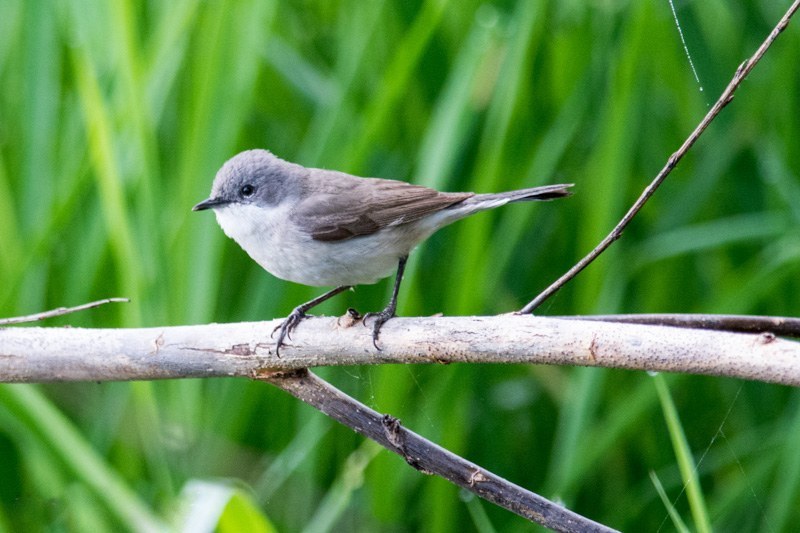
Key Field Marks
- Size & shape: Small warbler, about 5.1-5.5 inches, slim and neat with a relatively short, fine bill and rounded head.
- Head: Gray crown and nape with a darker gray to blackish mask through the eye and ear coverts, giving a slightly masked look.
- Throat: Crisp white throat, contrasting with the gray head above and buffy-gray breast/flanks below.
- Upperparts: Grayish-brown back, lacking the warmer rufous tones seen in Common Whitethroat's wings.
- Legs: Dark gray to blackish, unlike the paler pinkish legs of Common Whitethroat.
- Eye: Dark eye without a pale eye-ring, adding to the subtly masked appearance.
Separating from Similar Species
- Common Whitethroat: Larger, with a rustier/rufous fringed wing panel, paler pinkish legs, a pale eye-ring, and lacks the dark mask; also has a more scratchy, chattering song delivered often from an exposed perch or in a brief song-flight.
- Garden Warbler: Plain, unmarked grayish-brown overall with no mask, white throat, or contrasting head pattern -- much plainer-faced than Lesser Whitethroat.
- Blackcap: Shows a solid black (male) or reddish-brown (female) cap rather than a masked face pattern, and lacks the crisp white throat contrast.
- Voice is often the quickest identifier: the distinctive rattling song carries well even when the bird is hidden in dense cover.
Habitat, Range & Season
- Breeds across Europe and temperate Asia in dense scrub, hedgerows, thickets, and woodland edge, favoring somewhat drier and denser cover than Common Whitethroat.
- A long-distance migrant; most populations winter in northeastern Africa and the Arabian Peninsula, with some Siberian populations wintering further east in South Asia.
- Present on breeding grounds roughly April/May through August/September in Europe; a scarce but regular vagrant well outside its normal range during migration.
Behavior
- Skulking and often hard to see, staying low in dense hedgerows and scrub; more often heard than seen.
- Forages methodically through foliage for insects, also taking berries and soft fruit, especially before autumn migration.
- Builds a neat cup nest low in dense bramble, hedge, or scrub vegetation.
Voice
- Song is highly distinctive: a quiet, scratchy warbling introduction followed by a loud, monotonous rattle on a single pitch -- quite unlike the scratchy, varied chatter of Common Whitethroat.
- Call is a hard, sharp tack note, often given from cover when disturbed.
Frequently asked questions
What is the easiest way to identify a Lesser Whitethroat by ear?
Listen for its distinctive song: a brief scratchy warble followed by a loud, flat, monotonous rattle on one pitch, quite different from the varied scratchy chatter of Common Whitethroat.
How do you tell Lesser Whitethroat from Common Whitethroat by sight?
Lesser Whitethroat has a gray head with a darker mask, dark legs, and lacks the rufous wing panel and pale eye-ring found on the larger, browner Common Whitethroat.
Where does the Lesser Whitethroat spend the winter?
Most populations migrate to winter in northeastern Africa and the Arabian Peninsula, though some eastern populations winter farther east in South Asia.
What habitat should I search for Lesser Whitethroat?
Dense scrub, hedgerows, and thickets at woodland edges, where it tends to stay low and skulk rather than perch in the open.
What does the Lesser Whitethroat eat?
Mainly insects gleaned from foliage during the breeding season, supplemented by berries and soft fruit, particularly before and during autumn migration.