
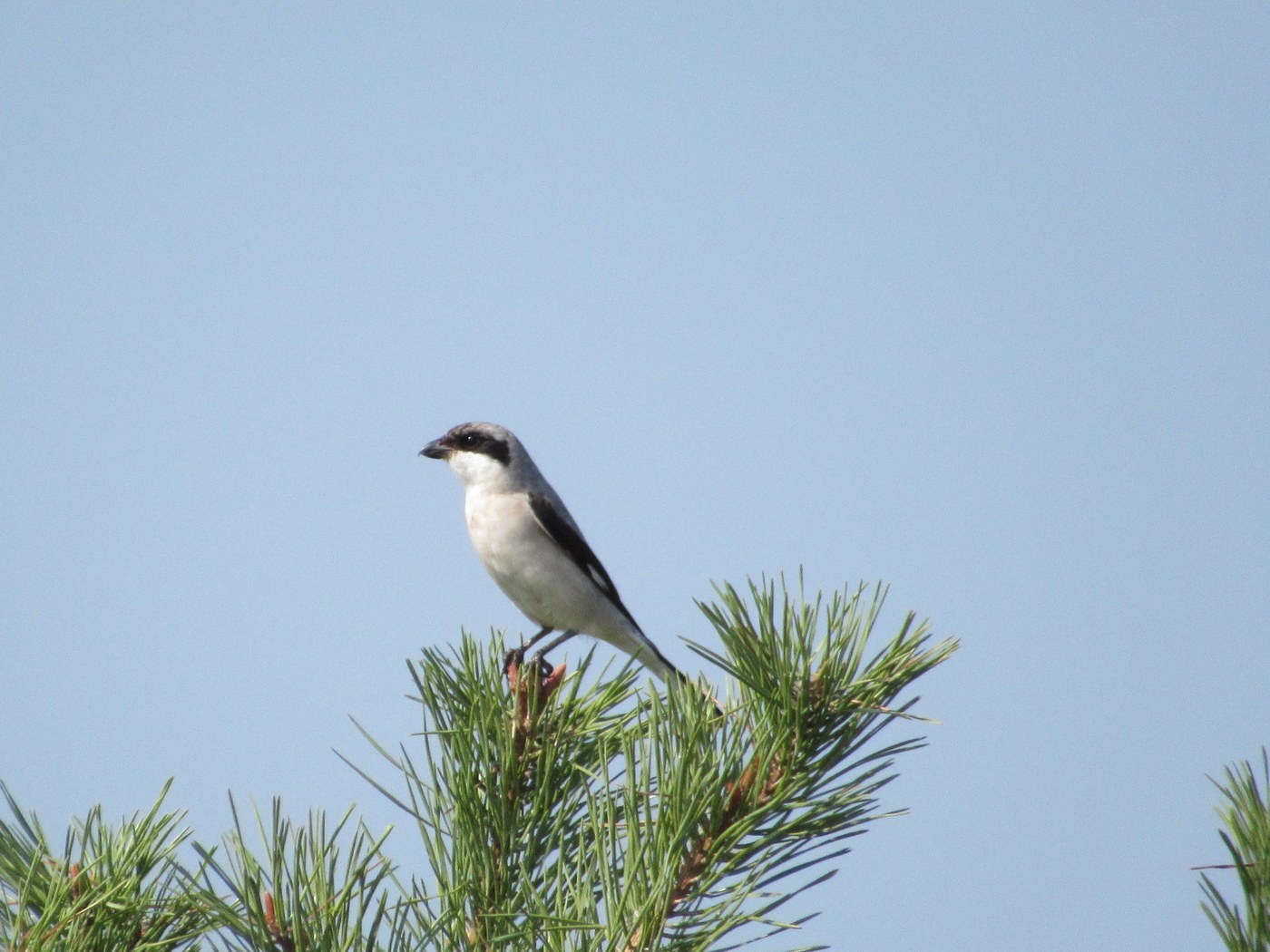
Lesser Grey Shrike
Lanius minor
A sleek grey-and-black shrike with a broad black mask extending across the forehead, favoring open farmland and steppe.
- Size
- 19-21 cm (7.5-8 in) long, 32-37 cm wingspan
- Habitat
- open steppe, farmland, and orchards with scattered trees
- Type
- songbird
Spotted a bird like this?
Identify any bird from a photo, free.
Overview
The Lesser Grey Shrike is a slim, elegant predatory songbird, pale grey above and white below, with black wings, a black tail, and a broad black mask that -- unlike most other shrikes -- extends across the forehead above the bill. This gives the face a distinctive, almost helmeted look.
Breast and flanks often show a faint pinkish wash, and a white patch on the black wing is visible in flight. It closely resembles the larger Great Grey Shrike but is more lightly built with proportionately longer wings, reflecting its long-distance migratory habits.
How to identify it
Key field marks
- Pale grey crown, nape, and back with a black mask that crosses the forehead (unlike Great Grey Shrike, in which the forehead stays pale)
- Black wings with a single white patch, black tail with white edges
- White underparts often tinged pink on the breast
- Long, pointed wings adapted for extended migration flights
Similar species
Most easily confused with the Great Grey Shrike, which is larger, has a pale forehead above the mask, and a longer tail. Told from the Red-backed and Woodchat Shrikes by its overall grey (not chestnut) upperparts.
Habitat & range
Range
Breeds patchily across central and south-eastern Europe into western and central Asia. It winters far south in southern Africa, making it one of the longest-distance migrant shrikes.
Habitat
Open, warm lowland country such as steppe, dry farmland, orchards, and vineyards with scattered trees for perching and nesting; avoids dense woodland.
Migration
A long-distance migrant traveling from Eurasian breeding grounds to wintering areas in southern Africa, one of the most extensive migrations of any Old World shrike.
Behavior & voice
Behavior
Hunts conspicuously from perches such as wires, bushes, or treetops, sallying out to catch large flying insects or dropping onto prey on the ground. Highly social on migration, sometimes gathering in loose groups.
Voice
The song is a scratchy, warbling series of notes, often including mimicry; calls are harsh and chattering, similar to other shrikes.
Feeding
Feeds mainly on large insects, particularly beetles, grasshoppers, and dragonflies, occasionally taking small lizards or rodents.
Nesting and breeding
Builds a bulky nest of twigs and grass in a tree, often loosely colonial with other pairs nearby. Clutches usually contain 5-6 eggs.
Frequently asked questions
How do you tell a Lesser Grey Shrike from a Great Grey Shrike?
The Lesser Grey Shrike's black mask extends across the forehead, while the Great Grey Shrike has a pale forehead above the mask and is noticeably larger.
Where does the Lesser Grey Shrike winter?
It undertakes a very long migration to winter in southern Africa, far south of most other European shrikes.
What does the Lesser Grey Shrike eat?
Mostly large insects such as beetles and grasshoppers, occasionally small lizards or rodents.
Is the Lesser Grey Shrike a colonial nester?
It sometimes nests in loose, semi-colonial groups where suitable trees and open hunting ground are available.
Lesser Grey Shrike guides
In-depth guides for identifying, finding, and understanding Lesser Grey Shrike.
Other birds you may enjoy

Black Redstart
13-14.5 cm (5.1-5.7 in) long, 23-26 cm wingspan

Black-throated Sparrow
12-14 cm (4.7-5.5 in) long, about 19-20 cm (7.5-8 in) wingspan

Greater Bird-of-paradise
Body about 43 cm; males with additional flank plumes up to 50 cm and long tail wires

Blue Tit
11-12 cm (4.3-4.7 in) long, 17-20 cm wingspan

Red-billed Quelea
11.5–13 cm long, wingspan about 20–22 cm
White-plumed Antbird
13-14 cm (5-5.5 in) long

Pyrrhuloxia
19-22 cm (7.5-8.7 in) long, 30 cm wingspan

Blue-gray Tanager
16-18 cm (6-7 in) long

Blackburnian Warbler
11-13 cm (4.3-5.1 in) long, 20-22 cm wingspan

Bluethroat
13-14 cm (5.1-5.5 in) long, 20-22 cm wingspan

Eurasian Nuthatch
12-14.5 cm (4.7-5.7 in) long, 22.5-27 cm wingspan

Wood Thrush
19-21 cm (7.5-8.3 in) long, about 33 cm (13 in) wingspan