
Lesser Grey Shrike Identification Guide
A striking gray, black, and white shrike of open country in Europe and Asia, distinguished from the Great Grey Shrike by its broader black mask and pinkish wash below.
Read the full Lesser Grey Shrike encyclopedia entry →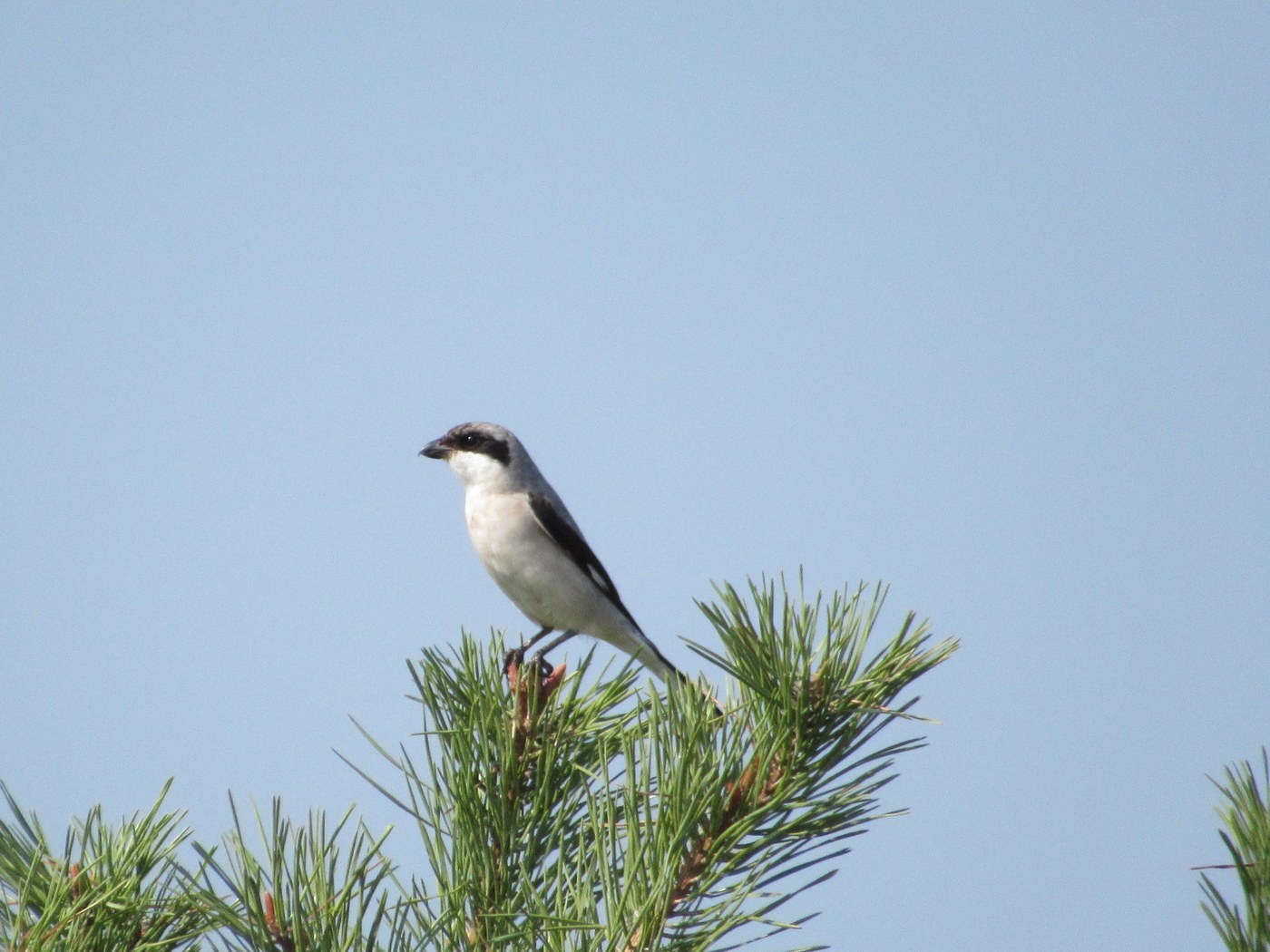
Key Field Marks
- Size & shape: Medium-sized shrike, about 7.5-8.5 inches, slightly smaller and more compact/short-tailed than Great Grey Shrike, with a proportionally larger-headed look.
- Mask: Broad black mask that extends across the forehead in adults (a key difference from Great Grey Shrike, whose black mask does not cross the forehead), giving a more hooded appearance.
- Upperparts: Clean pale gray back, black wings with a bold white primary patch, black tail with white outer edges.
- Underparts: Whitish with a distinct pinkish or peachy wash on the breast and flanks in adults, especially in fresh plumage -- Great Grey Shrike lacks this warm tone.
- Bill: Strong, hooked, black bill typical of shrikes, used for impaling prey on thorns (shrike larders).
- Wings: Relatively long and pointed compared to other shrikes, giving a more streamlined flight silhouette.
Separating from Similar Species
- Great Grey Shrike: Larger, longer-tailed, black mask does not extend across the forehead, and underparts are whiter without the pink wash.
- Red-backed Shrike: Smaller, with a chestnut-brown back (not gray) and different mask pattern; males show a gray crown/nape contrasting with rufous back.
- Woodchat Shrike: Shows a chestnut crown/nape and different overall pattern, easily separated by color.
- Overall structure -- big-headed, short-tailed, forehead-crossing mask -- is diagnostic once learned.
Habitat, Range & Season
- Breeds across central and southeastern Europe into western and central Asia, favoring open farmland, orchards, steppe, and scattered-tree grasslands with prominent perches.
- A long-distance migrant, wintering in southern Africa.
- Present on breeding grounds roughly May through August; a rare but regular vagrant to Britain and other parts of northwestern Europe during migration.
Behavior
- Classic sit-and-wait predator: perches conspicuously on wires, fence posts, or treetops, scanning for large insects (beetles, grasshoppers) and occasionally small vertebrates.
- Impales prey on thorns or barbed wire to create a larder for later feeding, a behavior shared with other true shrikes.
- Often nests in loose, semi-colonial groups where habitat is favorable, unlike many solitary-nesting shrikes.
Voice
- Song is a varied, scratchy warbling mix, sometimes incorporating mimicry of other species.
- Calls include harsh, chattering alarm notes typical of shrikes.
Frequently asked questions
How can you tell Lesser Grey Shrike from Great Grey Shrike?
Lesser Grey Shrike is smaller and shorter-tailed with a black mask that extends across the forehead and a pinkish wash on the underparts, while Great Grey Shrike is larger with a mask that does not cross the forehead and whiter underparts.
Where does the Lesser Grey Shrike breed?
It breeds in open farmland and steppe habitats across central and southeastern Europe through to central Asia, typically from May to August.
Where do Lesser Grey Shrikes spend the winter?
They are long-distance migrants that winter in southern Africa.
What does the Lesser Grey Shrike eat?
Mainly large insects such as beetles and grasshoppers, caught from an exposed perch, and occasionally small vertebrates.
Why does the Lesser Grey Shrike impale its prey?
Like other true shrikes, it lacks the strong grasping talons of raptors, so it impales prey on thorns or barbed wire to hold it steady while feeding or to store it for later.