
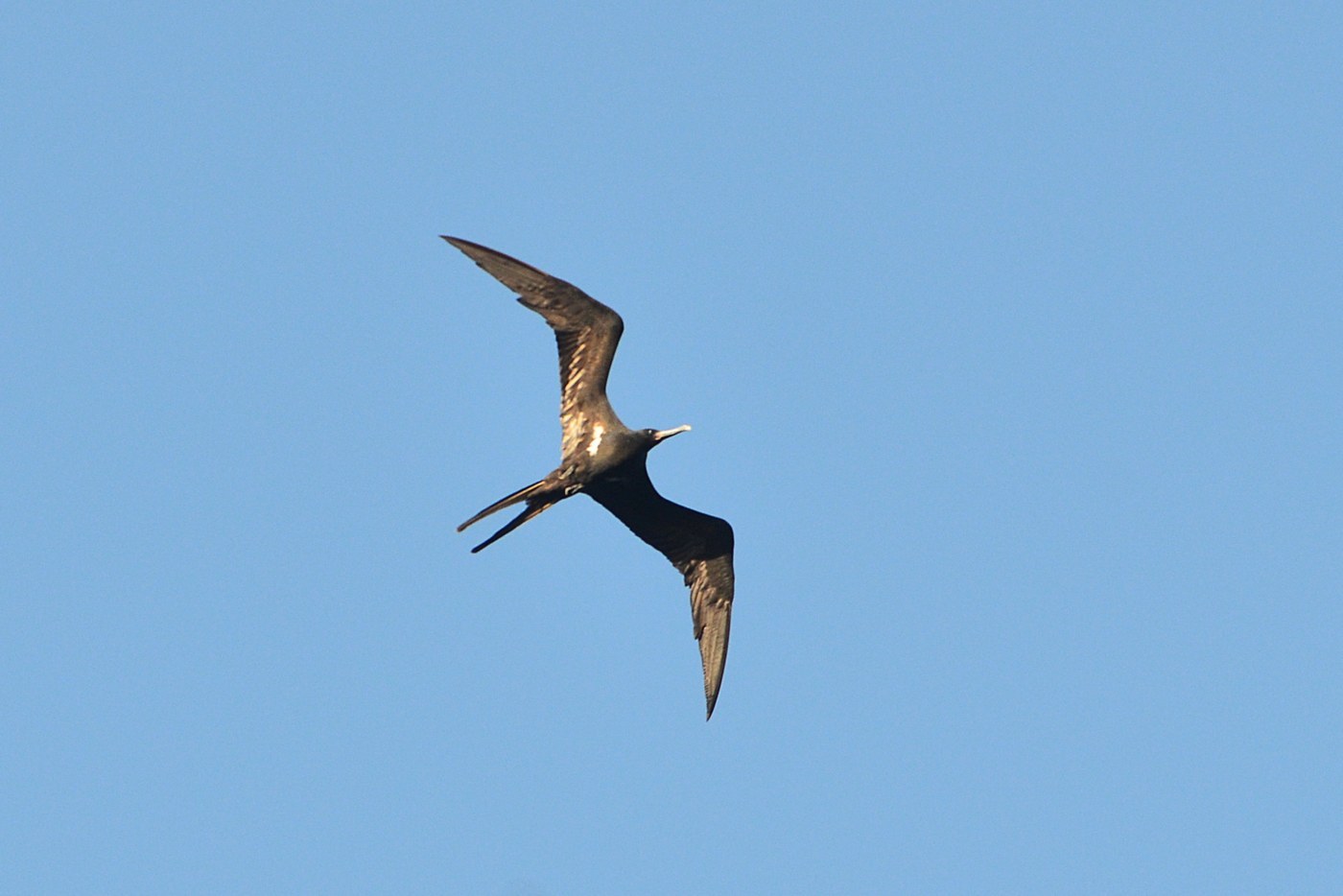
Lesser Frigatebird
Fregata ariel
The smallest frigatebird, black overall with distinctive white patches on the flanks, found across the tropical Indo-Pacific.
- Size
- 66-81 cm (26-32 in) long, 175-193 cm wingspan
- Habitat
- tropical islands and open waters of the Indian and Pacific Oceans
- Type
- seabird
Spotted a bird like this?
Identify any bird from a photo, free.
Overview
The Lesser Frigatebird is the smallest of the five frigatebird species, sharing the family's long, angular wings and deeply forked tail but with a noticeably lighter, more buoyant flight due to its reduced size. Adult males are glossy black with a green sheen and the typical inflatable red throat pouch, distinguished from other frigatebirds by white patches on the sides of the breast that extend as a spur onto the underwing. Females have a black head, white breast extending further onto the flanks, and a dark throat, differing from the pale throat of female Great Frigatebirds.
Highly aerial and pelagic, Lesser Frigatebirds range widely over tropical seas of the Indian and Pacific Oceans, nesting in scattered colonies on remote islands.
How to identify it
Key field marks
- Smallest frigatebird, with slimmer, lighter build
- White axillary "spur" patches on the flanks/underwing sides, present in both sexes
- Males otherwise all black with green gloss and red throat pouch
- Females show a black throat and head contrasting with white breast
Similar species
- Great Frigatebird is larger and lacks the white flank spurs; female Great Frigatebirds have a pale throat rather than the dark throat of Lesser Frigatebird females.
- Christmas Island Frigatebird and Ascension Frigatebird are rarer, geographically restricted relatives with more localized ranges.
- Juveniles have rusty or white heads, further complicating identification, and require careful attention to underwing pattern.
Habitat & range
Lesser Frigatebirds breed on remote tropical islands across the Indian and Pacific Oceans, including sites in northern Australia, the Seychelles, and various Pacific atolls, generally favoring low vegetation for nesting on predator-free islets. They are highly pelagic outside the breeding season, ranging over vast expanses of open tropical ocean.
The species can wander considerable distances, with vagrants occasionally recorded far outside their normal range, sometimes assisted by strong tropical storm systems.
Behavior & voice
Behavior
Like other frigatebirds, Lesser Frigatebirds are aerial kleptoparasites and surface feeders, harassing other seabirds to steal food and snatching prey from the ocean surface without landing.
Voice
Males rattle their bill against the inflated pouch and give whistling calls during courtship displays at the colony; otherwise they are relatively quiet at sea.
Feeding
Small fish and squid taken at the surface make up the bulk of the diet, supplemented by food stolen from boobies, terns, and tropicbirds.
Nesting and breeding
Colonies form on low trees, shrubs, or even bare ground on predator-free islands; a single egg is laid, and chick-rearing is prolonged, with young frigatebirds remaining dependent on parents for many months after fledging.
Frequently asked questions
How do you tell a Lesser Frigatebird from other frigatebirds?
Look for white patches on the flanks that extend as a spur onto the underwing, present in both sexes and distinctive to this species, plus its smaller overall size.
Where does the Lesser Frigatebird live?
It breeds on remote tropical islands across the Indian and Pacific Oceans and forages widely over open tropical seas.
What is the smallest frigatebird species?
The Lesser Frigatebird is the smallest of the five frigatebird species.
What do Lesser Frigatebirds eat?
Small fish and squid taken from the ocean surface, along with food stolen from other seabirds in flight.
Can Lesser Frigatebirds swim?
No, like other frigatebirds their feathers are not waterproof, so they avoid contact with the water and feed entirely on the wing.
Lesser Frigatebird guides
In-depth guides for identifying, finding, and understanding Lesser Frigatebird.
Other birds you may enjoy
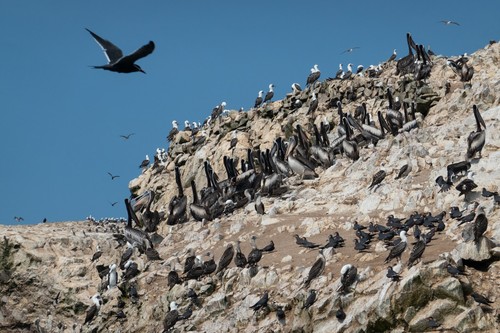
Peruvian Pelican
137-152 cm (54-60 in) long, up to 228 cm wingspan
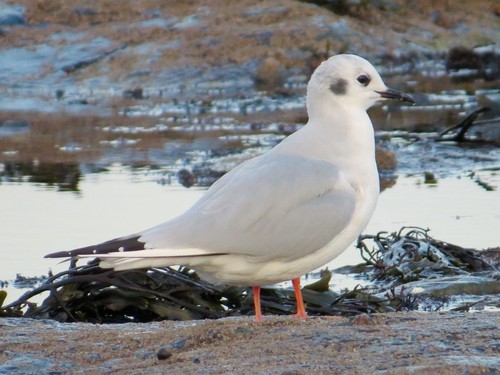
Bonaparte's Gull
28-33 cm (11-13 in) long, 76-84 cm wingspan

Brown Pelican
106-137 cm (42-54 in) long, 200-230 cm wingspan
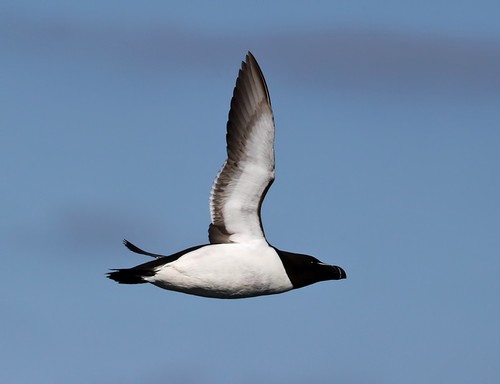
Razorbill
37-39 cm (15-15.5 in) long, 63-68 cm wingspan
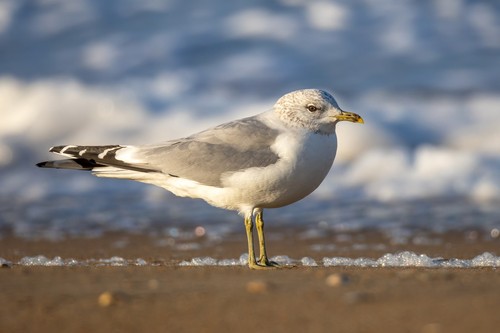
Common Gull
40-46 cm (16-18 in) long, 110-130 cm wingspan
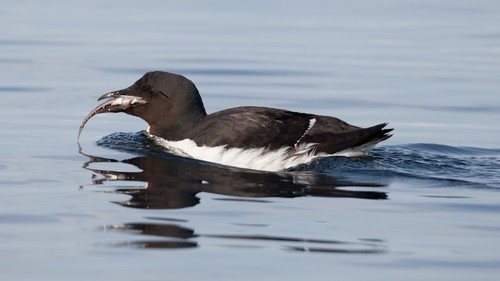
Thick-billed Murre
40-48 cm (16-19 in) long, 65-75 cm wingspan
Western Gull
55-68 cm (22-27 in) long, 130-144 cm wingspan
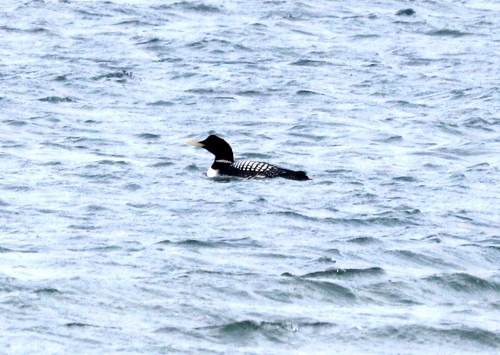
Yellow-billed Loon
76-97 cm (30-38 in) long, 135-152 cm wingspan
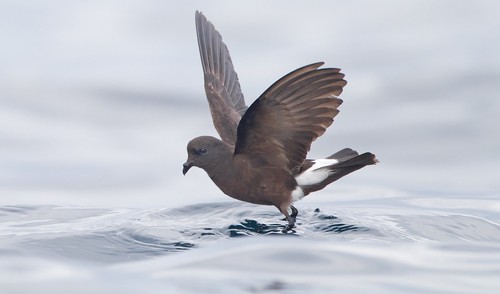
Wilson's Storm-Petrel
15-19 cm (6-7.5 in) long, wingspan 38-42 cm (15-16.5 in)
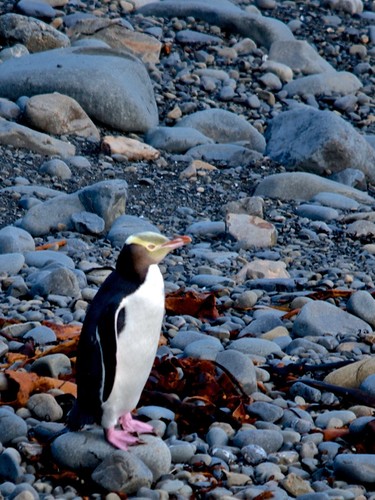
Yellow-eyed Penguin
62-79 cm (24-31 in) tall, 3-8.5 kg (6.6-18.7 lb)
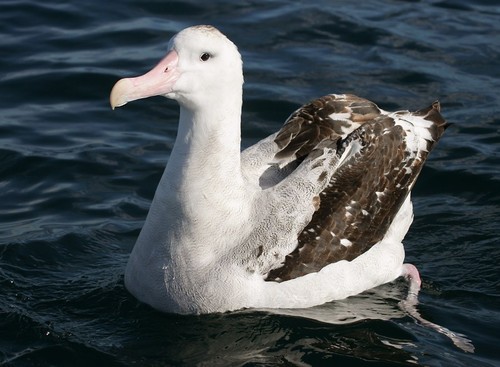
Wandering Albatross
107-135 cm (42-53 in) long, wingspan up to 3.5 m (11.5 ft)

Tufted Puffin
35-41 cm (14-16 in) long, about 63-70 cm wingspan