
Lesser Frigatebird Identification Guide
The smallest frigatebird, told from relatives by white axillary spurs (in females and juveniles) and its overall smaller, more angular silhouette.
Read the full Lesser Frigatebird encyclopedia entry →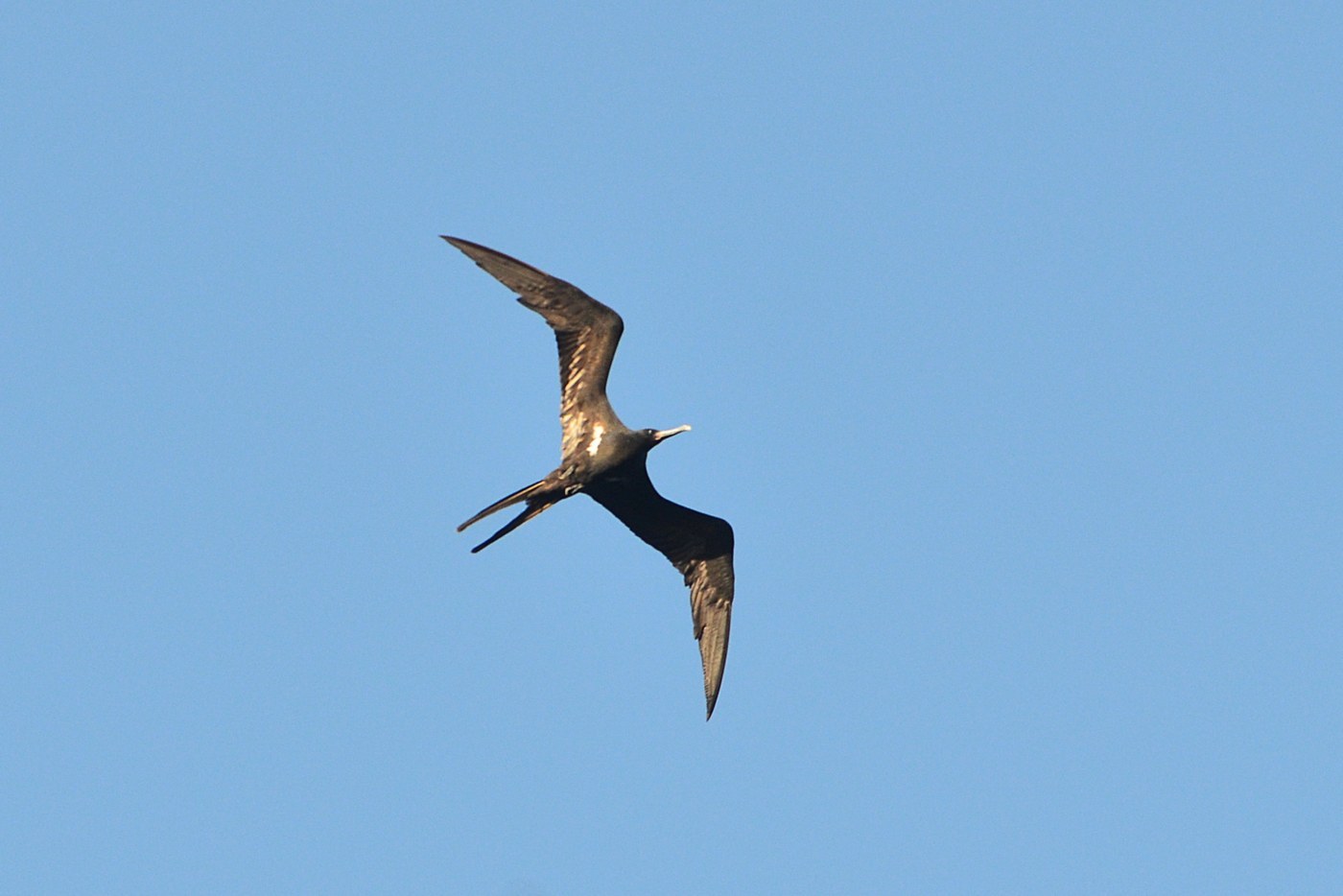
Key Field Marks
- Size & shape: Smallest of the five frigatebird species, with a wingspan around 6 feet, but still shows the classic frigatebird silhouette: long angular wings, deeply forked tail, and slender hooked bill.
- Adult male: Entirely glossy black with a red inflatable throat pouch (gular sac) used in display; often shows a pale band across the underwing coverts.
- Adult female: Black head and upperparts, white breast/throat extending onto a distinctive white spur that reaches up onto the sides of the underwing near the axillaries -- the key diagnostic feature separating it from other frigatebirds.
- Juvenile: Rusty-orange to buffy head, white breast, and variable dark belly band; white spurs on underwing also often visible.
- Flight: Effortless soaring on thermals with minimal flapping; wings held in a distinctive bent-back, M-shaped silhouette.
Separating from Similar Species
- Great Frigatebird: Larger; females lack the white axillary spur (white extends across the breast but not down onto the underwing near the wing base).
- Magnificent Frigatebird: Larger, and females have a more extensive white breast without the diagnostic axillary spur.
- Christmas Island Frigatebird: Much rarer and geographically restricted; males show a white belly patch, unlike male Lesser Frigatebird's all-black body.
- The white spur on the underwing of female and juvenile Lesser Frigatebirds is the single most reliable field mark among the frigatebird complex.
Habitat, Range & Season
- Breeds on remote tropical islands across the Indian and Pacific Oceans, including islands off Australia, in the Coral Sea, and around Christmas Island.
- Wide-ranging at sea outside breeding season, sometimes wandering well beyond core range; occasional vagrants have reached North America.
- Rarely comes to land except to breed and roost; typically seen soaring over open ocean or near coastal cliffs and islands.
Behavior
- Kleptoparasitic -- frequently harasses other seabirds (boobies, terns) in flight to steal captured fish rather than diving for its own food, since its plumage isn't waterproof.
- Snatches flying fish and squid from the surface without landing on water.
- Males inflate bright red throat pouches and clatter bills during group courtship displays at breeding colonies.
Voice
- Largely silent at sea; at breeding colonies, males give rattling, drumming, and warbling sounds during display, while both sexes give harsh chattering calls near the nest.
Frequently asked questions
How do you tell a female Lesser Frigatebird from other frigatebirds?
Look for a white spur that extends from the white breast up onto the underwing near the axillaries -- this mark is unique to Lesser Frigatebird among the females of the frigatebird family.
Why do frigatebirds steal food from other seabirds?
Their feathers lack waterproofing, so they cannot dive or swim to fish; instead they snatch prey from the surface or harass other seabirds mid-air to force them to drop their catch.
Where do Lesser Frigatebirds breed?
On remote tropical islands across the Indian and Pacific Oceans, including sites in the Coral Sea and around Christmas Island.
What does the red throat pouch on male frigatebirds mean?
It's an inflatable gular sac used exclusively in courtship display to attract females at the breeding colony; it is not present outside the breeding context.
Is the Lesser Frigatebird ever seen in North America?
It's a very rare vagrant there; sightings are exceptional and typically involve storm-displaced individuals far outside their normal Indo-Pacific range.