
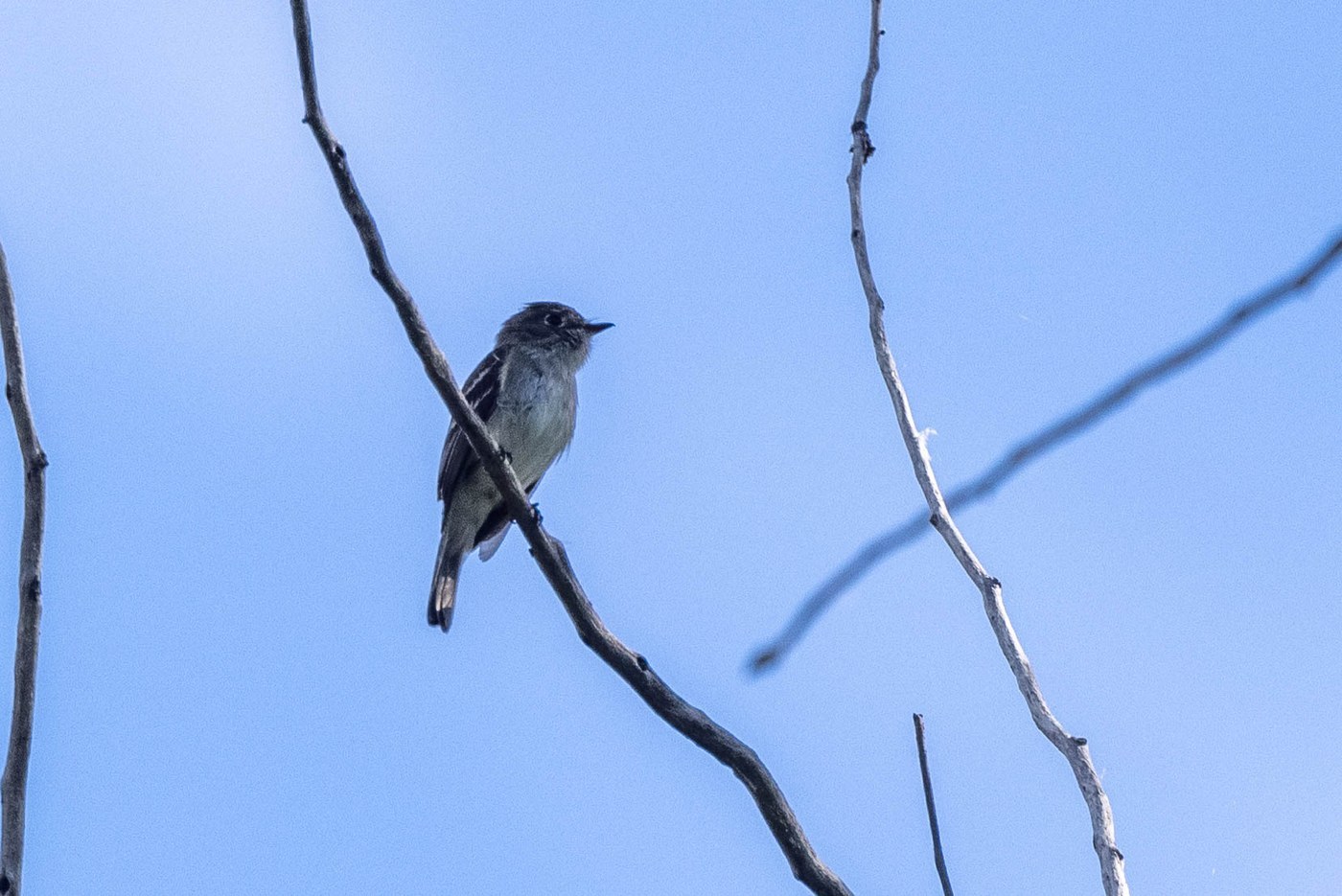
Least Flycatcher
Empidonax minimus
The smallest and most vocal of the eastern Empidonax flycatchers, easily located by its emphatic, repetitive 'che-BEK' call.
- Size
- 12-14 cm (4.7-5.5 in) long, 19-21 cm wingspan
- Habitat
- deciduous woodlands, forest edges, and orchards across northern and eastern North America
- Type
- songbird
Spotted a bird like this?
Identify any bird from a photo, free.
Overview
The Least Flycatcher is the smallest member of the Empidonax genus and, fortunately for birders, one of the easiest to identify thanks to its persistent, emphatic che-BEK call, repeated over and over from within the canopy. It shows the typical plain olive-gray upperparts, white eye-ring, and two whitish wing bars common to this notoriously difficult genus, but its diminutive size, relatively large-headed appearance, and distinctive voice help set it apart.
Active and often conspicuous for an Empidonax, it frequently flicks its wings and tail while perched, and is a common breeder in deciduous woodlands and edges across the northern and eastern United States and Canada.
How to identify it
Key Field Marks
- Small size with a relatively large-headed, short-tailed appearance
- Bold white eye-ring and two whitish wing bars
- Olive-gray upperparts and whitish underparts with a pale gray wash on the breast
- Frequent wing- and tail-flicking while perched
Similar Species
- Willow Flycatcher and Alder Flycatcher are larger, have fainter eye-rings, and lack the Least Flycatcher's distinctive che-BEK call.
- Hammond's Flycatcher and Dusky Flycatcher are similar in the West but do not overlap significantly with the Least Flycatcher's core eastern range; voice remains the best distinguishing tool.
Habitat & range
Least Flycatchers breed across the northern and eastern United States and much of Canada, favoring deciduous and mixed woodlands, forest edges, aspen groves, and orchards, often nesting semi-colonially with several pairs in loose proximity.
The species winters from Mexico south to Panama, migrating relatively early in fall compared to some other Empidonax species.
Behavior & voice
Voice
Gives an emphatic, repetitive che-BEK call, often repeated dozens of times in succession, making it one of the most easily identified Empidonax flycatchers by ear.
Feeding
Sallies from a perch within the canopy or understory to catch flying insects, and also gleans prey from foliage; frequently flicks its wings and tail while foraging or perched.
Nesting
Builds a compact cup nest of plant fibers, bark strips, and plant down in the fork of a tree branch, often at a moderate height; sometimes nests in loose, semi-colonial groupings within suitable habitat.
Frequently asked questions
How do I identify a Least Flycatcher?
Listen for its emphatic, repeated 'che-BEK' call, and look for a small flycatcher with a bold white eye-ring, whitish wing bars, and a large-headed, short-tailed appearance.
How is the Least Flycatcher different from other Empidonax flycatchers?
It is the smallest species in the genus and has the most distinctive, easily learned call, making it one of the more straightforward Empidonax flycatchers to identify by ear.
Where does the Least Flycatcher breed?
It breeds in deciduous and mixed woodlands, forest edges, and orchards across the northern and eastern United States and much of Canada.
Where do Least Flycatchers winter?
They migrate to winter from Mexico south to Panama.
Least Flycatcher guides
In-depth guides for identifying, finding, and understanding Least Flycatcher.
Other birds you may enjoy

Black Redstart
13-14.5 cm (5.1-5.7 in) long, 23-26 cm wingspan

Black-throated Sparrow
12-14 cm (4.7-5.5 in) long, about 19-20 cm (7.5-8 in) wingspan

Greater Bird-of-paradise
Body about 43 cm; males with additional flank plumes up to 50 cm and long tail wires

Blue Tit
11-12 cm (4.3-4.7 in) long, 17-20 cm wingspan

Red-billed Quelea
11.5–13 cm long, wingspan about 20–22 cm
White-plumed Antbird
13-14 cm (5-5.5 in) long

Pyrrhuloxia
19-22 cm (7.5-8.7 in) long, 30 cm wingspan

Blue-gray Tanager
16-18 cm (6-7 in) long

Blackburnian Warbler
11-13 cm (4.3-5.1 in) long, 20-22 cm wingspan

Bluethroat
13-14 cm (5.1-5.5 in) long, 20-22 cm wingspan

Eurasian Nuthatch
12-14.5 cm (4.7-5.7 in) long, 22.5-27 cm wingspan

Wood Thrush
19-21 cm (7.5-8.3 in) long, about 33 cm (13 in) wingspan