
Least Flycatcher Identification Guide
A small, compact Empidonax flycatcher of eastern woodlands, best distinguished from its similar relatives by its emphatic 'che-BEK' song and bold white eye-ring.
Read the full Least Flycatcher encyclopedia entry →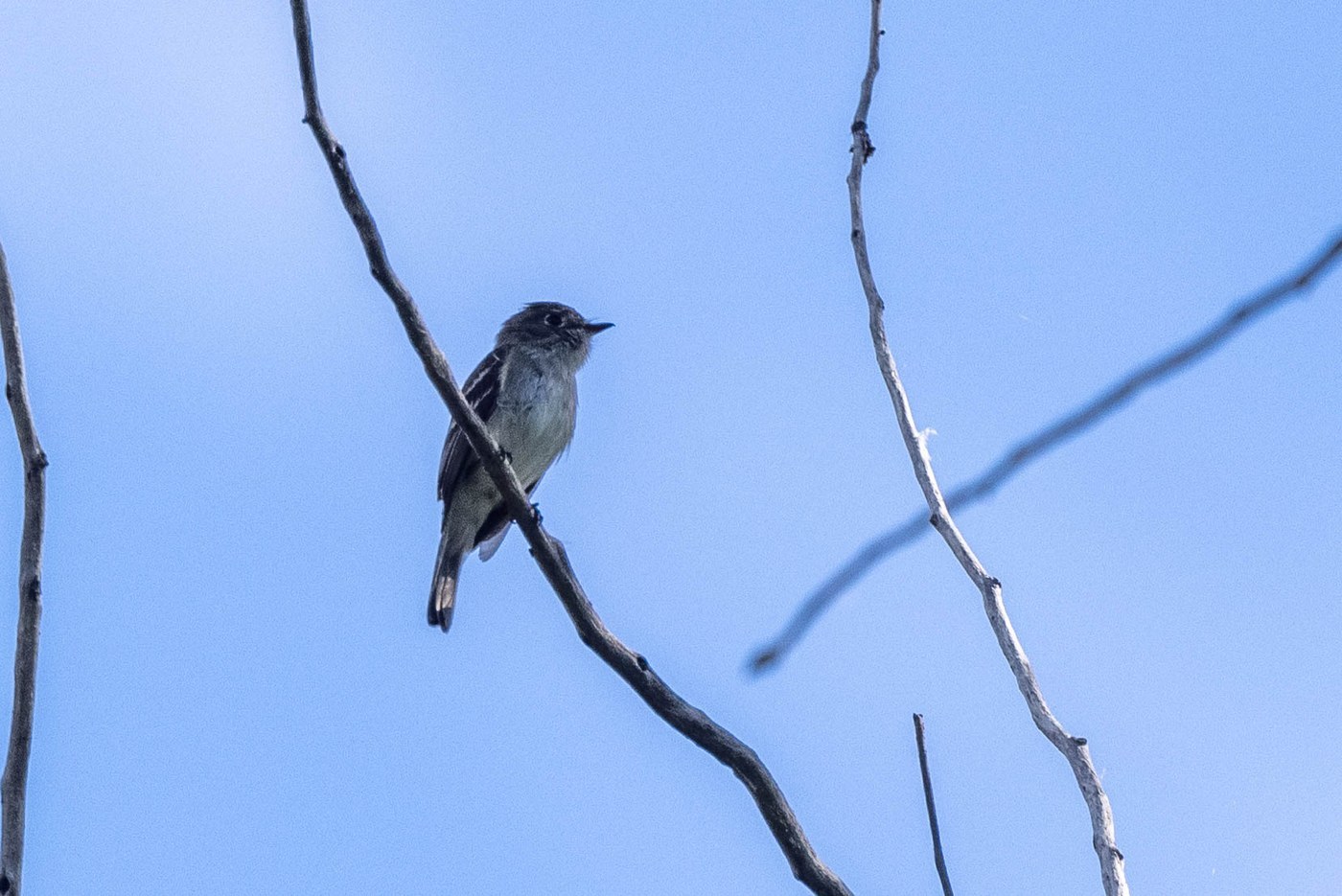
Key Field Marks
- Size & shape: One of the smallest Empidonax flycatchers, about 12–14 cm (4.7–5.5 in), with a relatively large, round head, short primary projection, and a short tail — a compact, big-headed look compared to some congeners.
- Plumage: Olive-gray to grayish-olive upperparts, whitish underparts with a pale gray wash on the breast, and two whitish wing bars on dark wings; a bold, complete white eye-ring is one of its most useful features.
- Bill: Short, fairly narrow bill, mostly dark above with a pale (pinkish-orange to yellowish) lower mandible.
- Behavior: Often flicks its tail upward and wings while perched, a habit shared with several Empidonax but especially pronounced and frequent in Least Flycatcher; forages by sallying out from a mid-level perch to catch flying insects and returning to the same or a nearby perch.
Separating It From Similar Species
- Empidonax flycatchers in general: This genus is notoriously difficult to identify by plumage alone; voice is the most reliable feature. Least Flycatcher's emphatic, two-note "che-BEK" song, repeated rapidly and often, is diagnostic and very different from the songs of other Empidonax.
- Hammond's Flycatcher and Dusky Flycatcher (western, limited range overlap): Both are western species with different calls; Hammond's has a longer primary projection and a more peaked head shape, while Dusky is intermediate in size and structure — largely separated from Least by range and voice.
- Willow Flycatcher and Alder Flycatcher: Both are larger with a less distinct or absent eye-ring and different, buzzier songs ("fitz-bew" for Willow, "free-beer" for Alder), and lack the compact, big-headed Least Flycatcher structure.
Where & When to See It
- Range: Breeds across southern Canada and the northern and central United States, from the Great Plains east to the Atlantic; winters in Mexico and Central America.
- Habitat: Open deciduous and mixed woodland, forest edges, orchards, parks, and shade trees — more tolerant of open, edge habitat than some other Empidonax.
- Season: Arrives on breeding grounds in May, breeds through summer, and departs by September for wintering grounds farther south.
Voice & Song Cues
- Song is a sharp, emphatic, two-syllable "che-BEK" (or "chi-BEK"), repeated persistently and rapidly, often many times in a row from an exposed perch — the single best field mark for this species.
- Call is a dry "whit" or "wit" given between song bouts or when agitated.
Frequently asked questions
What is the most reliable way to identify a Least Flycatcher?
Voice is by far the most reliable clue: its sharp, emphatic, two-note 'che-BEK' song, repeated rapidly, is diagnostic among the very similar-looking Empidonax flycatchers.
How can I tell Least Flycatcher apart from other Empidonax by appearance alone?
Least Flycatcher has a relatively large round head, short primary projection, and a bold, complete white eye-ring, giving it a slightly big-headed, compact look, though silent birds can still be very difficult to separate from relatives without vocalizations.
Does Least Flycatcher have any distinctive behavior?
It frequently flicks its tail upward along with wing flicks while perched, a habit more pronounced in this species than in many other Empidonax flycatchers.
What habitat does Least Flycatcher prefer?
It favors open deciduous and mixed woodland, forest edges, orchards, and shade trees, tolerating more open and edge-type habitat than some other Empidonax species.
When does Least Flycatcher arrive on its breeding grounds?
It typically arrives in May, breeds through the summer across its northern and eastern North American range, and departs for Mexico and Central America by September.