
Lark Bunting
Calamospiza melanocorys
A gregarious prairie songbird whose breeding male turns entirely black with a bold white wing patch, Colorado's state bird.
- Size
- 14-18 cm (5.5-7 in) long, about 26 cm (10 in) wingspan
- Habitat
- shortgrass and mixed-grass prairie, sagebrush plains
- Type
- songbird
Spotted a bird like this?
Identify any bird from a photo, free.
Overview
The Lark Bunting is a striking, highly social sparrow-relative of the North American Great Plains, notable for one of the most dramatic examples of seasonal plumage change among American songbirds. It is the official state bird of Colorado.
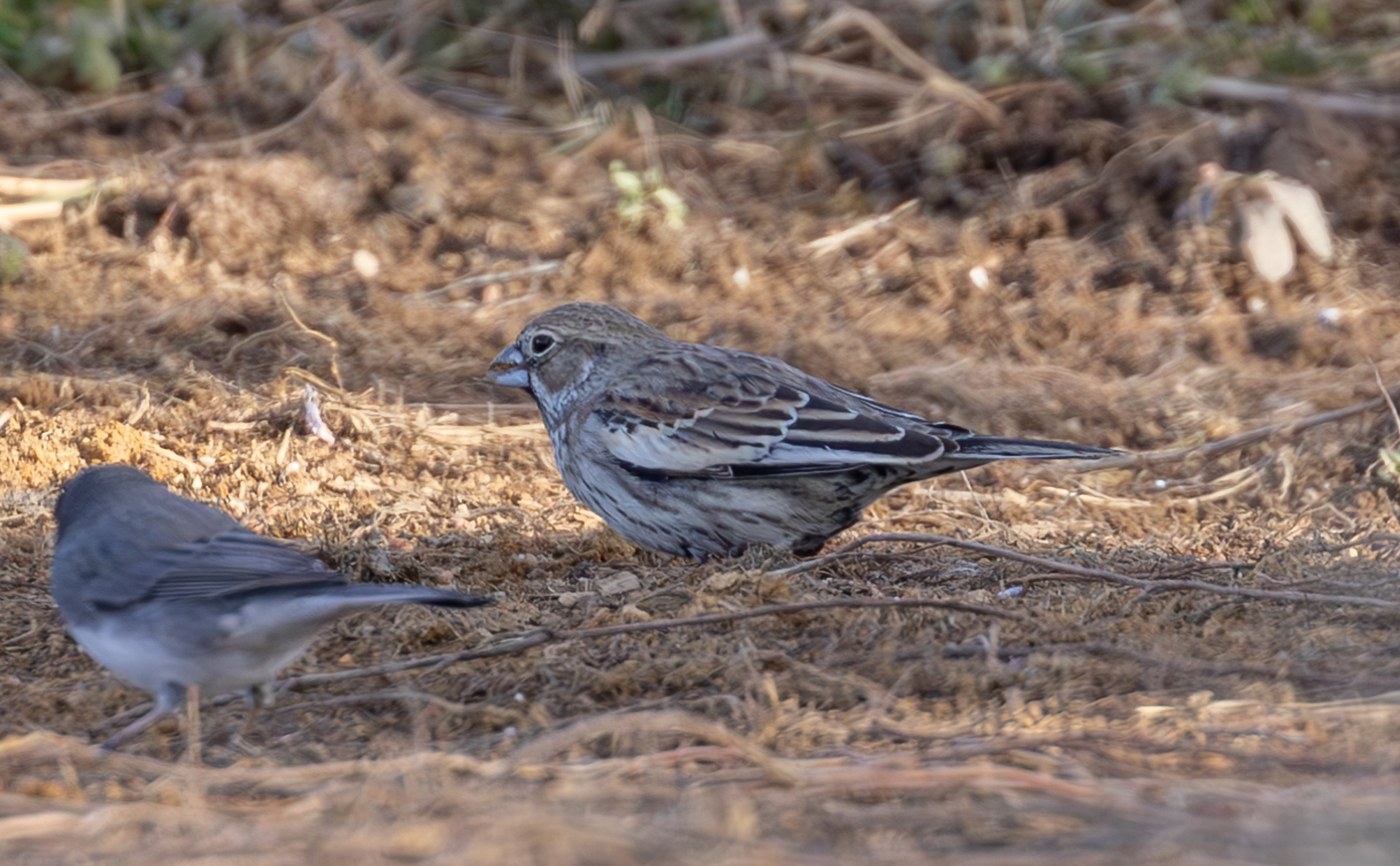
Breeding males are essentially entirely black except for a large, bold white patch on the wing, an unmistakable combination among grassland songbirds. Females and nonbreeding males, by contrast, are streaky grayish-brown overall, more typical of a sparrow, though they retain a smaller version of the same white wing patch, a useful clue even in dull plumage.
Outside the breeding season, Lark Buntings become highly gregarious, forming large, often mixed flocks that move nomadically across the plains and wintering grounds in response to food availability.
How to identify it
Key Field Marks
- Breeding male: entirely black body with a large white patch on the wing
- Female and nonbreeding male: streaky grayish-brown overall, sparrow-like, with a smaller white wing patch
- Relatively large, conical, pale-based bill
- Large size and bulky build compared to most sparrows
Similar Species
Breeding males are unmistakable due to their solid black body and white wing patch, a combination shared by no other North American sparrow-like bird. Females and winter males can resemble other streaky sparrows but the white wing patch, even when reduced, is a useful distinguishing mark, along with the bird's characteristically heavy bill and gregarious flocking behavior.
Habitat & range
Lark Buntings breed across the shortgrass and mixed-grass prairie of the Great Plains, from southern Canada south through Montana, the Dakotas, Nebraska, Kansas, Colorado, and into New Mexico and Texas, often in areas with scattered low shrubs such as sagebrush or greasewood.
In winter, the species withdraws to the southwestern United States and Mexico, where large flocks forage in open grassland, agricultural fields, and desert scrub. The species is highly nomadic, and its breeding distribution can shift substantially from year to year depending on rainfall and grassland conditions.
Behavior & voice
Behavior
Outside the breeding season, Lark Buntings are strongly gregarious, forming large flocks, sometimes numbering in the hundreds, that move together across open country in search of food.
Voice
Males deliver a rich, varied, warbling song, often performed during a skylarking flight display in which the bird flutters upward on shallow wingbeats and glides back down while singing.
Feeding
Diet shifts seasonally: insects dominate during the breeding season, especially for feeding nestlings, while seeds and waste grain become the primary food in fall and winter.
Nesting and Breeding
Nests are built on the ground, typically at the base of a grass clump or small shrub, as a woven cup of grasses. Clutches usually contain 3-5 pale blue eggs, and the species can be locally polygynous, with some males mating with more than one female.
Frequently asked questions
What does a breeding male Lark Bunting look like?
It is entirely black except for a large, bold white patch on the wing, unlike any other North American sparrow-relative.
Is the Lark Bunting a state bird?
Yes, it is the official state bird of Colorado.
How do female Lark Buntings differ from males?
Females and nonbreeding males are streaky grayish-brown overall, more typical of a sparrow, but retain a smaller white wing patch.
Where do Lark Buntings breed?
They breed across shortgrass and mixed-grass prairie of the Great Plains, from southern Canada south to New Mexico and Texas.
Do Lark Buntings form flocks?
Yes, outside the breeding season they are highly gregarious, forming large nomadic flocks that move across open country.
Lark Bunting guides
In-depth guides for identifying, finding, and understanding Lark Bunting.
Other birds you may enjoy

Black Redstart
13-14.5 cm (5.1-5.7 in) long, 23-26 cm wingspan

Black-throated Sparrow
12-14 cm (4.7-5.5 in) long, about 19-20 cm (7.5-8 in) wingspan

Greater Bird-of-paradise
Body about 43 cm; males with additional flank plumes up to 50 cm and long tail wires

Blue Tit
11-12 cm (4.3-4.7 in) long, 17-20 cm wingspan

Red-billed Quelea
11.5–13 cm long, wingspan about 20–22 cm
White-plumed Antbird
13-14 cm (5-5.5 in) long

Pyrrhuloxia
19-22 cm (7.5-8.7 in) long, 30 cm wingspan

Blue-gray Tanager
16-18 cm (6-7 in) long

Blackburnian Warbler
11-13 cm (4.3-5.1 in) long, 20-22 cm wingspan

Bluethroat
13-14 cm (5.1-5.5 in) long, 20-22 cm wingspan

Eurasian Nuthatch
12-14.5 cm (4.7-5.7 in) long, 22.5-27 cm wingspan

Wood Thrush
19-21 cm (7.5-8.3 in) long, about 33 cm (13 in) wingspan