
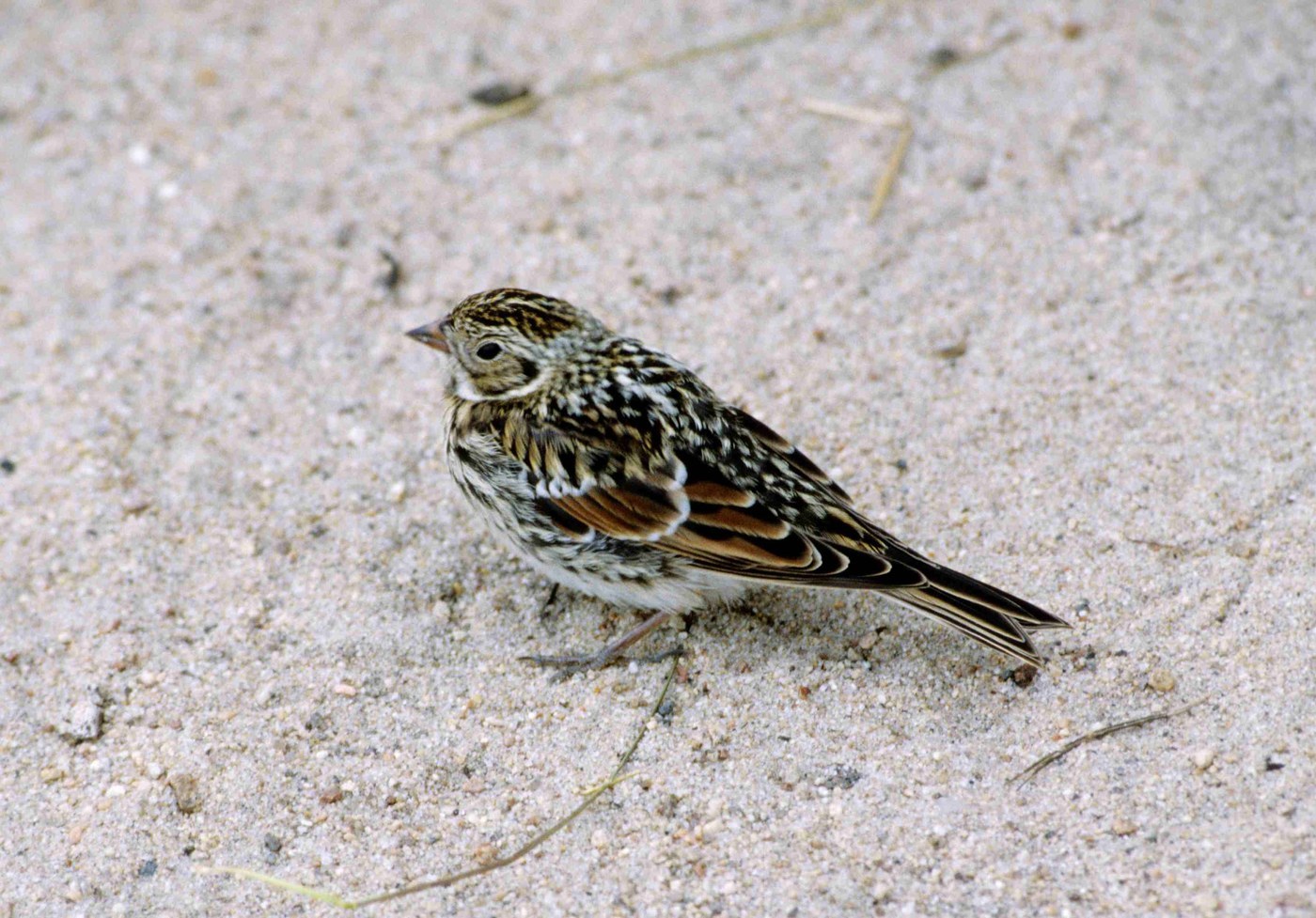
Lapland Longspur
Calcarius lapponicus
A circumpolar Arctic breeder that winters in large flocks across open fields, with striking black-faced breeding males and rusty-naped winter birds.
- Size
- 15-16 cm (6-6.3 in) long, about 28 cm (11 in) wingspan
- Habitat
- Arctic tundra when breeding; open fields, prairies, and shorelines in winter
- Type
- songbird
Spotted a bird like this?
Identify any bird from a photo, free.
Overview
The Lapland Longspur is a hardy songbird of the far north, breeding across Arctic tundra around the globe and wintering in large flocks on open agricultural land and prairies well to the south. The name 'longspur' refers to the unusually long, straight claw on the hind toe shared by this group of ground-dwelling birds.
Breeding males are boldly patterned, with a black face and throat, a rich chestnut nape, and a heavily streaked black crown, a striking combination against the pale tundra backdrop. Females and winter birds are much more subdued, streaky brown overall, but usually retain a hint of the rusty nape patch and show a distinctive dark triangular patch on the ear coverts.
Outside the breeding season, Lapland Longspurs are highly gregarious, often forming enormous mixed flocks with Snow Buntings, Horned Larks, and other open-country birds.
How to identify it
Key Field Marks
- Breeding male: black face and throat, chestnut nape, heavily streaked black crown
- Winter/female: streaky brown overall, often with a rusty nape patch and a dark patch on the ear coverts
- Relatively short, conical bill
- Long hind claw (rarely visible in the field but diagnostic of the group)
Similar Species
- Snow Bunting: shows much more extensive white in the wings, especially in flight, and lacks the dark ear patch
- Chestnut-collared and other longspurs: differ in tail pattern and facial markings; range and season help narrow down which longspur species is present
The combination of a rusty nape and a dark ear patch is a useful mark for identifying nonbreeding Lapland Longspurs among mixed winter flocks.
Habitat & range
Lapland Longspurs breed on Arctic tundra across the circumpolar north, including northern Alaska, Canada, Greenland, and Eurasia, nesting on the ground amid low tundra vegetation.
In winter, the species migrates south in large numbers to open habitats across the northern and central United States, including plowed fields, prairies, and shorelines, often forming immense flocks that can include thousands of birds, frequently mixed with Snow Buntings and Horned Larks.
Behavior & voice
Behavior
Wintering Lapland Longspurs are highly gregarious, forming large, sometimes massive flocks that forage together on open ground and take flight in coordinated, swirling movements when disturbed.
Voice
The breeding song is a musical, tinkling warble delivered during a brief flight display over the tundra; the flight call commonly heard from wintering flocks includes a dry rattle and a whistled 'tew.'
Feeding
Diet is mostly seeds in winter, gathered from open ground, shifting to insects during the short Arctic breeding season to feed rapidly growing chicks.
Nesting and Breeding
The nest is a grass-lined cup built on the ground, sheltered by tundra vegetation or a rock. Clutches typically contain 3-7 pale eggs with dark markings, and breeding is compressed into the brief Arctic summer.
Frequently asked questions
Where do Lapland Longspurs breed?
They breed on Arctic tundra across the circumpolar north, including Alaska, Canada, Greenland, and Eurasia.
What does a Lapland Longspur look like in winter?
Winter birds are streaky brown overall with a rusty nape patch and a dark patch on the ear coverts, quite different from the boldly black-faced breeding male.
Where can you see Lapland Longspurs in winter?
They winter in large flocks across open fields, prairies, and shorelines of the northern and central United States.
What is a 'longspur'?
The name refers to the unusually long, straight claw on the hind toe found in this group of ground-dwelling songbirds.
Do Lapland Longspurs flock with other species?
Yes, wintering flocks often mix with Snow Buntings and Horned Larks on open ground.
Lapland Longspur guides
In-depth guides for identifying, finding, and understanding Lapland Longspur.
Other birds you may enjoy

Black Redstart
13-14.5 cm (5.1-5.7 in) long, 23-26 cm wingspan

Black-throated Sparrow
12-14 cm (4.7-5.5 in) long, about 19-20 cm (7.5-8 in) wingspan

Greater Bird-of-paradise
Body about 43 cm; males with additional flank plumes up to 50 cm and long tail wires

Blue Tit
11-12 cm (4.3-4.7 in) long, 17-20 cm wingspan

Red-billed Quelea
11.5–13 cm long, wingspan about 20–22 cm
White-plumed Antbird
13-14 cm (5-5.5 in) long

Pyrrhuloxia
19-22 cm (7.5-8.7 in) long, 30 cm wingspan

Blue-gray Tanager
16-18 cm (6-7 in) long

Blackburnian Warbler
11-13 cm (4.3-5.1 in) long, 20-22 cm wingspan

Bluethroat
13-14 cm (5.1-5.5 in) long, 20-22 cm wingspan

Eurasian Nuthatch
12-14.5 cm (4.7-5.7 in) long, 22.5-27 cm wingspan

Wood Thrush
19-21 cm (7.5-8.3 in) long, about 33 cm (13 in) wingspan