
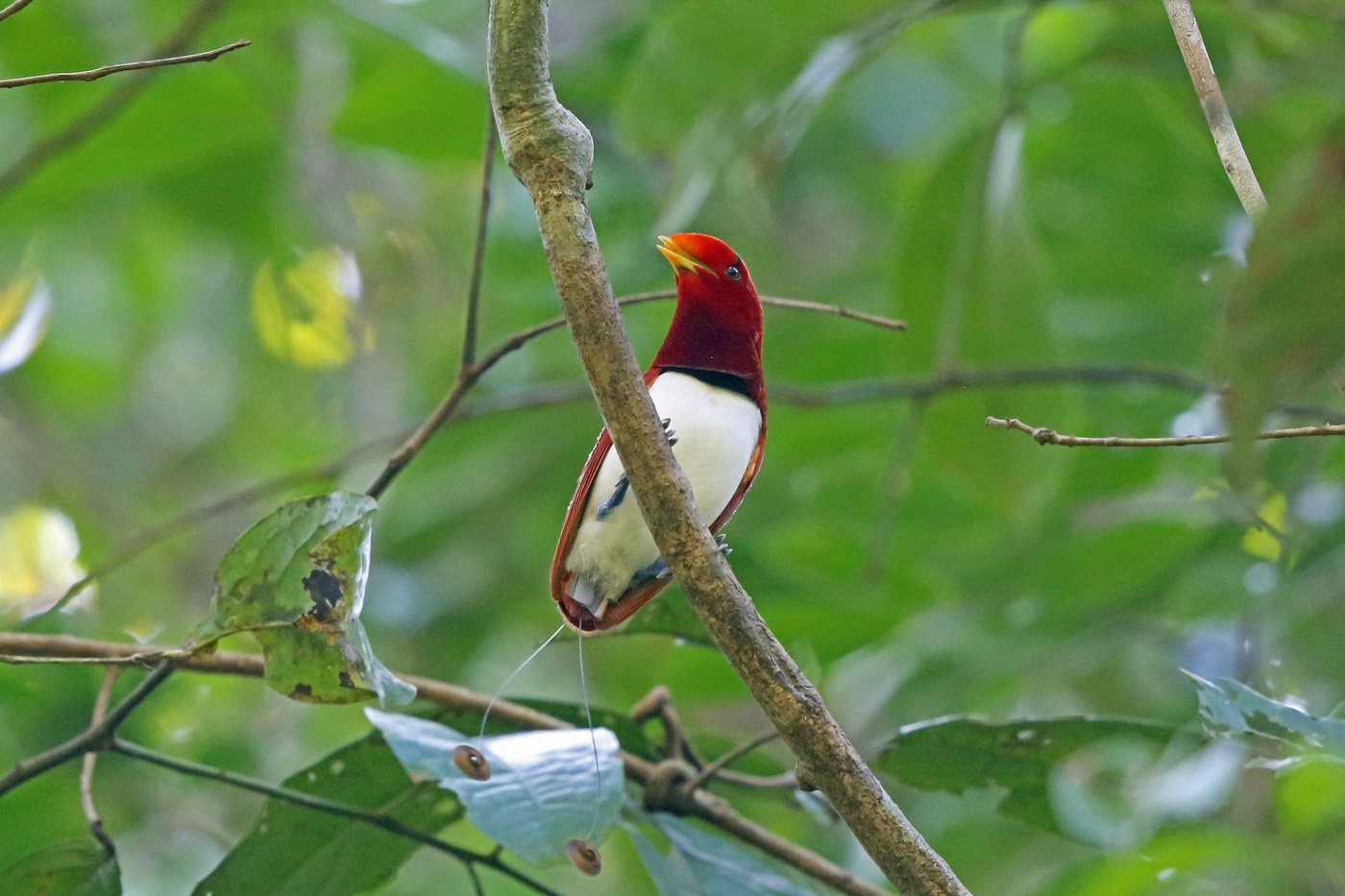
King Bird-of-paradise
Cicinnurus regius
A tiny, jewel-like bird-of-paradise with a crimson-and-white body and two wire-thin tail plumes tipped with emerald discs.
- Size
- Body about 16 cm (6.3 in), one of the smallest birds-of-paradise
- Habitat
- Lowland rainforest interior
- Type
- songbird
Spotted a bird like this?
Identify any bird from a photo, free.
Overview
The King Bird-of-paradise is the smallest species in the bird-of-paradise family and one of the most vividly colored. Males have a brilliant crimson-red head, back, and breast, a clean white belly, and a narrow band of iridescent green across the upper breast.
Most distinctive are the male's two central tail feathers, reduced to bare wire-like shafts that curl at the tips into flattened, iridescent emerald-green discs. Females are dull olive-brown with barred underparts, showing none of the male's color or tail ornamentation.
How to identify it
Key field marks
- Small size, roughly sparrow-sized, smaller than most other birds-of-paradise
- Male: bright crimson upperparts, white underparts, and curled wire tail plumes with green disc tips
- Female: plain olive-brown above with fine barring below, no wire tail
Similar species
- No other bird-of-paradise combines this small size with crimson-and-white plumage and curled wire tail discs, making adult males essentially unmistakable
- Females can be confused with other small brownish forest passerines but the barred underparts and forest-interior habits help narrow identification
Habitat & range
Habitat
Prefers the interior and edges of lowland and hill rainforest, typically below 900 m elevation.
Range
Endemic to New Guinea and nearby satellite islands including the Aru Islands and Misool.
Migration
Non-migratory resident.
Behavior & voice
Behavior
Males perform acrobatic solo displays on thin vertical saplings, puffing out their breast feathers, bouncing, and swinging upside down to show off the white belly and curled tail wires.
Voice
A distinctive series of sharp, high whistled notes and buzzy calls given from the forest mid-story.
Feeding
Forages alone or in small groups on fruit, particularly small drupes, and supplements its diet with insects and other arthropods gleaned from foliage.
Nesting and breeding
Polygynous; females build a cup or domed nest and incubate and raise the brood alone, with no involvement from the male after mating.
Frequently asked questions
How small is the King Bird-of-paradise?
It is about 16 cm long, making it the smallest species in the bird-of-paradise family.
What are the curled discs on its tail?
They are the flattened, iridescent green tips of two wire-like central tail feathers, unique to males.
Where does the King Bird-of-paradise live?
It is endemic to lowland rainforests of New Guinea and nearby islands.
Do females look like males?
No, females are plain olive-brown with barred underparts and lack the crimson color and wire tail.
King Bird-of-paradise guides
In-depth guides for identifying, finding, and understanding King Bird-of-paradise.
Other birds you may enjoy

Black Redstart
13-14.5 cm (5.1-5.7 in) long, 23-26 cm wingspan

Black-throated Sparrow
12-14 cm (4.7-5.5 in) long, about 19-20 cm (7.5-8 in) wingspan

Greater Bird-of-paradise
Body about 43 cm; males with additional flank plumes up to 50 cm and long tail wires

Blue Tit
11-12 cm (4.3-4.7 in) long, 17-20 cm wingspan

Red-billed Quelea
11.5–13 cm long, wingspan about 20–22 cm
White-plumed Antbird
13-14 cm (5-5.5 in) long

Pyrrhuloxia
19-22 cm (7.5-8.7 in) long, 30 cm wingspan

Blue-gray Tanager
16-18 cm (6-7 in) long

Blackburnian Warbler
11-13 cm (4.3-5.1 in) long, 20-22 cm wingspan

Bluethroat
13-14 cm (5.1-5.5 in) long, 20-22 cm wingspan

Eurasian Nuthatch
12-14.5 cm (4.7-5.7 in) long, 22.5-27 cm wingspan

Wood Thrush
19-21 cm (7.5-8.3 in) long, about 33 cm (13 in) wingspan