
King Bird-of-paradise Identification Guide
A tiny, jewel-like New Guinea bird of paradise, with males identified by brilliant crimson-red plumage, a white belly, an iridescent green breast band, and unique wire-thin tail feathers ending in curled emerald discs.
Read the full King Bird-of-paradise encyclopedia entry →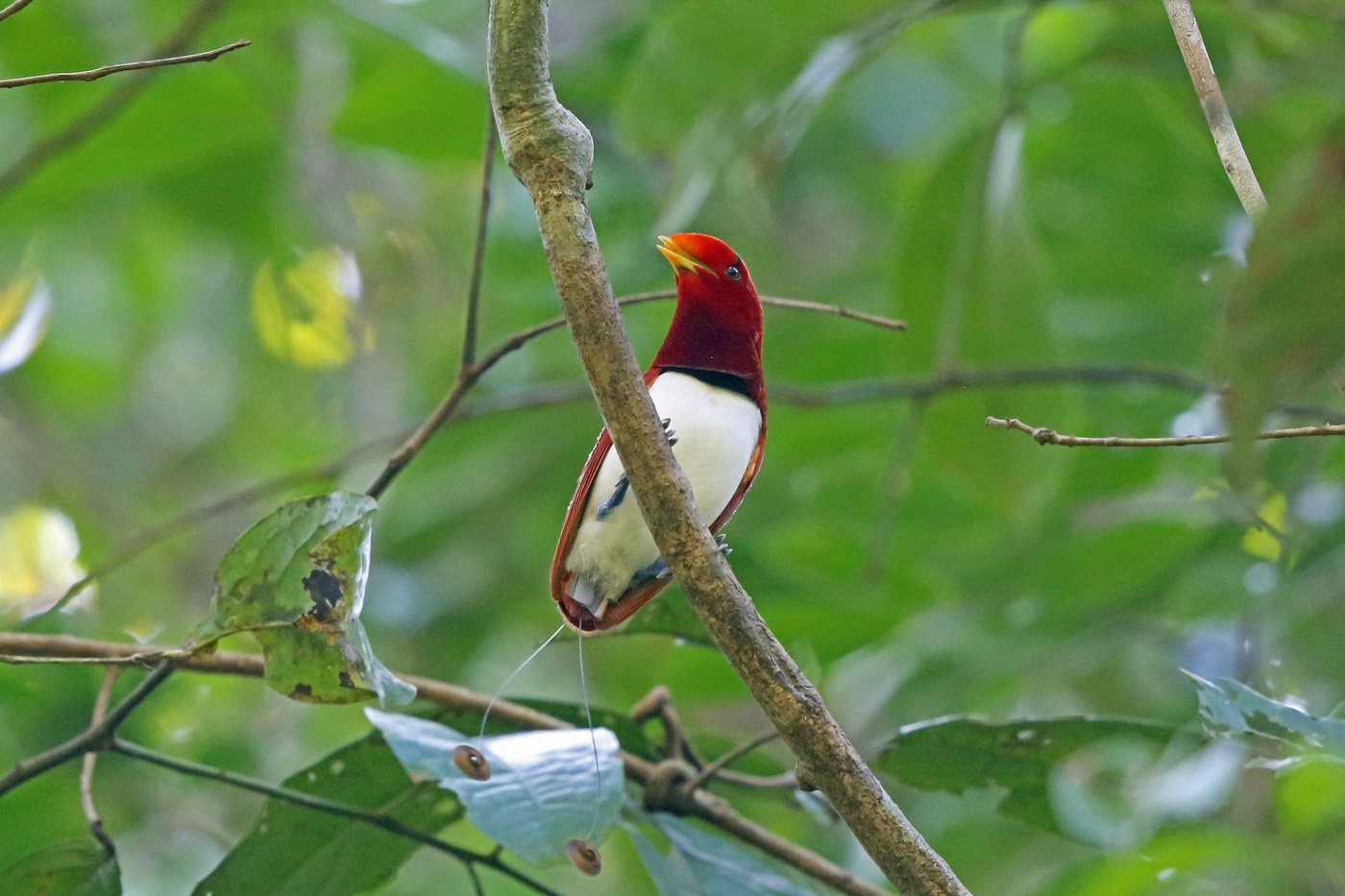
Key Field Marks
- Size & shape: One of the smallest birds of paradise, about 16 cm (6.3 in) in body length, with males adding two long, thin wire-like central tail feathers that can extend the total length considerably.
- Plumage (adult male): Brilliant crimson-red head, back, and upper breast, sharply demarcated from a clean white lower breast and belly. A narrow iridescent emerald-green band crosses the upper breast. The wire-like tail plumes are bare-shafted except for tightly curled, disc-shaped iridescent green tips resembling small emerald "rackets."
- Other features: Small pale blue-grey legs and feet, short dark bill, and a tuft of pale, fan-like feathers that can be raised over the back/flank during display.
- Female/immature: Much duller, plain rufous-brown above with buffy or barred underparts, lacking both the vivid red-and-white pattern and the wire tail plumes.
- Behavior: Small and active, moving briskly through the mid-to-upper levels of the forest interior; males perform acrobatic displays including hanging upside-down from branches and fanning the flank plumes.
Separating It From Similar Species
Adult male King Bird-of-paradise is unmistakable due to the combination of small size, vivid red-and-white body, and unique curled wire tail tips found in no other species. Female and immature birds are harder to identify and can resemble female Magnificent Bird-of-paradise or other female birds of paradise sharing the range; careful attention to size, bill shape, and habitat/voice is needed for these plumages, and often confirmation depends on locating a displaying or perched adult male nearby.
Where & When to See One
Found only on the island of New Guinea and some nearby satellite islands (such as Aru and Salawati), inhabiting lowland and hill tropical rainforest. It is a lowland specialist, generally found below about 900 m elevation, unlike many higher-elevation birds of paradise. Resident year-round with no long-distance migration; best located at known display sites (leks or solitary display perches) used by displaying males, most active in early morning.
Voice & Sound Cues
Gives a series of loud, sharp, whistled or buzzy notes and harsh chattering calls, often the first indication of a bird's presence in the dense canopy before it is seen. Males also produce mechanical-sounding wing/display noises during their acrobatic courtship routines.
Frequently asked questions
What makes the King Bird-of-paradise male so distinctive?
Its combination of small size, brilliant crimson-red and white plumage, an iridescent green breast band, and unique wire-like tail feathers ending in curled emerald discs is unlike any other bird.
How can I identify a female King Bird-of-paradise?
Females are much duller, plain rufous-brown above with buffy or barred underparts, lacking the male's red-and-white pattern and wire tail plumes, making them harder to distinguish from other female birds of paradise.
Where does the King Bird-of-paradise live?
Only on the island of New Guinea and nearby satellite islands, in lowland and hill tropical rainforest generally below about 900 meters elevation.
What are the curled tail tips on a male King Bird-of-paradise called?
They are the tips of elongated wire-like central tail feathers that curl into small iridescent emerald discs, sometimes described as 'racket' tips, used in courtship display.
Is the King Bird-of-paradise found anywhere outside New Guinea?
It is essentially restricted to New Guinea and a few adjacent smaller islands and is not found naturally elsewhere.