
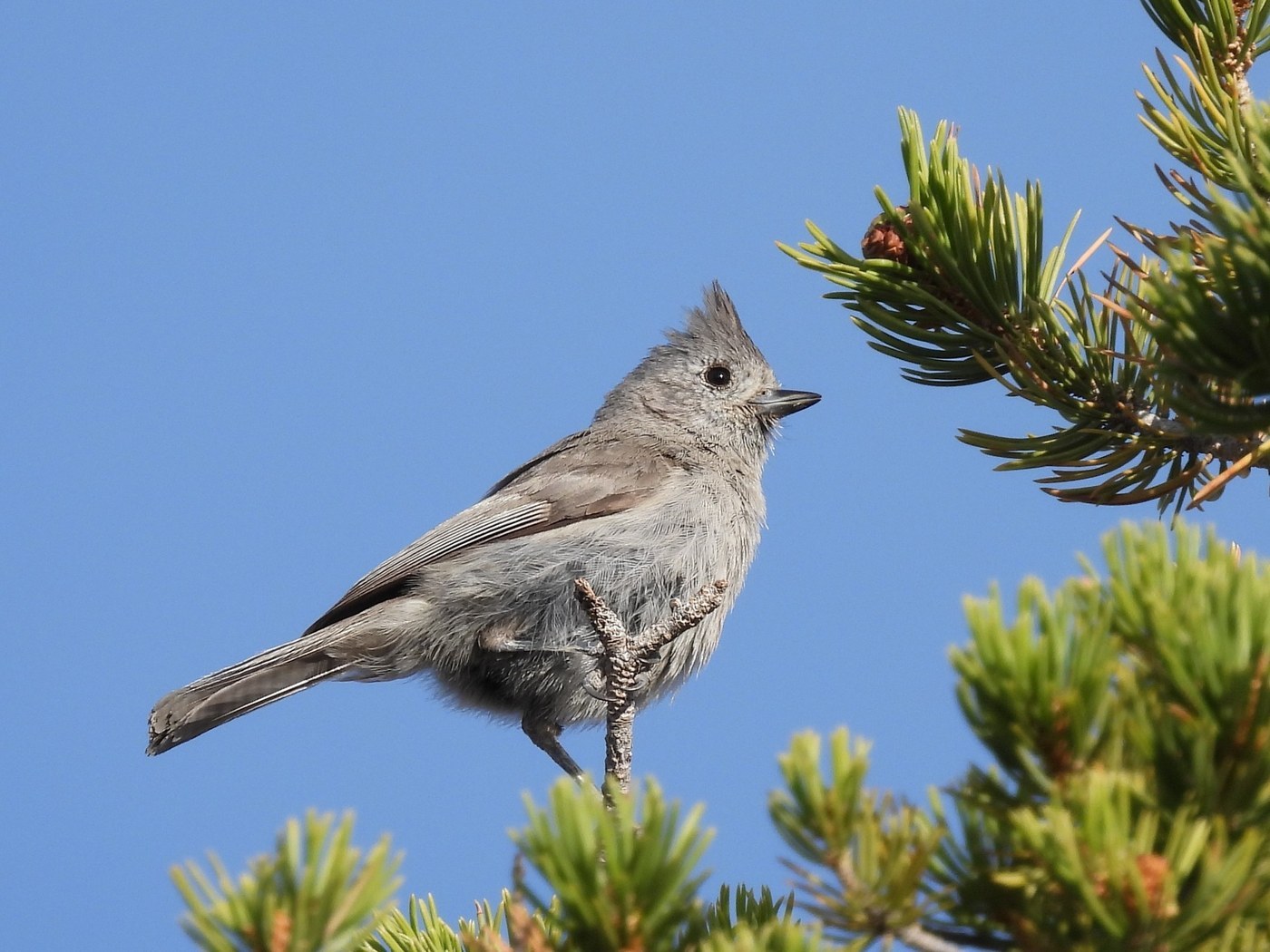
Juniper Titmouse
Baeolophus ridgwayi
A plain gray, crested titmouse of pinyon-juniper woodlands across the Great Basin and interior West.
- Size
- 13-14.5 cm (5.1-5.7 in) long, 20-23 cm wingspan
- Habitat
- pinyon-juniper woodlands of the Great Basin and interior western United States
- Type
- songbird
Spotted a bird like this?
Identify any bird from a photo, free.
Overview
The Juniper Titmouse is a small, plain gray, crested songbird closely resembling the Oak Titmouse but adapted to a different habitat — the pinyon pine and juniper woodlands of the Great Basin and surrounding interior West. It shows the same lack of bold plumage markings typical of the group: uniform gray body, modest crest, plain face, and no wing bars.
Until relatively recently, the Juniper and Oak Titmice were considered a single species called the Plain Titmouse, before being split based on differences in voice, habitat, and subtle plumage tone. The Juniper Titmouse is tightly bound to pinyon-juniper woodland and rarely strays from it.
How to identify it
Key Field Marks
- Plain gray body, slightly grayer overall than the browner-toned Oak Titmouse
- Modest pointed crest
- Plain face with no bold pattern
- Short dark bill
Similar Species
- Oak Titmouse: nearly identical but browner-toned overall and found in California oak woodland rather than Great Basin pinyon-juniper habitat, with minimal range overlap.
- Bridled Titmouse: bold black-and-white face pattern readily separates it from the plain-faced Juniper Titmouse.
- Bushtit: much smaller, longer-tailed, and lacks a crest.
Habitat & range
Habitat
Juniper Titmice are closely tied to pinyon-juniper woodland, and are also found in adjacent oak or riparian habitat where pinyon-juniper woodland borders it.
Range
The species occurs throughout the Great Basin and interior West, including parts of Nevada, Utah, Colorado, Arizona, New Mexico, and portions of surrounding states.
Migration
Juniper Titmice are non-migratory and sedentary, generally remaining within a small home range year-round, closely tied to the presence of pinyon-juniper woodland.
Behavior & voice
Behavior
Active and curious, Juniper Titmice forage through pinyon and juniper canopy, often joining mixed flocks with chickadees, nuthatches, and bushtits outside the breeding season.
Voice
The song is a rapid, repeated whistled phrase, similar in structure to the Oak Titmouse's song but subtly different in quality; calls include a harsh, scolding chatter.
Feeding
Diet includes insects and spiders gleaned from bark and foliage, along with seeds and juniper berries, which form an important food source, especially in winter.
Nesting
Nests are built in natural cavities or old woodpecker holes in junipers or pinyon pines, lined with fur, feathers, and plant material. Clutches typically number 3-9 eggs.
Frequently asked questions
How is the Juniper Titmouse different from the Oak Titmouse?
The two look almost identical but occupy different habitats and ranges: Juniper Titmouse in Great Basin pinyon-juniper woodland, Oak Titmouse in California oak woodland, with subtle differences in voice and grayer versus browner tone.
Were Juniper and Oak Titmice once considered the same species?
Yes, they were formerly lumped together as the Plain Titmouse before being split into two species based on differences in voice, habitat, and plumage tone.
Where does the Juniper Titmouse live?
In pinyon-juniper woodlands across the Great Basin and interior western United States, including Nevada, Utah, Colorado, Arizona, and New Mexico.
Does the Juniper Titmouse migrate?
No, it is a sedentary, non-migratory resident closely tied to its pinyon-juniper woodland habitat year-round.
What does the Juniper Titmouse eat?
Insects, spiders, seeds, and juniper berries, with berries being an especially important food source in winter.
Juniper Titmouse guides
In-depth guides for identifying, finding, and understanding Juniper Titmouse.
Other birds you may enjoy

Black Redstart
13-14.5 cm (5.1-5.7 in) long, 23-26 cm wingspan

Black-throated Sparrow
12-14 cm (4.7-5.5 in) long, about 19-20 cm (7.5-8 in) wingspan

Greater Bird-of-paradise
Body about 43 cm; males with additional flank plumes up to 50 cm and long tail wires

Blue Tit
11-12 cm (4.3-4.7 in) long, 17-20 cm wingspan

Red-billed Quelea
11.5–13 cm long, wingspan about 20–22 cm
White-plumed Antbird
13-14 cm (5-5.5 in) long

Pyrrhuloxia
19-22 cm (7.5-8.7 in) long, 30 cm wingspan

Blue-gray Tanager
16-18 cm (6-7 in) long

Blackburnian Warbler
11-13 cm (4.3-5.1 in) long, 20-22 cm wingspan

Bluethroat
13-14 cm (5.1-5.5 in) long, 20-22 cm wingspan

Eurasian Nuthatch
12-14.5 cm (4.7-5.7 in) long, 22.5-27 cm wingspan

Wood Thrush
19-21 cm (7.5-8.3 in) long, about 33 cm (13 in) wingspan