
Juniper Titmouse Identification Guide
A plain gray, crested songbird of the arid interior West, nearly identical to the Oak Titmouse but separated by range, habitat, and voice.
Read the full Juniper Titmouse encyclopedia entry →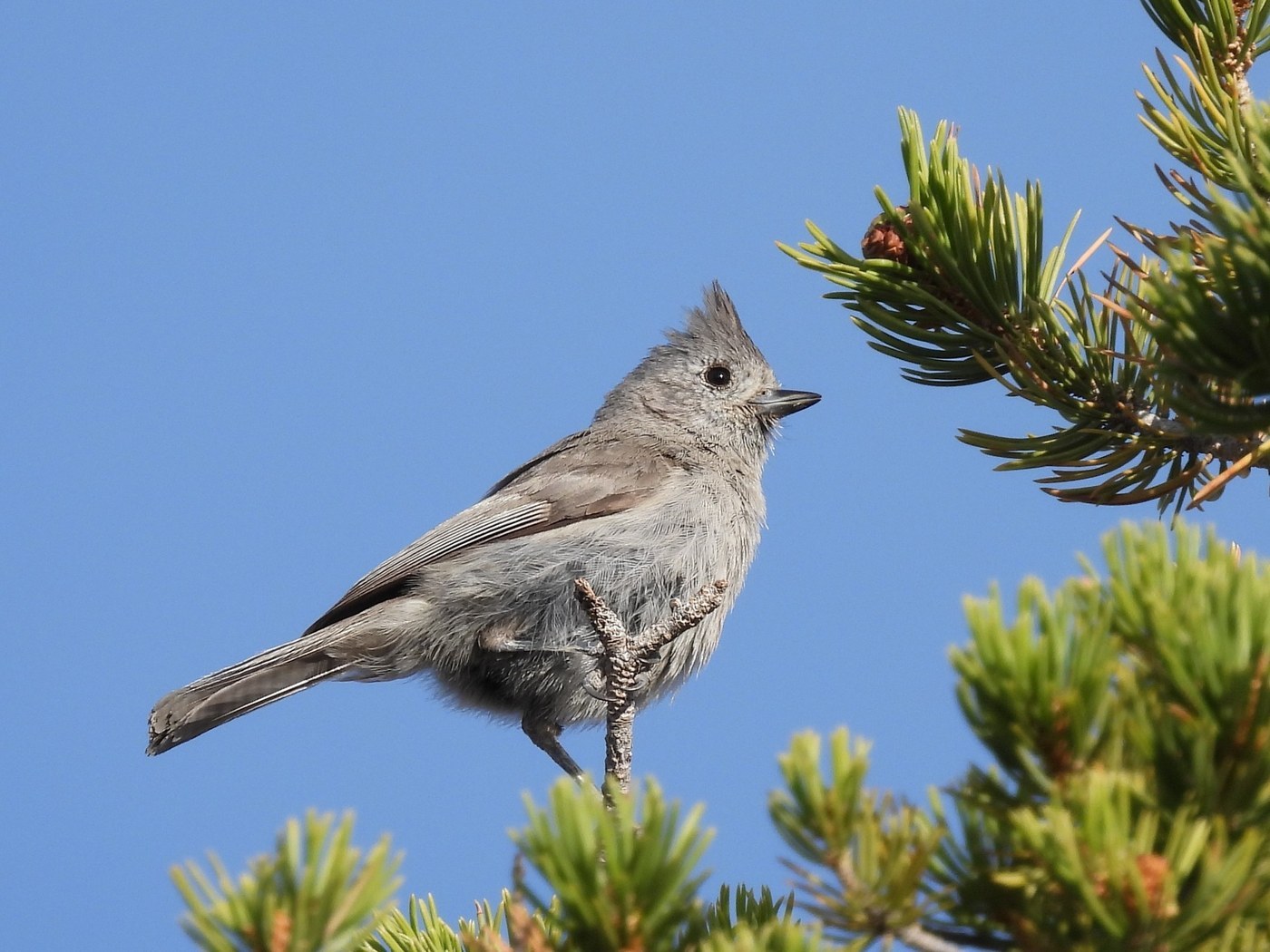
Key Field Marks
- Size & shape: Small songbird with a short, pointed crest, giving a distinctive peaked-head silhouette.
- Plumage: Uniformly gray to grayish-brown overall, with no bold markings, wing bars, or contrasting patches — one of the plainest-looking titmice.
- Bill & eyes: Short, stubby bill; dark eye that doesn't stand out much against the gray-brown head.
- Legs: Gray.
Separating It From Similar Species
- Oak Titmouse: Essentially identical in plumage; the two were once considered a single species ("Plain Titmouse"). They are best separated by range (Juniper Titmouse occupies pinyon-juniper woodlands of the Great Basin and Four Corners region, while Oak Titmouse occupies California oak woodland and chaparral, with limited range overlap) and by voice — Juniper Titmouse's song and calls tend to be faster and harsher.
- Bridled Titmouse: Clearly different, showing a bold black-and-white facial pattern with a black bib, unlike the plain face of Juniper Titmouse.
Where & When to See One
A habitat specialist strongly tied to pinyon-juniper woodland across the arid interior western United States, including the Great Basin and Colorado Plateau/Four Corners region. It is a non-migratory permanent resident, so it can be found in the same woodlands year-round.
Behavior & Voice
Forages actively in juniper and pinyon pine canopy for insects and seeds (including pine seeds), and readily joins mixed-species foraging flocks with chickadees, nuthatches, and kinglets in the non-breeding season. Nests in tree cavities. Its calls include a rapid, harsh, chickadee-like scolding series, and its song is a fast, rattling "jrrrit-jrrrit-jrrrit," delivered more quickly and harshly than the similar song of Oak Titmouse.
Frequently asked questions
How do I tell a Juniper Titmouse from an Oak Titmouse?
The two species look nearly identical, so range and habitat are key: Juniper Titmouse lives in pinyon-juniper woodland of the Great Basin and Four Corners region, while Oak Titmouse lives in California oak woodland; their voices also differ, with Juniper Titmouse's calls and song being faster and harsher.
What habitat is most reliable for finding a Juniper Titmouse?
Pinyon-juniper woodland — it is a strong habitat specialist for this vegetation type across the arid interior West.
Does the Juniper Titmouse migrate?
No, it is a non-migratory permanent resident found in the same woodlands year-round.
What does a Juniper Titmouse's song sound like?
A fast, harsh, rattling series often rendered as 'jrrrit-jrrrit-jrrrit,' quicker and coarser than the similar song of the Oak Titmouse.