
Java Sparrow
Lonchura oryzivora
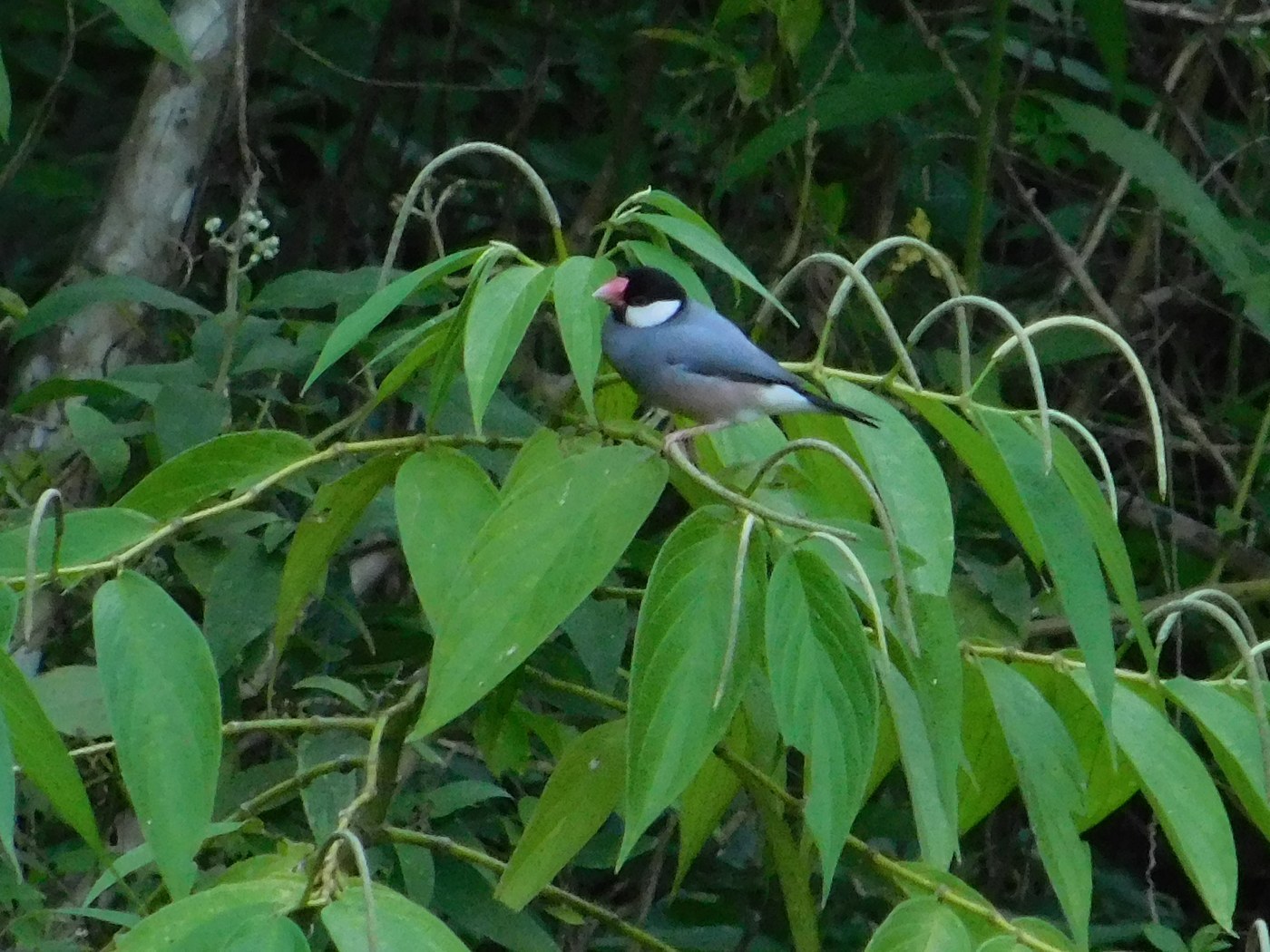
A sleek grey-and-white estrildid finch with a bold black head, white cheek patch, and a large pink bill, native to Indonesia and widely introduced elsewhere.
- Size
- About 14–17 cm (5.5–6.7 in) long, including a proportionally long tail
- Habitat
- Lowland grassland, cultivated fields, and open scrub, native to Java and Bali
- Type
- songbird
Spotted a bird like this?
Identify any bird from a photo, free.
Overview
Overview
The Java Sparrow is a stocky, sleek finch (not a true sparrow) native to the Indonesian islands of Java and Bali. It has a smooth blue-grey body, a black head and tail, and a large, conspicuous pink bill with a matching pink eye-ring.
Plumage
A large white patch covers each cheek, standing out sharply against the black head. The underparts fade from grey on the breast to pale pinkish-buff on the belly. Sexes look alike. Juveniles are duller brown-grey overall with a dark bill and lack the crisp white cheek patch until maturing.
How to identify it
Field Marks
- Plump grey body with a black head and tail and a large, thick pink bill
- Bold white oval patch on each cheek is diagnostic
- Pink eye-ring and pink legs
Similar Species
No other estrildid finch shares this exact combination of grey body, black head, white cheek patch, and heavy pink bill, making adults readily identifiable. Juveniles, lacking the white cheek patch, can be confused with other munias but show a proportionally larger bill and overall grey (rather than brown) tone.
Habitat & range
Habitat & Range
The Java Sparrow is native to the lowlands of Java and Bali in Indonesia, where it favors open grassland, cultivated fields, and scrubby edges near human settlement. Because of its popularity in the cage-bird trade over past centuries, escaped and released birds established free-living populations in parts of Asia, East Africa, and elsewhere, though many introduced populations have since declined or disappeared.
Within its native range, the wild population has fallen steeply due to intensive historical trapping for trade and ongoing habitat conversion, leading to its endangered status; it is now considered scarce or absent across much of its original Indonesian range.
Behavior & voice
Behavior
Java Sparrows are gregarious, forming flocks that forage together on the ground and in low vegetation, often mixing with other seed-eating birds. Flight is direct and fairly fast on rounded wings.
Voice
Calls include a sharp, metallic "chip" or "tup" contact note; the song is a soft series of clicks, buzzes, and short warbled phrases.
Feeding
Birds feed mainly on grass and cereal seeds gleaned from the ground or seed heads, taking small insects opportunistically.
Nesting & Breeding
Pairs build bulky domed nests of grass in tree cavities, building eaves, or dense vegetation, laying small clutches of white eggs that both parents help incubate and rear.
Frequently asked questions
Is the Java Sparrow a true sparrow?
No, despite its common name it is an estrildid finch, more closely related to munias and mannikins than to true sparrows.
What does a Java Sparrow look like?
It has a smooth grey body, black head and tail, a bold white patch on each cheek, and a large pink bill and eye-ring.
Is the Java Sparrow endangered?
Yes, it is classified as Endangered in the wild due to historic trapping pressure and habitat loss in its native Java and Bali range.
Where is the Java Sparrow originally from?
It is native to the Indonesian islands of Java and Bali, though escaped populations have become established in scattered locations elsewhere.
What do Java Sparrows eat?
Primarily grass and cereal seeds, supplemented occasionally with small insects.
Java Sparrow guides
In-depth guides for identifying, finding, and understanding Java Sparrow.
Other birds you may enjoy

Black Redstart
13-14.5 cm (5.1-5.7 in) long, 23-26 cm wingspan

Black-throated Sparrow
12-14 cm (4.7-5.5 in) long, about 19-20 cm (7.5-8 in) wingspan

Greater Bird-of-paradise
Body about 43 cm; males with additional flank plumes up to 50 cm and long tail wires

Blue Tit
11-12 cm (4.3-4.7 in) long, 17-20 cm wingspan

Red-billed Quelea
11.5–13 cm long, wingspan about 20–22 cm
White-plumed Antbird
13-14 cm (5-5.5 in) long

Pyrrhuloxia
19-22 cm (7.5-8.7 in) long, 30 cm wingspan

Blue-gray Tanager
16-18 cm (6-7 in) long

Blackburnian Warbler
11-13 cm (4.3-5.1 in) long, 20-22 cm wingspan

Bluethroat
13-14 cm (5.1-5.5 in) long, 20-22 cm wingspan

Eurasian Nuthatch
12-14.5 cm (4.7-5.7 in) long, 22.5-27 cm wingspan

Wood Thrush
19-21 cm (7.5-8.3 in) long, about 33 cm (13 in) wingspan