
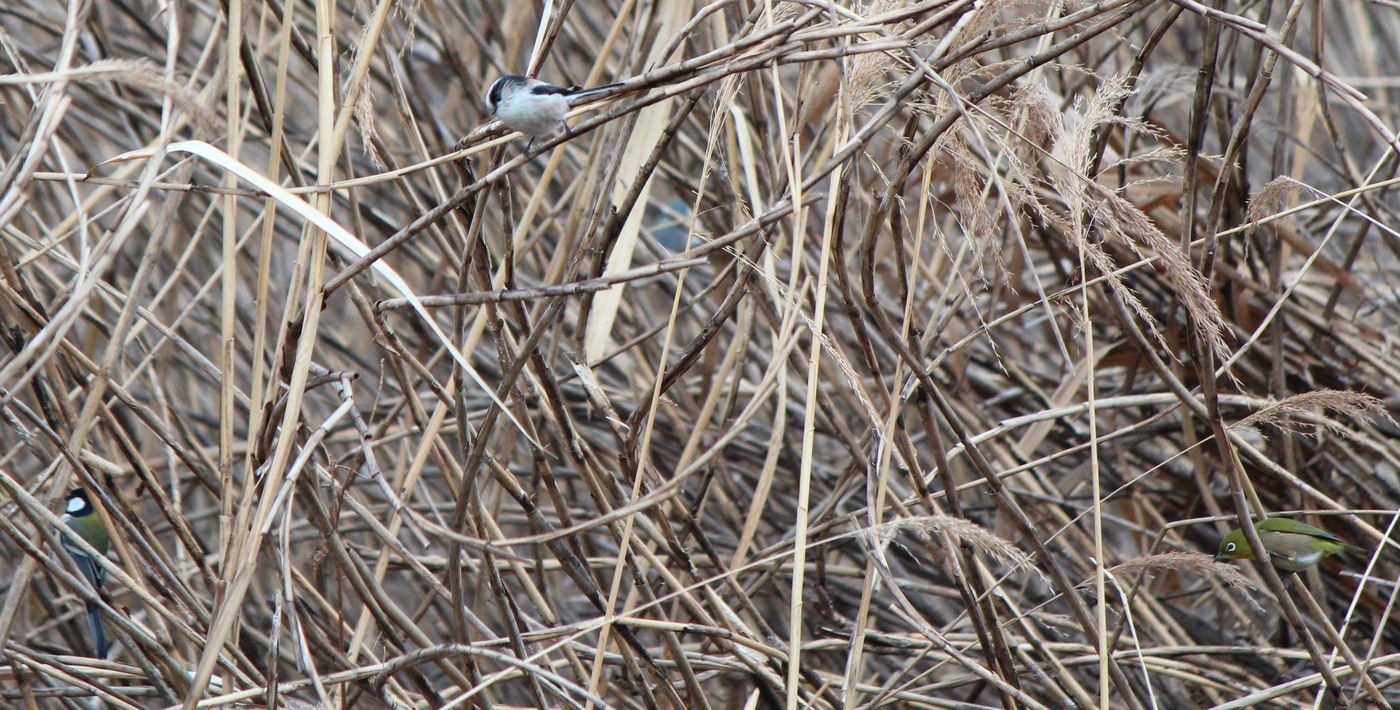
Japanese Tit
Parus minor
A cheerful East Asian tit with a glossy black head, white cheek patches, and a bold black stripe down its yellowish-white underside.
- Size
- 13-15 cm (5-6 in) long, 20-22 cm wingspan
- Habitat
- deciduous and mixed forests, woodlands, parks, and gardens
- Type
- songbird
Spotted a bird like this?
Identify any bird from a photo, free.
Overview
The Japanese Tit is a small, active songbird closely related to the familiar Great Tit of Europe, from which it was split as a separate species. It has a glossy black head and bib, contrasting white cheek patches, an olive-grey back, and pale underparts marked by a black central stripe running from the bib down the belly. This stripe is typically broader and bolder in males, offering a simple way to tell the sexes apart.
A familiar and vocal bird across much of East Asia, it is a frequent visitor to gardens, parks, and forest edges, often seen probing bark and foliage for insects in mixed foraging flocks, especially outside the breeding season.
How to identify it
Key field marks
- Glossy black head, nape, and throat with clean white cheek patches
- Bold black stripe down the center of the pale underparts, wider in males
- Olive-grey to bluish-grey back and wings with a pale wing bar
- Short, stout black bill suited to probing bark and foliage
Similar species
- Varied Tit has chestnut underparts and a black-and-white face pattern, easily distinguished by color alone.
- Great Tit of Europe is very similar but allopatric (non-overlapping range) and generally shows a slightly more yellow-green back in some populations; the two were only recently split.
- Coal Tit lacks the yellow-white belly and has a white nape patch instead.
Habitat & range
Habitat
Inhabits deciduous and mixed forests, woodland edges, bamboo groves, and readily adapts to parks, gardens, and suburban tree cover.
Range
Widespread across Japan, the Korean Peninsula, eastern China, Taiwan, and parts of the Russian Far East.
Migration
Largely resident, though some northern populations make short-distance altitudinal or latitudinal movements in winter, and birds often join mixed-species foraging flocks in the colder months.
Behavior & voice
Behavior
Active and acrobatic, frequently hanging upside down from twigs while gleaning insects from foliage and bark crevices; often joins mixed flocks with other tits, woodpeckers, and warblers outside the breeding season.
Voice
Song is a bright, ringing, repeated "tsi-tsi-pee, tsi-tsi-pee"; calls include a scolding "chika-chika-chika" and various sharp notes.
Feeding
Forages on insects, spiders, and their larvae for most of the year, switching to seeds and berries in autumn and winter; readily visits garden feeders.
Nesting
A cavity nester, using natural tree holes, old woodpecker holes, or nest boxes; builds a moss-and-fur lined cup and lays 6-10 white eggs speckled with reddish-brown.
Frequently asked questions
How do you tell a male from a female Japanese Tit?
Males have a wider, bolder black stripe running down the center of the belly, while females show a narrower, sometimes broken stripe.
Is the Japanese Tit the same as the Great Tit?
It was formerly considered a subspecies of the Great Tit but is now recognized as a separate species, Parus minor, found across East Asia rather than Europe.
What does a Japanese Tit eat?
Mostly insects and spiders during the breeding season, switching to seeds and berries in colder months, and it readily visits feeders.
Where does the Japanese Tit live?
In deciduous and mixed forests, woodland edges, parks, and gardens across Japan, Korea, eastern China, and Taiwan.
Japanese Tit guides
In-depth guides for identifying, finding, and understanding Japanese Tit.
Other birds you may enjoy

Black Redstart
13-14.5 cm (5.1-5.7 in) long, 23-26 cm wingspan

Black-throated Sparrow
12-14 cm (4.7-5.5 in) long, about 19-20 cm (7.5-8 in) wingspan

Greater Bird-of-paradise
Body about 43 cm; males with additional flank plumes up to 50 cm and long tail wires

Blue Tit
11-12 cm (4.3-4.7 in) long, 17-20 cm wingspan

Red-billed Quelea
11.5–13 cm long, wingspan about 20–22 cm
White-plumed Antbird
13-14 cm (5-5.5 in) long

Pyrrhuloxia
19-22 cm (7.5-8.7 in) long, 30 cm wingspan

Blue-gray Tanager
16-18 cm (6-7 in) long

Blackburnian Warbler
11-13 cm (4.3-5.1 in) long, 20-22 cm wingspan

Bluethroat
13-14 cm (5.1-5.5 in) long, 20-22 cm wingspan

Eurasian Nuthatch
12-14.5 cm (4.7-5.7 in) long, 22.5-27 cm wingspan

Wood Thrush
19-21 cm (7.5-8.3 in) long, about 33 cm (13 in) wingspan