
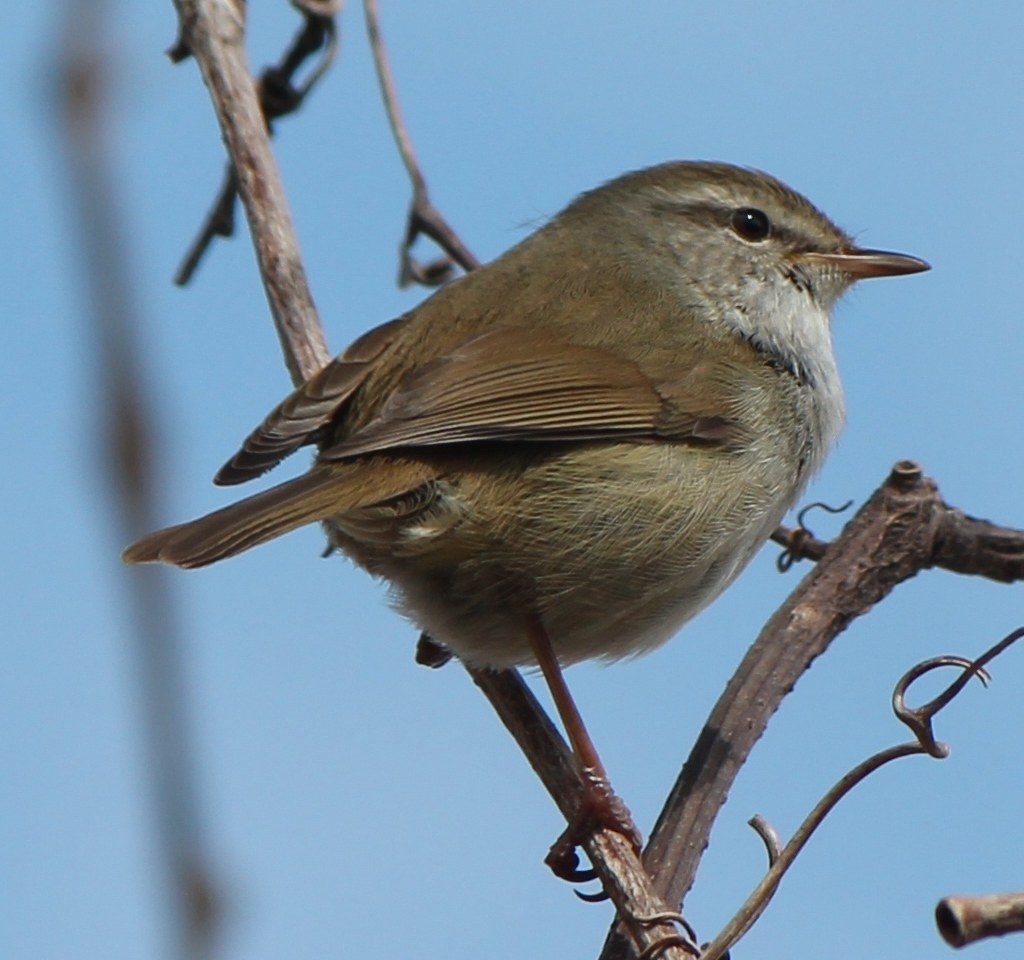
Japanese Bush Warbler
Horornis diphone
A skulking, plain olive-brown warbler far better known for its explosive, flute-like spring song than for its rarely seen plumage.
- Size
- 14-16 cm (5.5-6.3 in) long
- Habitat
- dense undergrowth, thickets, bamboo groves, and scrubby woodland
- Type
- songbird
Spotted a bird like this?
Identify any bird from a photo, free.
Overview
The Japanese Bush Warbler is a plain, olive-brown bird with a pale supercilium and paler underparts, offering little in the way of striking plumage. What it lacks in color it makes up for in voice: its loud, distinctive song is one of the most iconic sounds of the East Asian spring and has made the species, known in Japan as "uguisu," a celebrated symbol of the season in poetry and culture.
The bird itself is notoriously difficult to see, spending nearly all of its time hidden within dense low vegetation, where it creeps and hops rather than flies, making the ears far more useful than the eyes for detecting its presence.
How to identify it
Key field marks
- Plain olive-brown upperparts with no wing bars or strong markings
- Pale buffy-white underparts and a pale supercilium (eyebrow stripe)
- Rounded wings and a longish, often cocked tail
- Skulking behavior, staying low in dense cover rather than perching in the open
Similar species
- Many other small brown warblers occur in the region, but the Japanese Bush Warbler's unmistakable, far-carrying song is the most reliable way to confirm its identity.
- Manchurian Bush Warbler and other related bush warblers are very similar in plumage and best separated by voice and range.
Habitat & range
Habitat
Favors dense, low tangles of scrub, bamboo, brambles, and thick undergrowth in forest understory, forest edge, and overgrown gardens.
Range
Breeds across Japan, the Korean Peninsula, and parts of eastern China and the Russian Far East; also introduced to Hawaii.
Migration
Northern and montane populations migrate to lower elevations or further south for winter, while southern populations are largely resident.
Behavior & voice
Behavior
Extremely skulking, moving through dense low cover on foot or with short hopping flights, and rarely venturing into the open; males sing from cover to defend territory.
Voice
A loud, explosive song beginning with a long whistled "hoo" followed by a rapid, bubbling "hokekyo," often rendered as "hoo-hokekyo"; also gives a sharp, scolding call note.
Feeding
Gleans insects, spiders, and other small invertebrates from low vegetation and leaf litter, occasionally taking berries in colder months.
Nesting
Builds a well-hidden, domed or cup nest low in dense shrubs or bamboo; lays 4-6 chocolate-brown eggs.
Frequently asked questions
Why is the Japanese Bush Warbler famous?
It is celebrated for its loud, distinctive spring song, a whistled "hoo" followed by a bubbling "hokekyo," which is one of the most recognized bird sounds in Japan and a traditional symbol of spring.
Why is the Japanese Bush Warbler hard to see?
It is extremely skulking, spending nearly all its time hidden within dense undergrowth and thickets rather than perching in the open.
What does a Japanese Bush Warbler look like?
It is plain and olive-brown with a pale eyebrow stripe and pale underparts, with no bold markings.
What does a Japanese Bush Warbler eat?
Mainly insects and spiders gleaned from low vegetation and leaf litter, with some berries eaten in winter.
Japanese Bush Warbler guides
In-depth guides for identifying, finding, and understanding Japanese Bush Warbler.
Other birds you may enjoy

Black Redstart
13-14.5 cm (5.1-5.7 in) long, 23-26 cm wingspan

Black-throated Sparrow
12-14 cm (4.7-5.5 in) long, about 19-20 cm (7.5-8 in) wingspan

Greater Bird-of-paradise
Body about 43 cm; males with additional flank plumes up to 50 cm and long tail wires

Blue Tit
11-12 cm (4.3-4.7 in) long, 17-20 cm wingspan

Red-billed Quelea
11.5–13 cm long, wingspan about 20–22 cm
White-plumed Antbird
13-14 cm (5-5.5 in) long

Pyrrhuloxia
19-22 cm (7.5-8.7 in) long, 30 cm wingspan

Blue-gray Tanager
16-18 cm (6-7 in) long

Blackburnian Warbler
11-13 cm (4.3-5.1 in) long, 20-22 cm wingspan

Bluethroat
13-14 cm (5.1-5.5 in) long, 20-22 cm wingspan

Eurasian Nuthatch
12-14.5 cm (4.7-5.7 in) long, 22.5-27 cm wingspan

Wood Thrush
19-21 cm (7.5-8.3 in) long, about 33 cm (13 in) wingspan