
Japanese Bush Warbler Identification Guide
A skulking olive-brown warbler far more often heard than seen, famous for its explosive whistled song that heralds spring across Japan.
Read the full Japanese Bush Warbler encyclopedia entry →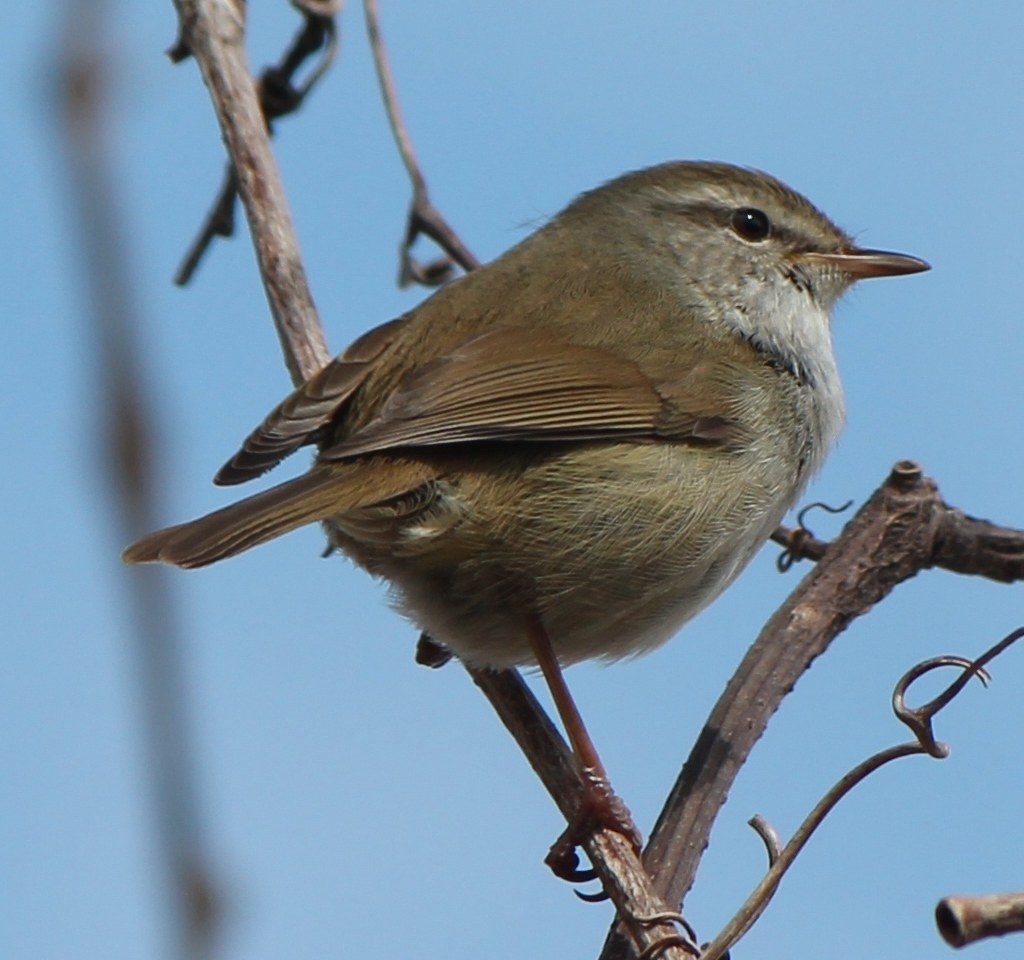
Key Field Marks
- Size & shape: Small, chunky warbler with a relatively long, often cocked tail and short, rounded wings.
- Plumage: Plain olive-brown upperparts with no wing bars or streaking; underparts are dull grayish-white to buffy.
- Head: A pale, somewhat indistinct eyebrow (supercilium) contrasts subtly with a darker eye-line.
- Bill: Fine and pointed, typical of a warbler.
- Sexes: Similar in plumage, though males average noticeably larger than females.
Separating It From Similar Species
- Most confusion species (other Asian bush warblers such as Manchurian Bush Warbler) are extremely similar in plumage and are best separated by voice, range, and habitat rather than appearance alone.
- Overall drab, unmarked olive-brown plumage combined with a skulking, low-to-the-ground habit helps rule out more boldly patterned warblers and buntings sharing its habitat.
Where & When to See One
Found throughout Japan (and locally in parts of Korea, China, and the Russian Far East), the Japanese Bush Warbler favors dense understory: thickets, bamboo groves, secondary scrub, forest edges, and even shrubby gardens and parks in lowlands and low mountains. It is a year-round resident across much of its range, though northern populations may shift to milder areas in winter. Introduced populations are also established in Hawaii.
Behavior & Voice
This species is a classic skulker — it forages low in dense cover and is reluctant to show itself in the open, so most encounters are auditory. Its loud, far-carrying song, often rendered as "hoo-hokekyo," is one of the most recognizable sounds of the Japanese countryside and is traditionally regarded as a herald of spring. The call is a sharp, dry "chack" or scolding note given when disturbed.
Frequently asked questions
Why is the Japanese Bush Warbler so hard to see?
It is a skulking species that stays low in dense thickets and bamboo understory, rarely venturing into the open, so birders usually detect it by its distinctive song rather than by sight.
What does the Japanese Bush Warbler's song sound like?
A loud, whistled phrase often transcribed as 'hoo-hokekyo,' widely recognized in Japan as a sound announcing the arrival of spring.
Where can I find Japanese Bush Warblers?
In dense scrub, bamboo groves, and thicketed forest edges across Japan, as well as parts of Korea, China, and the Russian Far East; an introduced population also exists in Hawaii.
Do male and female Japanese Bush Warblers look different?
No, plumage is similar between sexes, but males are noticeably larger-bodied than females.