
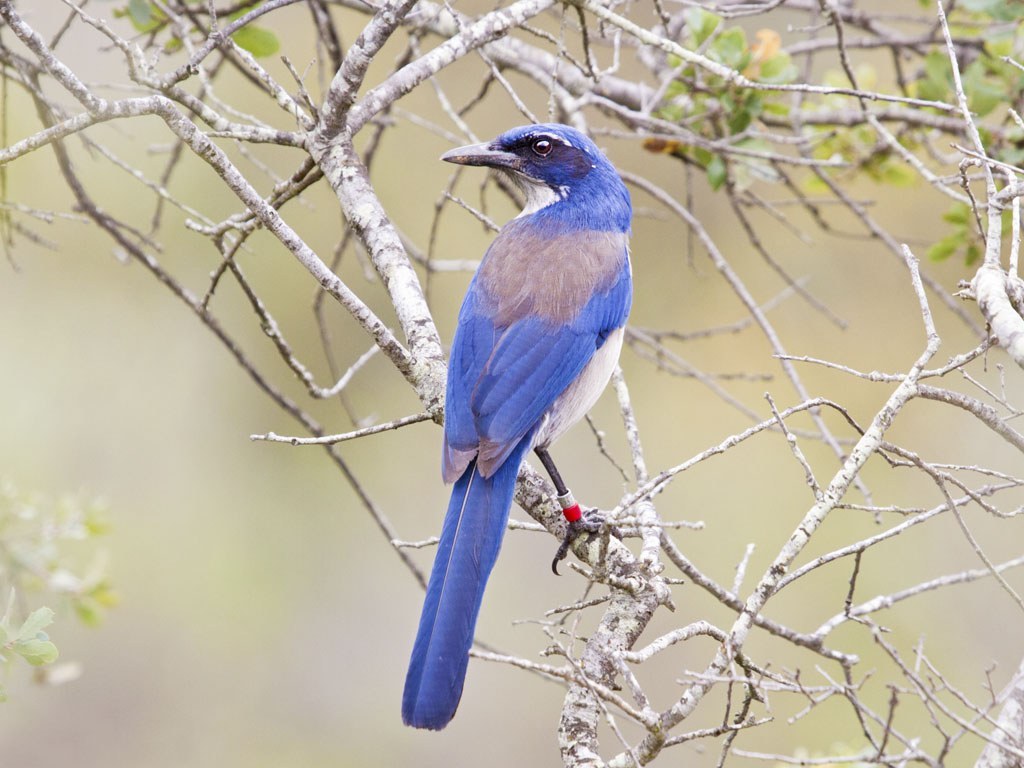
Island Scrub-Jay
Aphelocoma insularis
A large, deep-blue scrub-jay found only on Santa Cruz Island off the California coast, the most range-restricted bird in the continental United States.
- Size
- 31-34 cm (12-13.5 in) long, larger than mainland scrub-jays
- Habitat
- oak woodland, pine forest, and chaparral, found only on Santa Cruz Island, California
- Type
- songbird
Spotted a bird like this?
Identify any bird from a photo, free.
Overview
The Island Scrub-Jay is a striking, oversized relative of the mainland scrub-jays found exclusively on Santa Cruz Island in the Channel Islands off Santa Barbara, California, making it the bird species with the smallest range in the continental United States. It is noticeably larger, bulkier, and more richly, deeply colored than its mainland relatives, with a bold blue head, wings, and tail and a striking blue necklace across a whitish breast.
Having evolved in isolation on a single island roughly 250 square kilometers in area, the species shows a classic example of island gigantism among songbirds and has become an important focus of island conservation efforts.
How to identify it
Key Field Marks
- Deep, saturated blue head, wings, and tail, darker and richer than mainland scrub-jays
- Larger overall size and a notably longer, heavier bill than related species
- White-streaked throat bordered by a bold blue necklace
- Pale grayish underparts
Similar Species
- California Scrub-Jay, its closest mainland relative, is smaller with paler, less saturated blue plumage and a proportionally smaller bill; the two do not overlap since Island Scrub-Jay occurs only on Santa Cruz Island.
- No other jay occurs on Santa Cruz Island, so any scrub-jay seen there is this species.
Habitat & range
This species is found solely on Santa Cruz Island, the largest of California's Channel Islands, where it occupies a mosaic of oak woodland, closed-cone pine forest, and chaparral. Its entire global population is confined to this single island, with no other breeding population anywhere else in the world.
Island Scrub-Jays are non-migratory and permanent residents, with pairs defending year-round territories across the island's varied habitats.
Behavior & voice
Voice
Gives harsh, scratchy calls similar to mainland scrub-jays, including scolding rattles and a repeated shreep note, though the pitch and delivery differ subtly.
Feeding
Forages for acorns from the island's oaks and seeds from Bishop pine, along with insects and other invertebrates; caches acorns in the ground for later retrieval, playing a role in oak regeneration on the island.
Nesting
Builds a twig nest in dense shrubs or low trees; pairs are territorial and, unlike some mainland scrub-jays, generally do not breed cooperatively with helpers.
Frequently asked questions
Where does the Island Scrub-Jay live?
It is found only on Santa Cruz Island, part of Channel Islands National Park off the coast of Santa Barbara, California, and nowhere else in the world.
How is the Island Scrub-Jay different from mainland scrub-jays?
It is noticeably larger and more deeply, richly blue colored than the California Scrub-Jay, with a heavier bill, reflecting its evolution in isolation on the island.
Why is the Island Scrub-Jay considered vulnerable?
Its entire population is restricted to one small island, making it highly susceptible to disease outbreaks, wildfire, and other localized threats despite a currently stable population.
Can I see an Island Scrub-Jay on the California mainland?
No, the species does not occur on the mainland; seeing one requires visiting Santa Cruz Island itself.
Island Scrub-Jay guides
In-depth guides for identifying, finding, and understanding Island Scrub-Jay.
Other birds you may enjoy

Black Redstart
13-14.5 cm (5.1-5.7 in) long, 23-26 cm wingspan

Black-throated Sparrow
12-14 cm (4.7-5.5 in) long, about 19-20 cm (7.5-8 in) wingspan

Greater Bird-of-paradise
Body about 43 cm; males with additional flank plumes up to 50 cm and long tail wires

Blue Tit
11-12 cm (4.3-4.7 in) long, 17-20 cm wingspan

Red-billed Quelea
11.5–13 cm long, wingspan about 20–22 cm
White-plumed Antbird
13-14 cm (5-5.5 in) long

Pyrrhuloxia
19-22 cm (7.5-8.7 in) long, 30 cm wingspan

Blue-gray Tanager
16-18 cm (6-7 in) long

Blackburnian Warbler
11-13 cm (4.3-5.1 in) long, 20-22 cm wingspan

Bluethroat
13-14 cm (5.1-5.5 in) long, 20-22 cm wingspan

Eurasian Nuthatch
12-14.5 cm (4.7-5.7 in) long, 22.5-27 cm wingspan

Wood Thrush
19-21 cm (7.5-8.3 in) long, about 33 cm (13 in) wingspan