
Island Scrub-Jay Identification Guide
A large, deep-blue jay found nowhere on Earth except Santa Cruz Island off the California coast, distinguished from its mainland relative by its bigger size, bolder colors, and heavier bill.
Read the full Island Scrub-Jay encyclopedia entry →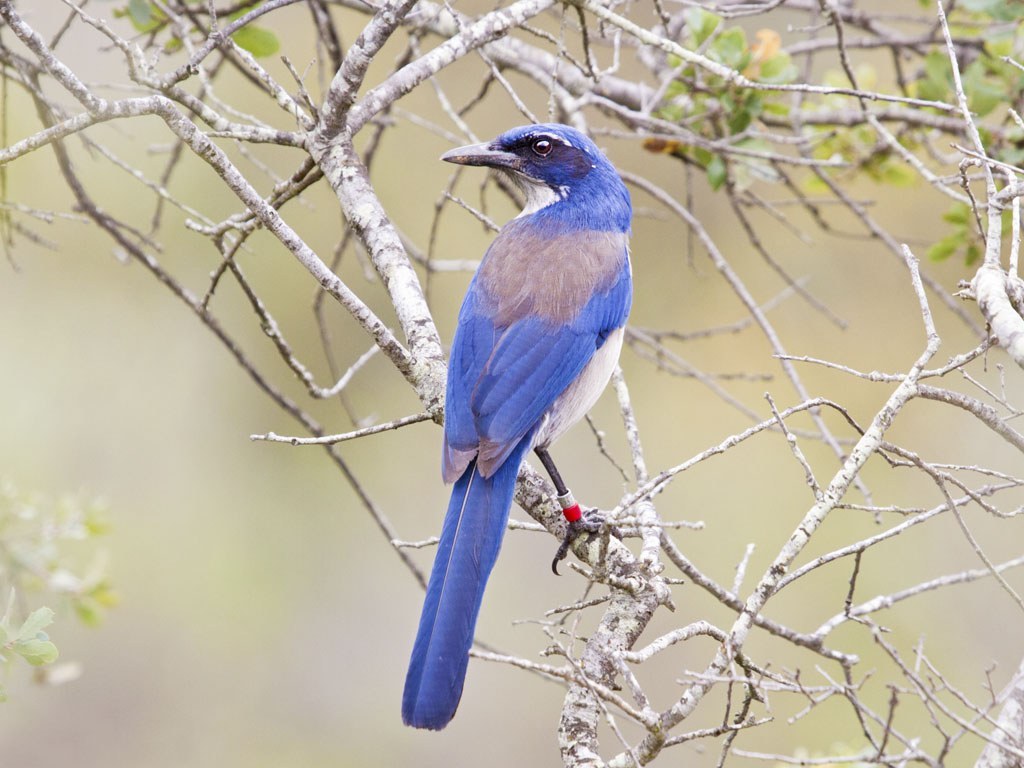
Key Field Marks
- Size & shape: A notably large, robust jay, about 12–13.5 inches (30–34 cm) long — roughly 20–30% bigger and bulkier than the mainland California Scrub-Jay, with a heavier, longer bill and a longer tail.
- Plumage: Deep, rich blue head, wings, and tail contrasting with a grayish-brown back; underparts are pale gray, with a bold, fairly solid blue-gray breast band/necklace across the upper chest — colors are noticeably brighter, more saturated blue than the mainland species.
- Face pattern: Shows a whitish eyebrow/supercilium and a blue-streaked white throat bordered by the blue breast band, similar in pattern to California Scrub-Jay but bolder.
- Bill: Notably large, thick, and heavy — an adaptation linked to its diet of large acorns from island oaks; the single best structural clue when direct size comparison isn't possible.
- Behavior/posture: Bold, inquisitive, and often approaches people closely; frequently perches conspicuously and holds its long tail level or slightly cocked.
Separating It From Similar Species
- California Scrub-Jay: The mainland counterpart and closest relative; Island Scrub-Jay is larger overall with a markedly heavier bill and deeper, more saturated blue plumage. Because the two do not overlap in range (Island Scrub-Jay is confined to Santa Cruz Island), location alone confirms identification — any scrub-jay seen on Santa Cruz Island is this species, and any seen on the mainland is not.
- Woodhouse's Scrub-Jay: Paler, grayer-blue overall with a less distinct breast band and no range overlap with Island Scrub-Jay.
- Steller's Jay (rare on nearby mainland coast): Has a prominent black crest and blackish head/upper body, entirely different from the crestless, all-blue-headed Island Scrub-Jay.
Where & When to See It
- Habitat: Restricted to a mix of oak woodland, chaparral, and pine forest on Santa Cruz Island; especially associated with island scrub oak, whose acorns are a primary food source.
- Range: The most range-restricted bird species in the continental United States — found only on Santa Cruz Island, one of the Channel Islands off the coast of Santa Barbara, California, and nowhere else in the world.
- Season: Non-migratory resident; present on the island year-round.
- Behavior: Caches acorns for later use (scatter-hoarding), an important ecological role in island oak regeneration; bold around humans in developed areas of the island; territorial and vocal, especially in the breeding season.
Voice
- Calls are harsher and lower-pitched than the mainland California Scrub-Jay's, including a raspy "shreep" or "jaay" scold, though the two species' vocal repertoires are broadly similar in structure.
Frequently asked questions
Where is the only place to see an Island Scrub-Jay?
Santa Cruz Island, one of California's Channel Islands off Santa Barbara — it is the only bird species in the continental U.S. restricted to a single small island, and simply being on the island confirms identification.
How is Island Scrub-Jay different from California Scrub-Jay?
Island Scrub-Jay is noticeably larger, with a heavier bill and deeper, more saturated blue plumage than its close mainland relative, the California Scrub-Jay; the two species do not overlap in range.
Why does the Island Scrub-Jay have such a large bill?
Its heavy bill is adapted for processing the large acorns of island scrub oak, a key food source it caches for later use.
Is the Island Scrub-Jay endangered?
It has a very small total range and population confined to one island, making it vulnerable to threats like disease and habitat change, and it is considered a species of conservation concern, though conservation efforts on the island have helped stabilize numbers.