
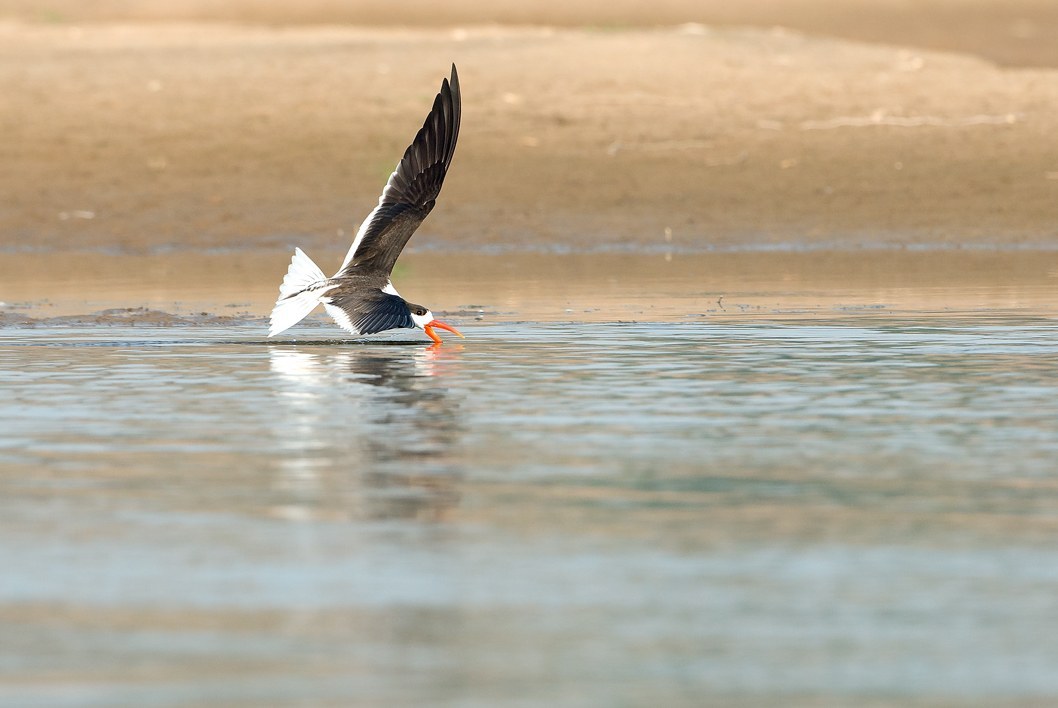
Indian Skimmer
Rynchops albicollis
A striking black-capped skimmer of South Asian rivers, now Endangered due to widespread loss of undisturbed sandbar habitat along major waterways.
- Size
- 40-43 cm (16-17 in) long, about 108 cm wingspan
- Habitat
- large rivers and lakes of South and Southeast Asia
- Type
- seabird
Spotted a bird like this?
Identify any bird from a photo, free.
Overview
The Indian Skimmer is the rarest and most range-restricted of the three skimmer species, confined to river systems of South and Southeast Asia. It shares the family's unmistakable bill shape but has suffered steep declines linked to habitat degradation along its riverine breeding grounds.
Appearance
Adults have a black cap and black upperparts contrasting with white underparts and a white collar around the hindneck, along with a yellow-orange bill tipped in black and orange-red legs.
How to identify it
Key field marks
- Black cap sharply defined against a white collar and underparts
- Yellow-orange bill with a black tip
- Orange-red legs
- Elongated lower mandible typical of skimmers
- Graceful, low flight over rivers while foraging
Similar species
The Indian Skimmer's range does not overlap with the Black or African Skimmers, so geography readily separates them; within its range it is distinctive and unlikely to be confused with any other bird due to its unique bill.
Habitat & range
Habitat and range
Indian Skimmers are found along large, slow-flowing rivers, lakes, and estuaries across the Indian subcontinent and parts of Southeast Asia, with strongholds along major river systems in India, Nepal, Bangladesh, and Myanmar. They depend on wide river channels with exposed sandbars for both foraging and breeding.
The species has disappeared from large parts of its historic range due to river damming, sand mining, and pollution, leading to its current fragmented and declining distribution.
Behavior & voice
Behavior
Indian Skimmers forage in the same manner as other skimmers, flying low over calm river water with the lower mandible slicing the surface to detect and seize small fish.
Voice
Calls are sharp, tern-like notes, given especially in alarm near nesting colonies on exposed sandbars.
Nesting and breeding
Breeding occurs colonially on riverine sandbars exposed during the dry season, with two to four eggs laid in a shallow scrape. Nesting success is heavily threatened by disturbance from fishing, sand extraction, livestock grazing, and unpredictable water releases from upstream dams.
Frequently asked questions
Why is the Indian Skimmer Endangered?
Its breeding depends on undisturbed river sandbars, which have been widely lost or degraded due to dam construction, sand mining, and increasing human disturbance along major rivers.
Where does the Indian Skimmer live?
Along large rivers, lakes, and estuaries of the Indian subcontinent and parts of Southeast Asia.
How do you identify an Indian Skimmer?
Look for a black cap, white collar and underparts, a yellow-orange bill with a black tip, and orange-red legs.
What does the Indian Skimmer eat?
Small fish, caught by skimming its elongated lower bill through the water's surface in low flight.
Indian Skimmer guides
In-depth guides for identifying, finding, and understanding Indian Skimmer.
Other birds you may enjoy
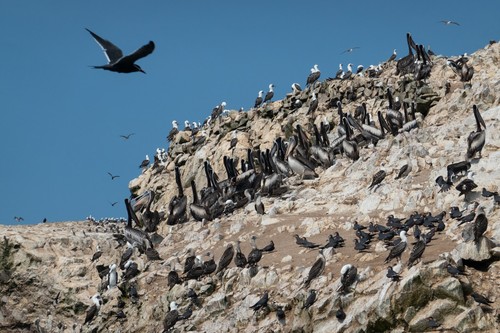
Peruvian Pelican
137-152 cm (54-60 in) long, up to 228 cm wingspan
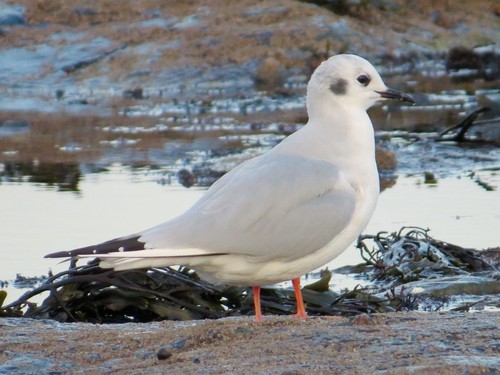
Bonaparte's Gull
28-33 cm (11-13 in) long, 76-84 cm wingspan
Brown Pelican
106-137 cm (42-54 in) long, 200-230 cm wingspan
Razorbill
37-39 cm (15-15.5 in) long, 63-68 cm wingspan
Common Gull
40-46 cm (16-18 in) long, 110-130 cm wingspan
Thick-billed Murre
40-48 cm (16-19 in) long, 65-75 cm wingspan
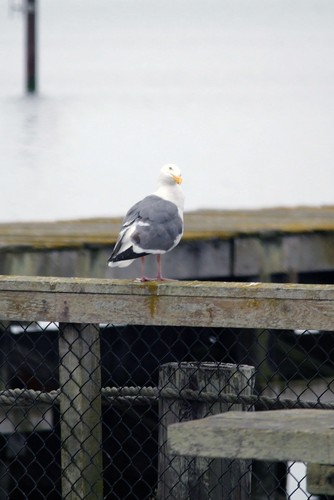
Western Gull
55-68 cm (22-27 in) long, 130-144 cm wingspan
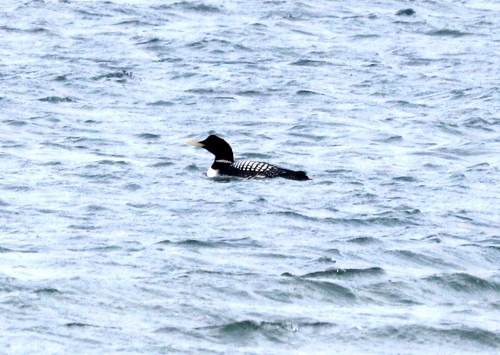
Yellow-billed Loon
76-97 cm (30-38 in) long, 135-152 cm wingspan
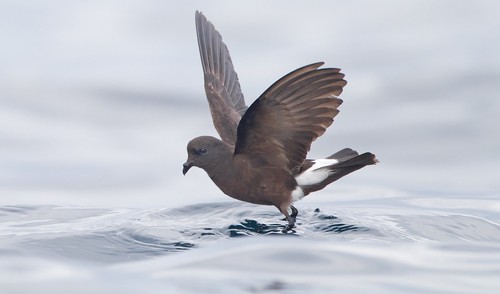
Wilson's Storm-Petrel
15-19 cm (6-7.5 in) long, wingspan 38-42 cm (15-16.5 in)
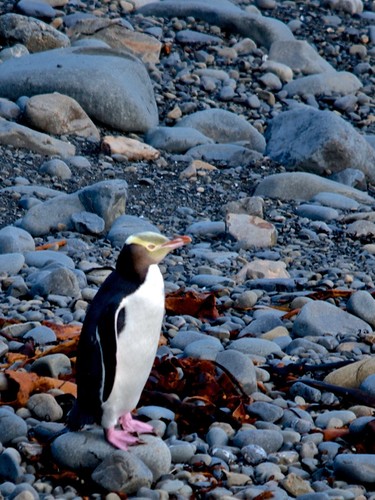
Yellow-eyed Penguin
62-79 cm (24-31 in) tall, 3-8.5 kg (6.6-18.7 lb)
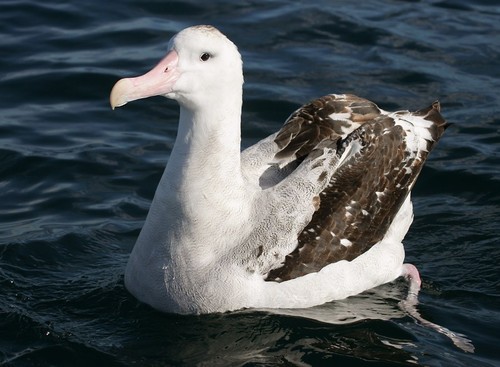
Wandering Albatross
107-135 cm (42-53 in) long, wingspan up to 3.5 m (11.5 ft)
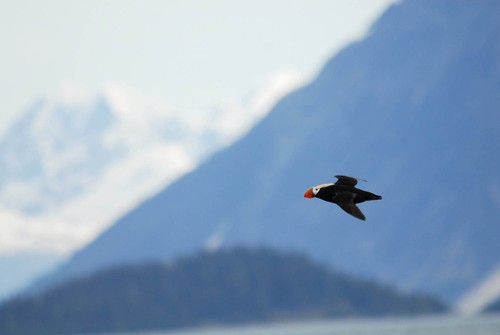
Tufted Puffin
35-41 cm (14-16 in) long, about 63-70 cm wingspan