
Indian Skimmer Identification Guide
An endangered riverine tern relative with a striking orange knife-blade bill, best known for skimming its lower mandible across the water surface to catch fish.
Read the full Indian Skimmer encyclopedia entry →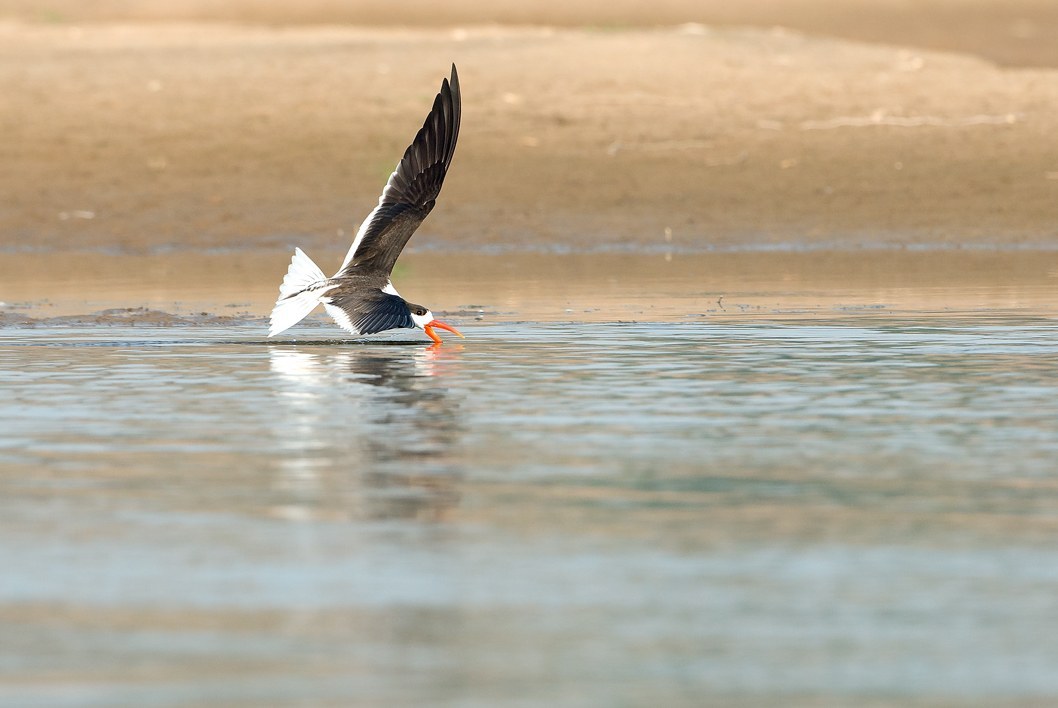
Key Field Marks
- Size & shape: A medium-large waterbird, about 16–17 inches (40–43 cm) long, with long pointed wings, a short forked tail, and short red legs; the body is sleek and tern-like.
- Bill: The standout feature — a long, laterally compressed, knife-like bill that is bright orange-yellow with a yellow tip; the lower mandible is distinctly longer than the upper, an adaptation for skimming the water surface.
- Plumage: Clean black cap and upperparts contrasting sharply with white underparts, forehead, and collar — a bold black-and-white pattern similar to a large tern.
- In flight: Long, pointed black wings with a white trailing edge on the secondaries; flight is buoyant and graceful with slow, deep wingbeats low over the water.
- Non-breeding/immature: Duller, browner cap and upperparts, and a duskier bill, but the diagnostic bill shape remains.
Separating It From Similar Species
- Terns (various species): Share the black-cap-white-body pattern, but no tern has the elongated, blade-like bill with a longer lower mandible; the skimming bill shape is unique among the region's waterbirds.
- African Skimmer / Black Skimmer (non-overlapping ranges): Very similar in shape and behavior but geographically separate; African Skimmer occurs in Africa and Black Skimmer in the Americas, so range alone rules out confusion with Indian Skimmer in South/Southeast Asia.
- River Tern: Also found on sandbars and rivers with an orange-red bill, but has a straight, dagger-shaped bill of equal-length mandibles, unlike the skimmer's unequal, blade-like bill.
Where & When to See It
- Habitat: Large lowland rivers, sandbanks, and estuaries with slow-moving or still water; breeds colonially on exposed river sandbars.
- Range: A South Asian endemic breeder, historically found from Pakistan through India, Nepal, Bangladesh, and Myanmar, with wintering birds reaching further south into peninsular India and Sri Lanka; now a globally endangered species with a fragmented, declining range concentrated on major river systems such as the Chambal, Ganges, and Mahanadi.
- Season: Breeds in the dry season when river sandbars are exposed (roughly winter into pre-monsoon months); more dispersed and wide-ranging outside the breeding season.
- Behavior: Feeds by flying low with the lower mandible slicing the water surface, snapping shut on contact with fish; highly social, breeding and roosting in colonies on sandbars, often alongside terns and pratincoles.
Voice
- A sharp, barking "kap" or "kip" call, often given in flight and especially vocal around breeding colonies when disturbed.
Frequently asked questions
What is the single best way to identify an Indian Skimmer?
Look for its uniquely shaped orange-yellow bill, where the lower mandible is noticeably longer than the upper — no other bird in its range shares this bill shape.
How does an Indian Skimmer catch fish?
It flies low and steady just above the water surface, slicing its elongated lower mandible through the water and snapping the bill shut instantly when it contacts a fish.
Is the Indian Skimmer rare?
Yes, it is classified as globally Endangered, with a small and declining population tied to threatened river sandbar habitats in South Asia.
Where should I look for Indian Skimmers?
Search large, slow rivers and estuaries with exposed sandbars, particularly on major river systems in India, Nepal, Bangladesh, and Pakistan, especially during the dry-season breeding period.
How is Indian Skimmer different from a River Tern?
River Tern has a straight dagger-like bill with mandibles of equal length, while Indian Skimmer's lower mandible is distinctly longer, giving it a blade-like, laterally flattened bill.