
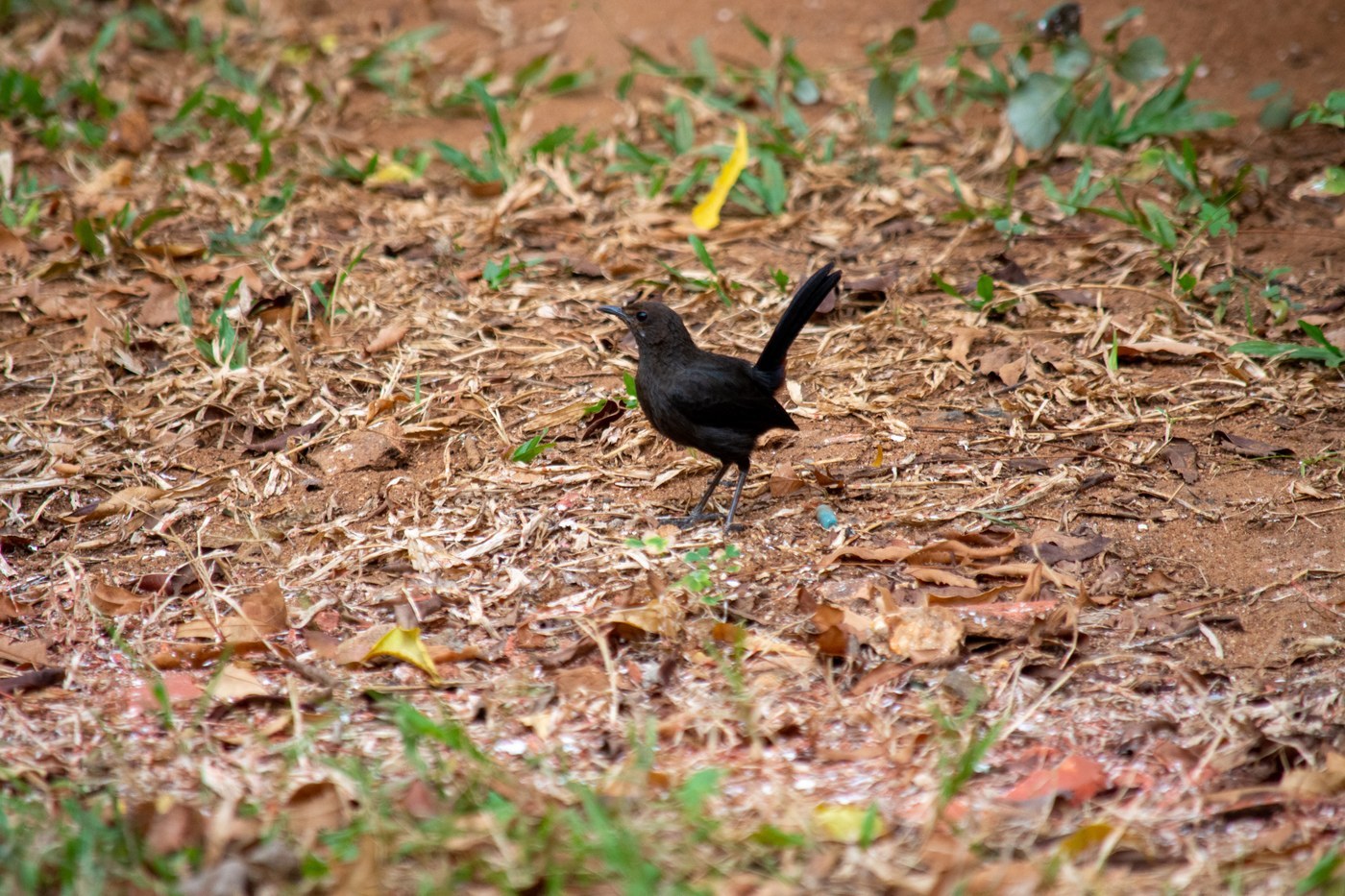
Indian Robin
Copsychus fulicatus
A small, confiding chat of dry open country, the male glossy black with a white shoulder flash and chestnut under the tail.
- Size
- 16-19 cm (6.3-7.5 in) long
- Habitat
- dry scrub, open stony ground, farmland, and villages across the Indian subcontinent
- Type
- songbird
Spotted a bird like this?
Identify any bird from a photo, free.
Overview
The Indian Robin is a small, confident chat found in dry, open habitats across much of the Indian subcontinent. The adult male is glossy black overall, with a small but conspicuous white patch on the shoulder and rich chestnut-orange feathers under the tail (undertail coverts), often flashed conspicuously during display. Some populations in southern India and Sri Lanka instead show brownish-grey upperparts on the male rather than glossy black.
Females are duller grey-brown throughout, lacking the white shoulder patch but retaining a paler rufous tinge under the tail. Like its relative the Oriental Magpie-Robin, the Indian Robin habitually cocks and fans its tail while perched or foraging, a lively and characteristic habit.
How to identify it
Key field marks
- Northern male: glossy black body, white patch on shoulder, chestnut undertail coverts
- Southern/Sri Lankan male: brownish-grey body instead of black, same white shoulder patch and chestnut vent
- Female: grey-brown overall, paler rufous under the tail, no white shoulder patch
- Frequently cocks and fans the tail while foraging on the ground
Similar species
The Oriental Magpie-Robin is larger, with extensive white on the wings, belly, and outer tail feathers, and a different overall pattern. The Pied Bushchat male is also black-and-white but shows a white rump and lacks the chestnut undertail.
Habitat & range
Indian Robins are widespread residents of India, Sri Lanka, Nepal, Bangladesh, and Pakistan, favoring dry, open habitats such as scrubland, stony or rocky ground, farmland edges, and villages, typically in lowland and plains habitats. They generally avoid dense forest and very wet regions, thriving instead in dry, sparsely vegetated country.
The species is non-migratory, holding fairly small year-round territories.
Behavior & voice
Voice
The song is a pleasant, warbling series of notes given from a low perch, rock, or the ground; calls include sharp, sputtering chatter notes when alarmed.
Feeding
Indian Robins forage almost entirely on the ground, running and hopping in short bursts to snatch insects and other small invertebrates, often flicking the tail up after each pounce.
Nesting and breeding
The nest is a loose cup of grass, rootlets, and hair placed in a low cavity, wall crevice, or hole in a bank or building. Both sexes may contribute to feeding the chicks, and the species readily nests close to human dwellings.
Frequently asked questions
How can you tell a male Indian Robin from a female?
Males are glossy black (or brownish-grey in some southern populations) with a white shoulder patch and chestnut undertail; females are plain grey-brown without the white shoulder patch.
Where do Indian Robins live?
They favor dry, open habitats such as scrub, stony ground, and farmland across the Indian subcontinent, avoiding dense forest.
Why does the Indian Robin have different male colors in different regions?
Northern populations have glossy black males, while some southern and Sri Lankan populations show brownish-grey males instead, reflecting regional subspecies variation.
What does an Indian Robin eat?
It feeds almost entirely on insects and other small invertebrates caught on the ground.
Indian Robin guides
In-depth guides for identifying, finding, and understanding Indian Robin.
Other birds you may enjoy

Black Redstart
13-14.5 cm (5.1-5.7 in) long, 23-26 cm wingspan

Black-throated Sparrow
12-14 cm (4.7-5.5 in) long, about 19-20 cm (7.5-8 in) wingspan

Greater Bird-of-paradise
Body about 43 cm; males with additional flank plumes up to 50 cm and long tail wires

Blue Tit
11-12 cm (4.3-4.7 in) long, 17-20 cm wingspan

Red-billed Quelea
11.5–13 cm long, wingspan about 20–22 cm
White-plumed Antbird
13-14 cm (5-5.5 in) long

Pyrrhuloxia
19-22 cm (7.5-8.7 in) long, 30 cm wingspan

Blue-gray Tanager
16-18 cm (6-7 in) long

Blackburnian Warbler
11-13 cm (4.3-5.1 in) long, 20-22 cm wingspan

Bluethroat
13-14 cm (5.1-5.5 in) long, 20-22 cm wingspan

Eurasian Nuthatch
12-14.5 cm (4.7-5.7 in) long, 22.5-27 cm wingspan

Wood Thrush
19-21 cm (7.5-8.3 in) long, about 33 cm (13 in) wingspan