
House Sparrow
Passer domesticus
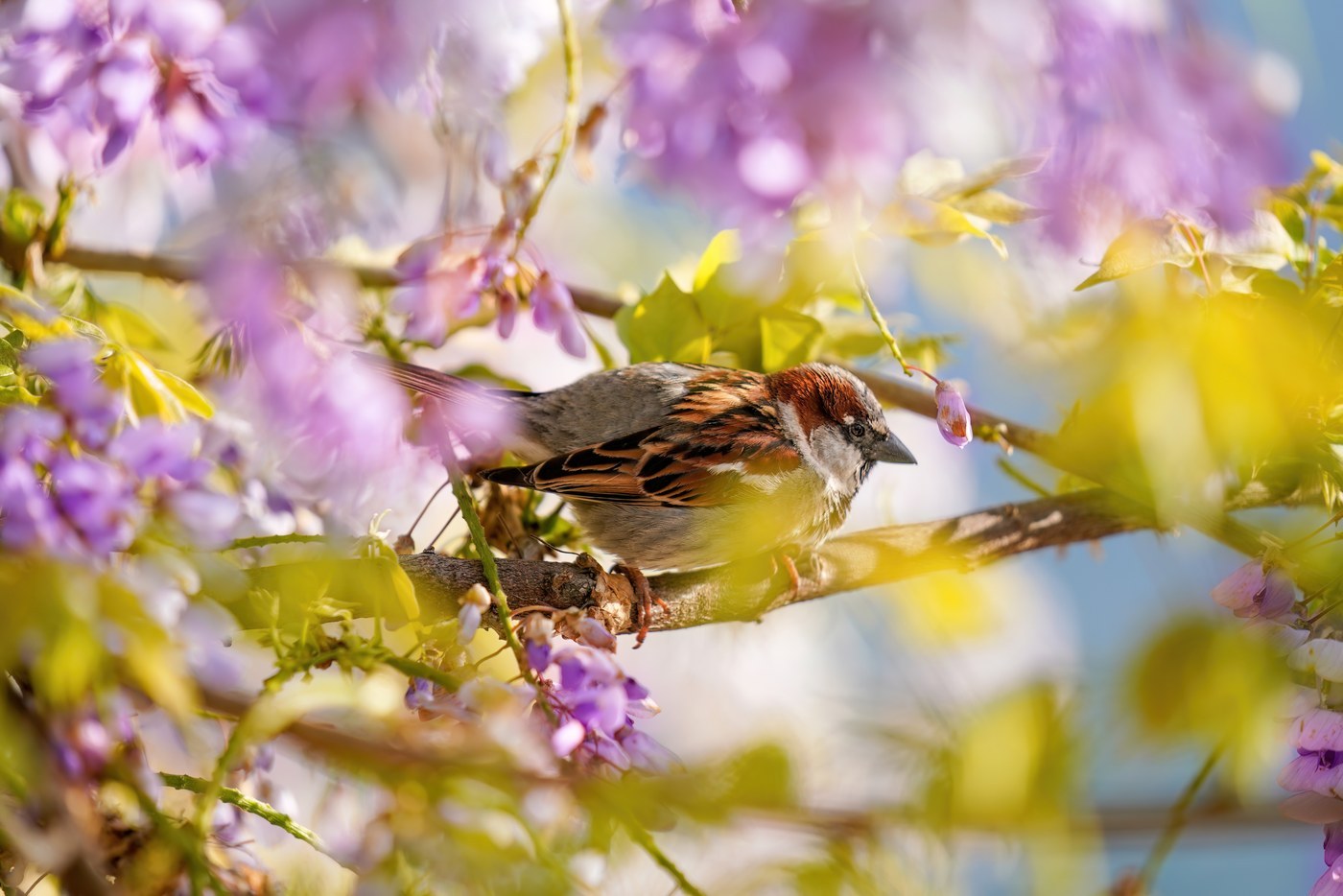
A stocky, chunky-billed sparrow closely tied to human settlements, with males showing a gray crown, chestnut nape, and black bib.
- Size
- 14-18 cm (5.5-7 in) long, 19-25 cm (7.5-10 in) wingspan
- Habitat
- urban and suburban areas, farms, and around human structures
- Type
- songbird
Spotted a bird like this?
Identify any bird from a photo, free.
Overview
The House Sparrow is a small, chunky bird that lives almost exclusively around human habitation and is one of the most widespread birds in the world. Males have a gray crown, chestnut-colored nape and eye-stripe, black bib on the throat and upper breast, and a mix of brown, black, and buff streaking on the back and wings. Females and immatures are plain grayish-brown overall, with a buffy eyebrow stripe and streaked back, lacking the male's bold markings.
Not a true sparrow in the New World sense (it belongs to the Old World sparrow family, Passeridae, rather than the American sparrow family), the House Sparrow is native to Eurasia and North Africa but has been introduced worldwide, including to North America in the mid-1800s.
How to identify it
Key Field Marks
- Male: gray crown, chestnut nape and eye-stripe, black throat/bib, streaked brown back
- Female: plain buffy-brown with a pale eyebrow stripe and streaked back, no bib
- Stout, conical bill (black in breeding males, duller in winter and females)
- Chunky body with a relatively short tail
Similar Species
- American Tree Sparrow: rufous cap and a dark central breast spot on a plain gray breast, found in more open/rural habitats and only present in winter across much of the House Sparrow's U.S. range.
- Chipping Sparrow: has a rufous cap and clean gray underparts without a black bib, and a thinner bill.
- Female House Finch: similarly plain brown, but has a more slender, curved-culmen bill and diffuse streaking on the underparts, unlike the female House Sparrow's plain buffy breast.
Habitat & range
Habitat
House Sparrows are strongly associated with human-altered environments: cities, towns, farms, and other areas with buildings, and are rarely found far from human settlement.
Range
Native to most of Europe, the Middle East, and parts of Asia and North Africa, House Sparrows have been introduced to and established in North America, South America, Australia, sub-Saharan Africa, and elsewhere, making them one of the most widely distributed wild birds on Earth.
Migration
House Sparrows are non-migratory and typically remain within a small home range year-round, rarely moving far from their nest site.
Behavior & voice
Behavior
Highly social, House Sparrows form flocks and often engage in communal dust-bathing and noisy group chattering; males also display and spar over mates and nest sites, including hopping displays with drooped wings.
Voice
Vocalizations are simple, consisting mainly of repetitive chirping and cheeping notes rather than a complex musical song, often given persistently near nest sites.
Feeding
They eat mainly seeds and grain, readily taking food scraps and waste around human areas, and feed insects to nestlings during the breeding season.
Nesting & Breeding
House Sparrows nest in cavities, including building crevices, birdhouses, and vents, building a bulky domed nest of grass and feathers; they lay 3-6 eggs and can raise several broods per year. They will aggressively compete with native cavity-nesting birds like bluebirds for nest sites.
Frequently asked questions
Are House Sparrows native to North America?
No, they are native to Eurasia and North Africa and were introduced to North America starting in 1851 in Brooklyn, New York, later spreading across the continent.
Why are House Sparrow populations declining in parts of Europe?
Declines in some cities have been linked to reduced insect food for nestlings, loss of nesting sites in modern buildings, and other urban environmental changes, though causes vary by region and are still studied.
Do House Sparrows compete with native birds?
In North America, introduced House Sparrows compete aggressively for nest cavities with native species such as Eastern Bluebirds and Purple Martins, sometimes evicting them from nest boxes.
How can you tell male and female House Sparrows apart?
Males have a gray crown, chestnut nape, and a black throat bib, while females are plain buffy-brown overall with a pale eyebrow stripe and no black bib.
What do House Sparrows eat?
They primarily eat seeds and grain but also consume insects, especially when feeding nestlings, and readily take advantage of food scraps in urban areas.
House Sparrow guides
In-depth guides for identifying, finding, and understanding House Sparrow.
House Sparrow identified by the community
Real birds identified with Bird Identifier.

Other birds you may enjoy

Black Redstart
13-14.5 cm (5.1-5.7 in) long, 23-26 cm wingspan

Black-throated Sparrow
12-14 cm (4.7-5.5 in) long, about 19-20 cm (7.5-8 in) wingspan

Greater Bird-of-paradise
Body about 43 cm; males with additional flank plumes up to 50 cm and long tail wires

Blue Tit
11-12 cm (4.3-4.7 in) long, 17-20 cm wingspan

Red-billed Quelea
11.5–13 cm long, wingspan about 20–22 cm
White-plumed Antbird
13-14 cm (5-5.5 in) long

Pyrrhuloxia
19-22 cm (7.5-8.7 in) long, 30 cm wingspan

Blue-gray Tanager
16-18 cm (6-7 in) long

Blackburnian Warbler
11-13 cm (4.3-5.1 in) long, 20-22 cm wingspan

Bluethroat
13-14 cm (5.1-5.5 in) long, 20-22 cm wingspan

Eurasian Nuthatch
12-14.5 cm (4.7-5.7 in) long, 22.5-27 cm wingspan

Wood Thrush
19-21 cm (7.5-8.3 in) long, about 33 cm (13 in) wingspan